


Sometimes, it’s important to look back to see where a team is headed.
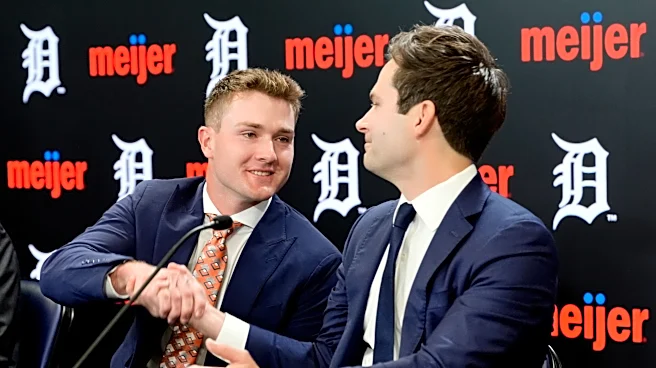
So today, I want to focus on what Scott Harris said he was going to do when he was named Detroit Tigers president of baseball operations on Sept. 20, 2022.
"We need to acquire, develop and retain young players," Harris said then. "It's not a unique strategy. Most organizations in baseball are trying to do that. But it's exceptionally important for us and we need to absolutely lean into that over the next years."
Listen, you can debate his strategy. Some critics have suggested it’s code for being cheap and not busting the bank in free agency. But you have to realize, love it or hate it, it is core to the Tigers’ strategy. It drives everything they do. It’s why they don’t sign
free agents who might block a prospect. And it’s why they haven’t traded highly ranked prospects for a short-term rental.
Again, you can love it or hate it – but it’s the Harris way.
So, over the last four years, how are the Tigers doing as far as acquiring and retaining young players?
Let’s start with Kevin McGonigle, Harris' second draft pick for the Tigers in 2023, who didn’t just have one of the most historic rookie seasons in history. He became one of the best players in the American League.
But something happened earlier this season that seems to be forgotten.
In the middle of April, after McGonigle had played just 17 games in the big leagues, Harris signed this young hit machine to an eight-year, $150 million contract extension. Now, instead of McGonigle reaching free agency after the 2031 season when he’s 27, the Tigers secured three additional years and he won’t reach free agency until after the 2034 season when he’s 30.

That’s how you retain young talent. And every day, that move looks even more shrewd.
It will allow the Tigers to build their entire infield around him for years to come. Because McGonigle is the foundation of this team.
[ DETROIT SPORTS: Listen to the new "Freep Sports Show" available anywhere you listen to podcasts (Apple or Spotify). ]
Tigers finally have several homegrown players
So, how are the Tigers doing drafting and developing talent?
It seems like they can take any pitcher and make them better.
But what about position players? Over the past quarter century, the Tigers didn’t have many standout homegrown guys. For a while, you had to go back to Brandon Inge (drafted in 1998), Curtis Granderson (drafted in 2002), Alex Avila (drafted in 2008) or Nick Castellanos (drafted in 2010).
OK, you could throw in James McCann (drafted in 2011) or even Andy Dirks (drafted in 2008).
Then came a group that included Riley Greene, Spencer Torkelson, Parker Meadows (briefly) and Dillon Dingler, who were drafted under Al Avila, the former boss.
But now?

There is young, homegrown talent everywhere you turn, all acquired in just the past four years under Harris.
In the Tigers' 2026 season finale, the Tigers started rookie Max Clark in center, McGonigle at third, Brett Callahan in left andJohn Peck at short. Then, Ben Malgeri came off the bench.
All were drafted by Harris.
And don’t forget about Hao-Yu Lee, a rookie whom the Tigers got from the Philadelphia Phillies in a 2023 trade for Michael Lorenzen. Lee is a still developing infielder but has some pop and promise.
Granted, not all will make it. But McGonigle and Clark are a heck of a place to start.
[ Framber Valdez, Spencer Torkelson and the Tigers' biggest questions ]
Tigers' best development success story
So, give the Tigers scouts credit for identifying talent. But picking guys is one thing. You still gotta develop them.
Which brings us to Eduardo Valencia, a development success story for the entire organization. The Tigers acquired Valencia under Avila when they signed him as an international free agent in April 2018.

After Valencia spent several stints on the injured list, he was never considered one of the Tigers' top prospects. In 2024, he was still playing at Low-A Lakeland in the Florida State League, even though several people in the organization still believed in him.
Since then, his career has taken off under the new developmental team. All the hitting coaches and trainers and biomechanic experts and mental-health folks.
In 2025, he started raking at Double-A Erie, hitting .304 with 11 homers in 53 games. And he kept crushing the ball at Triple-A Toledo, hitting .319 with 13 homers in 50 games.
Basically, he hit his way to the big leagues after a ton of work behind the scenes, learning another one of Harris’ tenants: Don’t swing at every strike, hunt the pitches you can damage.
Valencia, 26, has continued to develop under Tigers manager A.J. Hinch and his staff. Considering where Valencia was in 2024, the transformation has been remarkable.
He made his Tigers debut on July 9. Since then, he hit .341 with eight homers. And he had a crazy 1.016 OPS in 129 at-bats.
“He earned more playing time down the stretch,” Hinch said late in the season. “We're not in a small sample size. He's producing and his at-bats are pretty good.”

Not just that, but he had some incredible moments. Like hitting a homer in his first MLB at-bat, a 425‑foot shot off Athletics reliever Hogan Harris, making Valencia the 10th player in franchise history to homer in his debut plate appearance.
But his most memorable moment was a walk-off homer to give the Tigers a 4-3 win on the day Justin Verlander made his final start – yes, that’s how you end a magical day.
A day later, in the final game of the season, Valencia went 1-for-4 and hit his eighth homer.
“Today's a good example where he's a threat every single time up,” Hinch said after that game. “It doesn't always happen, but with his type of bat-to-ball skills and the way that he has impacted the ball in this period of time that he's been up here, he should feel like he belongs, and he should feel like he has every bit the opportunity to impact next year's roster.”
So, what’s he gonna work on during the offseason? OK, I know it’s cliché when a guy says he wants to go to spring training in the best shape of his life. But in this case, he means it. He wants to get healthier, get stronger and get leaner.
“Because I need to be ready next year to play every single game,” he said.
Yes, I'd take him hitting as much as possible.
So, let’s go back to what Harris said: acquire, develop and retain young players.
Yes, they have been acquiring talent, either through the draft or trades.
What about developing?
Listen, everybody knew McGonigle and Clark were gonna be big leaguers. That’s not really a surprise. But Valencia and even Malgeri? Those are true development success stories.
Now, let’s briefly look ahead.
When you think about all the prospects who made their MLB debuts in 2026, it’s noteworthy the Tigers still have four top 100 prospects in their system.
No. 1 is Zyhir Hope, a 21-year-old outfielder acquired in the Tarik Skubal trade, who is expected to debut in Detroit in 2027.
No. 2 is 21-year-old shortstop Bryce Rainer, a Harris first-round pick in 2024 who can mash but needs to cut down on strikeouts.

No. 3 is 28-year-old right-handed pitcher River Ryan, from the Skubal trade, who pitched twice in late September.
No. 4 is 22-year-old catcher/first baseman Josue Briceño, a seriously massive man who can crush the ball and is expected to make his Tigers debut in 2027.
So, in the end, whether you agree with the strategy or hate it, in my eyes, it sure looks like the plan is working.
Contact Jeff Seidel: jseidel@freepress.com. Follow him on X @seideljeff.
This article originally appeared on Detroit Free Press: Scott Harris had sneaky huge move for Tigers you may have forgotten