







Michigan Department of Natural Resources staff recently rescued 27 lake sturgeon stranded by low-water conditions in the Upper Peninsula's Ontonagon River channel.
DNR staff moved the fish to a location with deeper water, the Michigan Department of Natural Resourcessaid in a news release on Wednesday, Sept. 23.
The sturgeon, sometimes known as "dinosaur fish" because of their ancient origins, were reported to the DNR after they were found stranded in a shallow area in Ontonagon County by a group of hikers on Aug. 23.
The report prompted a search mission from DNR fisheries technicians and the Keweenaw Bay Indian Community and Upper Peninsula Power Company.
The hikers originally
saw only three sturgeon in the area where officials say there is either no flow or low flow in the channel.
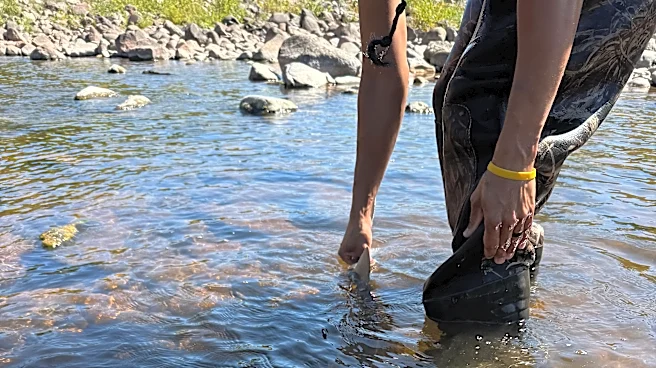
"DNR fisheries technicians Kyle Urban and Jack Cole were able to respond to the location, and they found two sturgeon in an isolated pool. They then relocated the fish downstream to where the river reaches full flow, nearly a mile over land in rugged conditions," a news release from the DNR reads.
DNR staff later returned to the site to search for the third sturgeon and observed a collection of additional fish in a pool clouded with sediment.
After relocating 10 sturgeon, officials noticed more but couldn't rescue them because of their location, among other factors.
Returning to the channel for a third time with more equipment and people, another 15 sturgeon were moved to safety.
None were left in the low stream channel, according to the DNR.
What is a lake sturgeon?
Lake sturgeon are one of the oldest species in the Great Lakes.
Lake sturgeon are freshwater fish native to Michigan, the only sturgeon species found in the Great Lakes. They have five rows of bony plates called scutes on their backs and sides, as well as whisker-like barbels near their mouths.
Often referred to as “living fossils” or “dinosaur fish,” lake sturgeon first appeared in the fossil record in the Mesozoic Era, 100 million to 150 million years ago, according to the DNR.

The fish are long-lived, with some documented at more than 100 years old. Recent research suggests the fish can live to be 300 years old.
Scientists knew the fish were long-lived, but the estimates were in the 80 to 100 years range. The oldest known specimen was captured at Lake of the Woods on the border between Minnesota and Canada in 1953 and estimated at 152 years old.
"I feel pretty comfortable saying that lake sturgeon can live to be 400 years old," said Edward Baker, DNR research station manager with the Marquette Fisheries Research Station, and coauthor of the peer-reviewed study reassessing lake sturgeon longevitypublished this spring in the Journal of Fish Biology.
Sturgeon grow very slowly, but can reach 8 feet and 300 pounds. It takes about 15 years for male lake sturgeon to reach reproductive maturity and 20-25 years for females, Sea Grant Michigan said.

"To say that lake sturgeon are a major part of Michigan’s aquatic history doesn’t quite do them justice,” said Patrick Ertel, with the Habitat Management Unit of the DNR’s Fisheries Division. “These fish have been around for more than 100 million years, which may be hard to even comprehend."
How many different species of fish are in Michigan waters?
Michigan is home to 155 different kinds of fish. Some fish, such as sunfish, are open to catch year-round while others, like walleye, bass and sturgeon, have specific seasons.

— Free Press writer Keith Matheny contributed.
Jalen Williams is a trending reporter at the Detroit Free Press. Contact him at jawilliams1@freepress.com.
This article originally appeared on Detroit Free Press: DNR saves 27 'dinosaur fish' trapped in river. How they rescued sturgeon