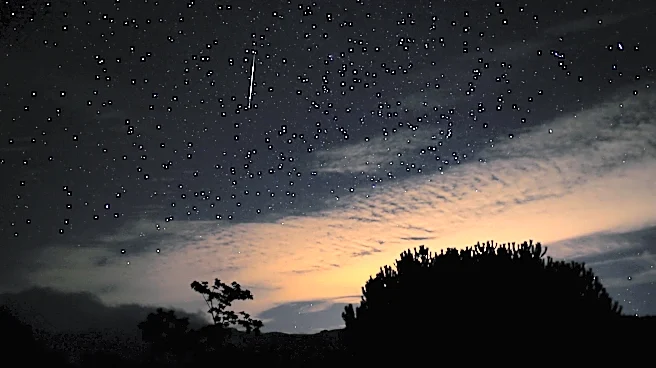







The Orionids meteor shower is set to begin this week and will peak in October, providing an extra bit of flare to the night sky around Halloween.
The "fast" meteor shower typically features 10 to 20 meteors per hour, streaking through the night sky at 41 miles per second, according to NASA. The Orionid meteor shower is expected to peak overnight Oct. 21-22 and will be active until Nov. 7.
Here's what to know about the Orionid meteor shower.
When do the Orionids peak?
The Orionids will be active from Oct. 2 to Nov. 7 and are set to peak overnight Oct. 21-22, according to NASA.
What is the Orionids meteor shower?
The Orionids is a fast, bright meteor shower known as one of the year's most beautiful, according to NASA. The shower produces about 10 to 20 meteors per hour traveling 41 miles per second and leaving
behind glowing trails of debris, NASA said.
The meteors appear to come from the area of the constellation Orion, though NASA notes the "constellation is not the source of the meteors." They will be visible anywhere in the night sky and looking away from the what appears to be the source of the meteors, or the radiant, is best for longer views, NASA suggested.
When is the best time to view the Orionids?
The best time to watch the Orionids in the Northern Hemisphere is after midnight, in the late night hours, according to the space agency.
How to enjoy the best Orionid views in Michigan
Here are some viewing tips for the Orionid meteor shower, including from NASA:
- Go to a dark area away from light pollution
- Allow up to 30 minutes to let your eyes adjust to the dark
- Bring a sleeping bag, blanket or lawn chair to sit comfortably as you watch the meteors
- Select an open viewing area for an unobstructed look at the sky
- Avoid looking at phones or bright lights
- Lie on your back with your feet facing southeast and look up to catch fast meteors
- Dress comfortably, warm for cold nights
- Keep a hot drink, water and snacks and bug spray with you
What causes a meteor shower?
A meteor shower occurs when the Earth passes through a trail of debris left behind by a comet or, less commonly, an asteroid, according to NASA. The celestial events happen annually or at other intervals, NASA says.
Where can you watch the Orionids in Michigan?
Look for a clear, open area to view the meteors in Michigan's skies. Keep an eye on the weather forecast closer to the peak to find out local viewing chances.
Michigan is home to six dark sky state parks, three international dark sky parks and an international dark sky sanctuary.
- The Alpena area has three Dark Sky Preserves: Rockport State Recreation Area, Thompson's Harbor State Park and Negwegon State Park.
- In Mackinaw City, Headlands International Dark Sky Park, 15675 Headlands Road.
- In Empire, Sleeping Bear Dunes National Lakeshore, 9922 Front St.
- In Munising, Pictured Rocks National Lakeshore.
- In Paradise, the Great Lakes Museum and Whitefish Point Light Station, 18335 N. Whitefish Point Road, and Tahquamenon Falls State Park at 41382 W. M-123.
- In Port Austin, Port Crescent State Park, 1775 Port Austin Road.
- In Clayton, Lake Hudson Recreation Area, 5505 Morey Hwy.
- In Carp Lake, Wilderness State Park, 903 Wilderness Park Drive.
- Keweenaw Dark Sky Park in Keweenaw County and Dr. T.K. Lawless Park in Cass County are international spots. And, finally, the Beaver Island State Wildlife Research Area is an international sanctuary.
Meteor, meteorites, meteoroids — which is it?
Those are words that sound similar, but there are important differences.
- Meteor shower: When we see a lot of meteors streaking across the sky in a small amount of time, usually a matter of a few days.
- Meteoroid: A body in space. Asteroids are larger rocks in space, but there's no official distinction.
- Meteor: A body passing through the atmosphere. If the meteor is large enough to show some dimensions or sparks, it's often called a fireball.
- Meteorite: A meteor that survives the fall to the Earth's surface.
When is the next meteor shower in 2026?
The Southern Taurids will be active until Nov. 20 and is set to peak overnight Nov. 4-5.
Contact Jenna Prestininzi: jprestininzi@freepress.com.
This article originally appeared on Detroit Free Press: 'Fast' meteor shower is set to start. When Orionids will peak