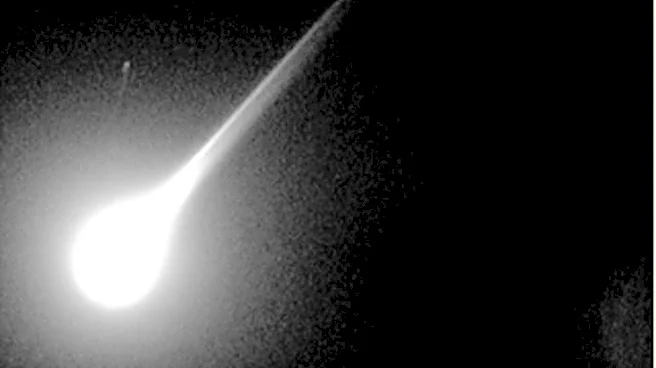






An unconfirmed meteor lit up the sky over Michigan Sunday evening, Sept. 13, according to the Michigan Storm Chasers, a group that tracks statewide weather and offers daily forecasts.
The meteor lit up the Michigan sky around 8:47 p.m. and traveled east.
The group said the meteor fell, broke apart and struck the Earth, possibly in Lake Huron and or Lake Ontario, which President Donald Trump ordered be renamed Lake America.
Video recordings of the fireball were shared across social media.
The streaking object was seen across Michigan. Multiple social media users commented, sharing videos of an object streaking through the sky.
Meteor, meteorites, meteoroids — which is it?
Those are words that sound similar, but there are important differences.
- Meteoroid: A body in space. Asteroids are larger rocks in space, but there's no official distinction.
- Meteor: A body passing through the atmosphere. If the meteor is large enough to show some dimensions or sparks, it's often called a fireball.
- Meteorite: A meteor that survives the fall to the Earth's surface.
- Meteor shower: A lot of meteors streaking across the sky in a small amount of time, usually a matter of a few days.
What is a fireball? What is the difference between a fireball and a bolide?
A fireball is another term for a very bright meteor,
generally brighter than magnitude minus 4, which is about the same magnitude of the planet Venus in the morning or evening sky, the American Meteor Society explains. A bolide is a special type of fireball which explodes in a bright terminal flash at its end, often with visible fragmentation.
Think you found a meteorite? What to do
According to the United States Geological Survey, people who find meteorites should look out for several properties to confirm if its accurate:
- Density: Meteorites are usually quite heavy for their size, since they contain metallic iron and dense minerals.
- Magnetic: Since most meteorites contain metallic iron, a magnet will often stick to them. For “stony” meteorites, a magnet might not stick, but if you hang the magnet by a string, it will be attracted.
- Unusual shape: iron-nickel meteorites are rarely rounded. Instead, they have an irregular shape with unusual pits like finger prints in their surface called “regmaglypts.”
- Fusion crust: stony meteorites typically have a thin crust on their surface where it melted as it passed through the atmosphere.
This article originally appeared on Detroit Free Press: Bright fireball lights up the sky. May have fall in Great Lakes