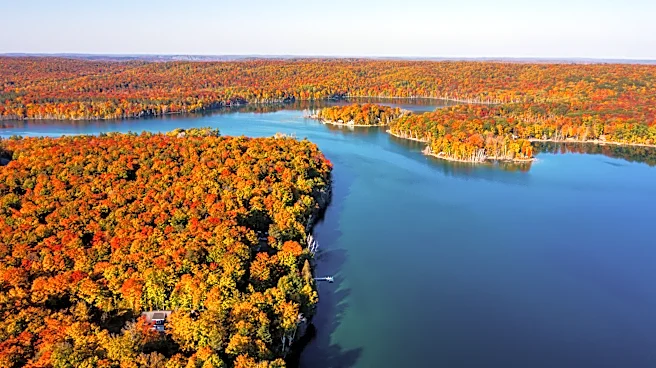







Michigan's Upper Peninsula is starting to see fall colors emerge, just in time for the official start of fall.
Foliage in the western U.P. has begun changing colors and the change is beginning to spread east across the peninsula, and southward, according to Explore Fall's Michigan Fall Foliage Map 2026. Tuesday, Sept. 22, marks the fall equinox, the start of astronomical fall.
The entire state is expected to see leaves begin to change by the first week in October. Leaves across the southern Lower Peninsula will be the last to turn red, orange and yellow, including cities like Lansing, Grand Rapids and metro Detroit.
According to the Explore Fall map, leaves from Negaunee and Ishpeming, southwest toward Iron Mountain and Iron River — and west to Ironwood
— are reaching 40% color now, while most of the U.P. is about 20% color.
"Michigan fall color is especially popular around Marquette, Munising, the Keweenaw Peninsula, Petoskey, Traverse City, Sleeping Bear Dunes, and the Tunnel of Trees. Maples, birches, aspens, and oaks create different color mixes from inland forests to lake-effect shoreline areas," Explore Fall said in its commentary.
The peak times to admire the fall colors in Michigan vary based on where you are in the state. Generally, peak times range from late September through early November, according to the century-old publication the Old Farmer's Almanac and its Sept. 10, 2026, Fall Foliage Map and Forecast.
Planning your fall road trip? Shop here
"Popular destinations include M-22 Scenic Drive, the Huron-Manistee National Forests, and the Tunnel of Trees," the Old Farmer's Almanac said.
Trees in the Upper Peninsula are estimated to lose their leaves around late October, according to the Almanac, then leaves in the Lower Peninsula will fall around early November.
Here's what to know about fall colors in Michigan.
Are fall colors here yet in Michigan?
Here's when leaves began or will begin showing color across Michigan, according to Explore Fall's Michigan Fall Foliage Map 2026:
- Western Upper Peninsula: Sept. 16.
- Eastern Upper Peninsula: Sept. 22.
- Northern Lower Peninsula: Sept. 28.
- Southern Lower Peninsula: Oct. 2.
When will fall colors peak in Michigan?
Here's when leaves are estimated to peak, per the foliage map:
- Western Upper Peninsula: Sept. 30.
- Eastern Upper Peninsula: Oct. 17.
- Northern Lower Peninsula: Oct. 20.
- Southern Lower Peninsula: Oct. 29.
When does fall start in 2026?
Astronomical fall will officially begin with the fall equinox at 8:04 p.m. on Sept. 22, while meteorological fall began on Sept. 1.
Where can you see fall colors in Michigan?
Among Michigan's many backroads, travelers consider M-22 along Lake Michigan's shoreline among the best. The road winds along the lake and through numerous stands of colorful hardwoods. M-22 was heavily damaged by spring rain runoff. The Michigan Department of Transportation's MiDrive map continues to show two full closuresalong the popular route.
Pure Michigan says numerous state parks offer colorful ways to enjoy the outdoors. Tahquamenon Falls State Park is among the most popular with UP trees bracketing the largest waterfall in the state.
Porcupine Mountains State Park features 60,000 acres of woodlands, with numerous elevated vantage points for hikers to take in the colors, including the Lake of the Clouds overlook and Summit Peak.
Copper Peak, north of Ironwood in western UP, offers an unparalleled view from the top of an 800-foot hill and an 18-story ski jump. The site boasts that visitors can see three states and Canada on a clear day.
How do colors vary by tree?
Michigan's diverse tree varieties each have their own color patterns, according to Michigan State University Extension.
In the Upper Peninsula and northern Lower Peninsula, maple trees feature orange and red leaves, while quaking aspen and larch trees produce yellow leaves. Sugar maples turn bright red, and red maples change from vivid red to orange to bright yellow.
Red oaks, present across the state, have subtle red leaves, while trees in the white oak group, with several in southern Michigan, feature yellow or dusty red leaves. Sassafras, present in southern Michigan, vary from yellow to deep red in the fall and can have three-lobed or mitten-shaped leaves.
Hickories, common in southern Michigan, can feature yellow leaves in the fall, the most common variety in the state being shagbark hickory. Larch trees feature needles, which turn bright yellow in the fall before shedding. Eastern larch, or tamarack, is a larch variety found in wetter parts of Michigan.
Lansing State Journal reporter Sarah Moore contributed.
Contact Jenna Prestininzi: jprestininzi@freepress.com.
This article originally appeared on Detroit Free Press: When will leaves turn colors? See latest fall predictions
Our editors independently choose our recommendations. Some content is produced with paid support from a third party, however our editorial decisions remain independent. If you buy through our links, the USA TODAY Network may earn a commission. Prices and availability may change.