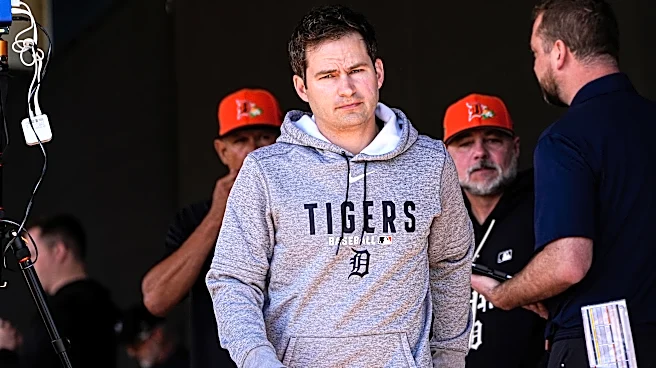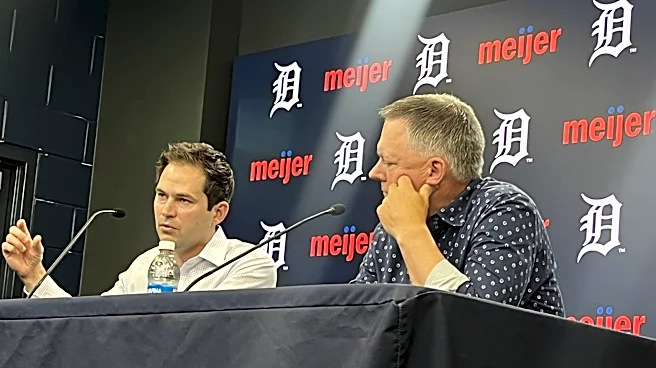



Scott Harris sat glumly in the Comerica Park interview room Monday, Sept. 28, and rued the Detroit Tigers’ failed season as he pointed the finger at himself for not building enough depth during the team’s ruinous May.
“We woke up on June 1 and we were in last place in the American League,”
the team’s president of baseball operations said after a rash of injuries decimated the roster. “It felt like we had lost a player and a game every day for about a month.”That’s when Harris knew. The hole was deep – too deep – and he had wielded the biggest shovel.
“It felt like we were sunk in that moment and, upon reflection, our inability to overcome adversity in real time starts with me,” he said. “I didn't build enough depth into this roster this year.
Our vulnerabilities on this roster got exposed in May, and it cost us. And that's part of the reason why I have a huge pit in my stomach, thinking about this season.”
But before too long Monday, Harris used that same finger to give the Tigers – and by extension, himself – plenty of credit.
[ NEW SHOW: Listen to the "Freep Sports Show" on our Detroit Free Press livestream on YouTube and available in the anywhere you listen to podcasts (Apple or Spotify). ]
“We finished second in all of baseball in team ERA,” he said. “We finished second in all of baseball in team [Weighted Runs Created Plus], and we finish with a run differential of plus-119. That's playoff-worthy.”
But Harris carefully sidestepped sticky questions about why he didn’t do more to add a big bat. Or more pitching help. Or defensive help. Especially when the Tigers were in the midst of going 6-22 in May.
His answer boiled down to not wanting to block prospects he didn’t expect to call up until later in the summer, such as outfielders Max Clark and Ben Malgeri and catcher Eduardo Valencia.

“I think of how we built the roster, and it's related to our strategy here,” he said. “Like we didn't want to block young players, we didn't want to like trade for depth players that were ultimately going to box Max out of the big leagues.
“So, you know, we were trying to thread that needle, and I think it probably was a mistake in the end. We probably should have just strengthened our depth and made sure that we could get through April and May intact.”
I’ll give Harris credit for owning that mistake. But admitting a fault isn’t a fix. And within Harris’ answer lies a fundamental problem to his approach. And since we’re talking baseball here, the metaphor is fitting: He never swings for the fences.
Sure, he almost got Alex Bregman that one time. But Monday brought reiteration of his philosophy of not building through free agency.
“We are building through development,” he said. “We are participating in free agency and we always will participate in free agency.”
Yeah, because who needs Pete Alonso or Nick Martinez? Free agency’s a joke! C’mon, what has that Ohtani guy done for the Dodgers lately?
Those big-spending fools in La La Land are gonna be crying in their fat-free oat milk matcha lattes when Zyhir Hope and River Ryan are leading the Tigers to multiple World Series in … well … at some prudent, cost-conscious, controllable years to be determined point in the future.
This was Harris’ fourth season in charge of the Tigers, and he’s done a good job of making them a sound organization with a solid strategic plan that includes responsible spending.
But my concern is that everyone has a ceiling, and we might be starting to reach Harris’. He could be good enough to get you to the playoffs somewhat regularly, but is he good enough to get you to, and win, a World Series? Because it’s incredibly difficult to win a championship without some top-tier free agents.
Maybe it’s not even Harris’ fault. There’s a good chance it’s an infectious disease going around Detroit’s top sports executives. Let’s call it Yzerman-itis, since it’s probably part of what cost The Captain his GM job. Brad Holmes seems to have contracted it, too, in Allen Park. (Note to Trajan Langdon: Please wear a mask when you’re around these guys.)

Symptoms may include: Drafting, developing and getting good – and then doing virtually nothing more at the trade deadline and nothing big in free agency.
But hey! We’re not gonna block all those youngsters who almost got us to the playoffs!
The great thing about young players is that they embody the future, and a silver-tongued personnel chief can always sell hope for the future, even if it never quite arrives.
This season was a setback, certainly, and darn near a step back for Harris and the Tigers.
Yes, they had many injuries. But Harris should learn a big lesson from 2026, and it’s this: He can’t give up on a promising present season for a future he can’t guarantee will ever arrive.
Contact Carlos Monarrez at cmonarrez@freepress.com and follow him on X @cmonarrez.
This article originally appeared on Detroit Free Press: It’s good Scott Harris took blame for Detroit Tigers' 2026 mess