



GREENFIELD VILLAGE — 'Twas scarcely morning but already the day was sultry — a sweltering affair indeed! — as the old farmer dragged a wooden rake along the soil as if in times of yore.
“It’s hard work, but I take pride in it,” said 79-year-old Tom Kemper, using gloved hands to free tangled weeds from his rake. “I think every farmer does that, no matter if he's an old farmer or a modern farmer. When he's done at end of the day, his field looks good. At the end of the year, he's taking stuff to market and getting paid, and there's a feeling of accomplishment. And I get that same feeling here.”
Kemper was using the same basic tools a farmer would’ve used a century ago, and despite the heat he was dressed as uncomfortably as farmers once did in a long-sleeve
shirt, wool trousers and a thick leather hat. Everything about him, in fact, seemed from a long time ago.
That’s because in this place, it’s always 1885.

Kemper is among a handful of people who work on Firestone Farm, a small corner inside Greenfield Village, the 80-acre museum where visitors can tour more than 100 historical structures that have been brought from all over the country. People come by the thousands each day to wander and explore, imagining what life was like in the past.
At Firestone Farm, they don’t have to imagine. They live it. The workers aren't playing a role or pretending; this is a real farmstead where they spend their days exactly as people did 140 years ago — using the same tools, wearing the same clothing, growing the same crops, cooking the same recipes and laboring just as hard, regardless of the weather. They have no phones, no electricity, no heat or air conditioning, no modern shortcuts to performing their long lists of daily chores. It makes the days long and the jobs arduous.
For some who work here, it’s exactly what they wanted.
“There's no schedule,” said Kemper, who retired years ago from a career in advertising. “There's nothing making you do this or making you do that. It’s Just the way life used to be, I think. It was much easier in some ways. I know it was tough in some ways to survive, but it didn't have all the distractions that we foist upon ourselves. I could have lived in 1885 and been very happy. If they sent me back in a time machine, I would be perfectly content.”
***
The windows of the farmhouse framed a view of the pasture outside where livestock could be seen grazing placidly. For the guests, it offered a bucolic glimpse of a scene from the past.
The animals were not there for show.
“The cows are for milk, sheep are for wool, our hens are for eggs and the pigs are for pork,” said Emily Doyle, 28, one of the farmhouse workers. "We consume a lot of pork here."
“The pigs have a really good life, and one really bad day," added her co-worker, Anne Okonowski, 32.

It was early morning inside the farmhouse, and the heat was magnified in the breezeless kitchen by the iron stove that was radiating warmth in stifling waves. It was worsened for the women in the house by the seven-layer outfits they wore to work every day — chemise, corset, two petticoats, a double-lined dress and an apron.
“We’re period accurate,” Doyle said, “but it’s all natural fibers. With cotton you sweat, and then it absorbs it, and then as the wind blows or as you walk through, it wicks it away from your body.”
Four women were in the kitchen preparing the day’s dinner, which in 1885 was the name of the meal served at noon, in contrast to evening’s supper.
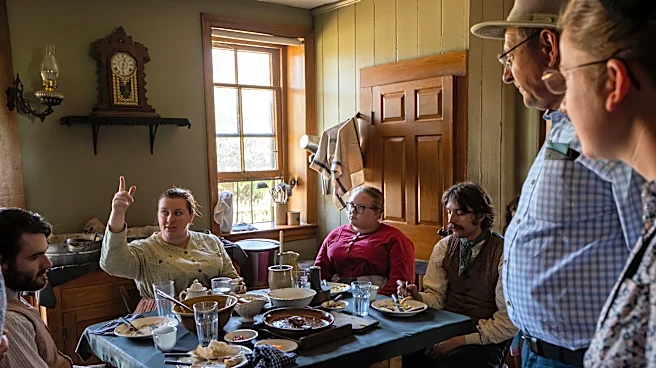
Each day they chose a recipe from an antique cookbook; that day it was from “Buckeye Cookery and Practical Housekeeping,” published in 1877. The main course was Yankee pork and beans with Irish potatoes. Salt pork was frying in grease in an iron skillet on the stove, greens just picked from the garden were being chopped into a salad, and farmhouse-baked bread was being sliced into little wedges.
Even with recipes at hand, cooking in 1885 on a farm was more of an art than a science.
“We do not have standardized measures,” Okonowski said. “There’s no measurement and no temperature control on the farm but you. So you say, ‘one of my broken teacups’ worth of this or that, but your ratios are going to end up still kind of working out. And they might say things like, ‘We’re going to make this in a quick oven,’ and how you would check your temperature is, you stick your hand in, and if you can hold it for 10 seconds, then it’s a quick oven. You really do start to get a feel for doing it.”

Now and then, the spell of the past would be broken as visitors walked in holding their phones, wearing shorts and sneakers, looking slightly bewildered. All day they’d toured the empty buildings of the museum, and now they’d seemingly stumbled through a portal into someone’s house 140 years ago.
“They're excited, but they're also like in kind of shock and awe because this isn't Disney,” Doyle said. “This is all real. So it's kind of that magical sense of something that we only see on TV. It's like going into ‘Little House on the Prairie,’ like going into the TV. I was with my grandparents a lot as a kid and I watched ‘Little House on the Prairie’ and all those shows, and being in it now is really cool.”
The house and barn once belonged to Benjamin and Catherine Firestone, who had a small farm in Columbiana County, Ohio. The house was built in 1828 and remodeled in 1882 to appear more modern for the time; the barn was constructed in 1830. Both structures would’ve faded and withered years ago like most other farmsteads, except that their son Harvey happened to grow up to found Firestone Tire and Rubber Co., which became the tire supplier for Ford Motor Co., whose namesake created this museum. The Firestone family donated the house and barn, which were disassembled down to the bricks and boards, shipped to Michigan and painstakingly rebuilt in 1983.
Life in 1885 was simpler. It also was brutal and harsh. Infant mortality was high. Child labor was common. Minor injuries could be deadly. Antibiotics didn’t exist. And back then, many rights and opportunities weren’t shared by all.
“I do like that I can have property and a banking account and I can vote,” Okonowski said. “But it is nice to have a little bit of a simpler way of thinking, maybe not being inundated with news all the time or constantly thinking I’ve got to check my phone, and just taking the time to take care of something bigger than yourself, being a part of something bigger than yourself. And I think that's what I've found working here for the most part.”

“I love this place and I love being here, but I love that I don't have to live in it,” Doyle said. “Like, indoor plumbing is pretty cool. Air conditioning is nice. So is running water that isn't us going to a pump and carrying a bunch of buckets of water. And it makes me grateful for what I have now. It is nice to have these tasks to work through your day, but it's all very laborious. Every single thing you would do in this time period is labor, like growing the food, taking care of the animals, getting water, doing laundry. It's all so hands on, so physical. I’m very tired when I go home.”
At noon, she stepped outside and pulled the chain that rang the dinner bell atop a tall pole, and the farmers came in from the fields and gathered at the wooden table in the hot kitchen for a meal together.
“It is a farm family, where you just get the flow with each other,” Doyle said. “I love the magic of it because there's so much energy. It's such an energetic place to be because there's people working in the house, there’s people working outside the house, we are all very active in the things we are doing. I feel like a lot of people are passionate about working here, and I think that does get relayed to the guests.”
Some of those guests stood along the walls of the room as the meal unfolded. A few retired to the next room over and sat on the horsehair chairs of the parlor, watching the past brought to uncanny life before them — the food, the furniture, the clothes, the dishware, the simple togetherness of the meal.

“I kind of almost see getting to working here as stewardship of these houses, maintaining history and thinking about what is it that we want to learn from how people lived in the past and how can we take that forward, and what are the things we want to maybe leave behind,” Okonowski said. “But it's nice to be able to invite people to slow down with you and say, 'Hey, let's take a moment. Let's show you some other ways of living life.'”
***
And lo, the unrelenting sun had now climbed to its highest station of the day. The fire in the stove was extinguished, the animals sought shade beneath the trees, but the farmers kept their posts.
“Part of what this job has taught me is the empathy that I have for the people that did it back in the day,” Kemper said. “I have so much respect for a 1885 Victorian farmer, because I know what work he did.”
Near him, just across a white picket fence that ringed around the house, a man was chopping wood for the stove in the kitchen. He, too, was drawn here by the austere simplicity of the job.
“I like work,” said Steve Schwecke, 70, who came to work here a year after retirement. “It's more rewarding to see something done rather than sitting at home and watching movies. I like the physical activity. And if I ever get this wood chopped — filling that box full of wood for the ladies — it’s going to be rewarding.”

Summer was fading. The spent vines of summer squash at Kemper’s feet were turning brown. Off in the distance, the wheat had already been harvested. But the branches of the pear trees were heavy with fruit, and the pumpkins at the base of the cornstalks were just now ripening. And of course, the animals always needed tending. On the farm, there’s always work waiting to be done.
Visitors strolling by stared at the farmer as they passed; a few approached to talk. He’d walk over, meet them at the wooden fence and tell them all about life on a small farm in another time. Some of them would walk away with a faraway look in their eyes after talking to him, as if daydreaming themselves away from modern life and into the past, back to the kind of world in which the farmer got to live every day.

“When I was young I wanted to go buy five acres someplace and do a little farm, and try to subsist,” Kemper said. “It was my dream. But then I got in the rat race. And I think that when I found this, I found my little farm without having to spend any money, without having to buy it. It was the dream that I had when I was a young man. And now I'm an old man, and I'm living it out.”
John Carlisle writes about Michigan. His stories can be found at freep.com/carlisle. Contact him: jcarlisle@freepress.com. Follow him on Twitter @_johncarlisle, Facebook at johncarlisle.freep or on Instagram at johncarlislefreep.
This article originally appeared on Detroit Free Press: At this Metro Detroit farm, it's always 1885