




(Editor's note: This is the first installment of UAW Candidate Q&A, a six-part series asking questions directly to candidates running to be president of the United Auto Workers. The Detroit Free Press will publish responses from all candidates, over the next six weekdays, beginning on Friday, July 31)
Come late August, hundreds of thousands of members of the United Auto Workers union will have a choice: Reelect sitting president Shawn Fain, or opt for a new face to lead one of the nation's most historic labor unions.
Five members are challenging Fain, a popular union president and political figure. Fain was at the helm of the union in 2023 when it secured handsome raises after a simultaneous strike of all three Detroit automakers (Ford Motor Co.,
General Motors and Stellantis). The election was complicated after news broke that Fain is facing a grand jury investigation directed by the U.S. Department of Justice over allegations he improperly used his post as UAW president to seek benefits for his family members. Fain has denied the allegations.
According to the UAW's court-appointed monitor, who oversees the union's elections, ballots will be delivered to members "on or about" Aug. 21. Ballots must be returned by Oct. 5, and tabulation will commence on Oct. 6.

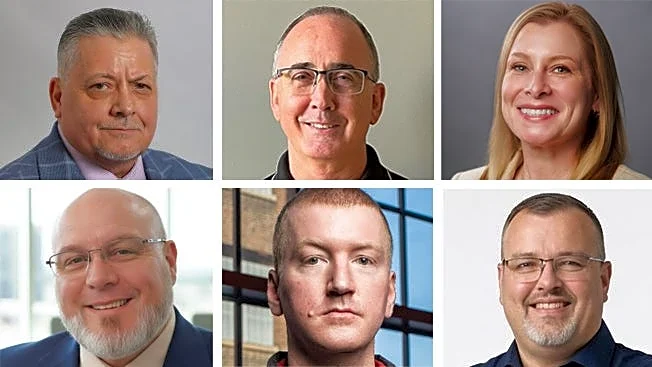
The candidates are:
Rich Boyer, the 63-year-old vice president of the UAW who rose out of Local 140 in Warren.
Shawn Fain, the 57-year-old incumbent president of the UAW, hailing from Local 1166 in Kokomo, Indiana.
Tricia Geiger, 43, a 20-year UAW member who is currently an international servicing representative at UAW Local 977, a GM union hall in Indiana. Geiger got her start in the union at UAW Local 651 in Flint.
Brian Keller, 57, a 27-year automotive worker and member of the union represented by Local 1248 in Warren.
Will Lehman, a 38-year-old Mack Trucks employee from Local 677 in Macungie, Pennsylvania.
Greg Mooney, a 46-year-old recording secretary from Local 2147 in Lima, Ohio, where he has worked in the aerospace and defense sector of the union for four years.
The Detroit Free Press offered each candidate the opportunity to answer six detailed questions, in their own words, for publication. Candidate responses were limited to 1,000 characters for the sake of brevity. They remain unedited.
Today, the Free Press asks:
What do you see as the most important issue facing the United Auto Workers?
Boyer: JOB SECURITY meaningful protections from off-shoring jobs, artificial intelligence and advanced manufacturing (but not to the detriment of our members who make a living in that sector (Aerospace, Defense, etc.)
HEALTH and SAFETY
WORK-LIFE BALANCE
A HEALTHY and DIGNIFIED RETIREMENT which includes health care & retirement income security
LEGISLATIVE INITIATIVES to protect unions from the enemies of labor who are like sharks that smell our blood.
Fain: We have the highest wealth inequality in the history of our nation. The biggest issue we face is a handful of billionaires and corporate America running away with all the profits while the working class gets left behind. The question is simple: Are we going to have the courage to unify as a working class and fight for what we deserve? We need to unite in common cause to overcome the billionaire dictatorship of corporate America.
We do that by setting out a bold working class agenda. I call it the four core issues: Wages, healthcare, retirement, and time off. The vast majority of working class people are united by these four issues. When we fight for those issues in a unified way, we unite the masses against the ultra wealthy who would play divide and conquer. We saw it in our 2023 strike, and we see it in every winning contract fight. And we need to get in front of AI and advancing technology to make it work for humanity, not a handful of billionaires.
Geiger: I don't think there is a single most important issue, we are facing. There are multiple issues with the potential to prove existential. The obvious external threat comes from the rise of AI and its integration into our workplaces and broader society. The UAW needs to lead on this issue and unfortunately, I haven't seen any substantive action or planning — only sound bites and headlines. Meanwhile we are still waging the familiar battles against, offshoring and anti-worker/labor legislation. Internally, we have to get our spending under control and our financial house in order, while reestablishing credibility, accountability, and clean governance in our Union. I don't think we are going to get another second chance to right the ship. In the midst of all these challenges we also have to deliver strong contracts for our members across all sectors in a weakening economy. The next board will undoubtedly have their work cut out for them, but I am prepared to lead in these challenging times.
Keller: The biggest challenge facing the UAW is rebuilding trust. Members need confidence that their dues are managed responsibly, their concerns are heard, and their leadership is focused on contracts, organizing, and servicing the membership—not infighting. A united membership is our greatest strength.
Lehman: The most important issue facing the UAW is that its members do not control it. All other problems — sellout contracts, layoffs, plant closures, unsafe conditions, the destruction of pensions — flow from this one.
Workers across this union face a jobs bloodbath. The companies are using AI, automation and restructuring to eliminate positions, drive speedup and gut safety. Workers are locked into contracts that erode living standards as inflation accelerates. Younger workers start at or below poverty wages. Health care workers face understaffing and forced overtime. Academic workers cannot cover rent. Retirees have been sold out again and again.
The central issue is power: who runs this union, and in whose interest. My campaign fights to resolve that in favor of the rank and file by abolishing the bureaucracy and building rank-and-file committees in every workplace that link up across plants, companies and borders. With that power, every fight becomes winnable. Without it, none are.
Mooney: Artificial intelligence and automation represent the single greatest threat to our jobs since the union was founded. Companies are already replacing workers with robots and AI, yet much of our current leadership remains unprepared and largely technology illiterate. They have failed to negotiate meaningful protections in recent contracts and continue to talk about the issue at a high level without offering any real solutions or contract language.
If we do not get serious about this now, we will continue to lose thousands of jobs. This is not a future problem; it is happening on shop floors today.
We need leadership that actually understands the threat and has a detailed, enforceable plan to protect our members before it’s too late. The current leadership wants to talk about their experience, but why aren't they negotiating A.I. protections into current contracts? Moreover, I am the only candidate that has actionable CBA language that can be used today.
Liam Rappleye covers Stellantis and the UAW for the Detroit Free Press. Contact him: LRappleye@freepress.com.
This article originally appeared on Detroit Free Press: UAW Q&A: What is most important issue to president hopefuls? We asked