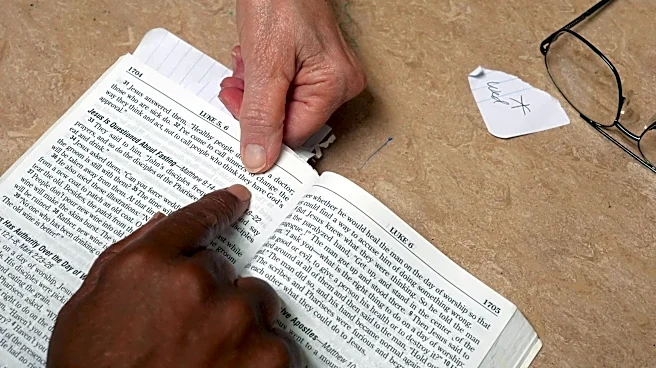

Three times a week, James Samuel sits in a room at the Harper Woods Public Library and reads aloud to a tutor. On this day, the 67-year-old made his way through passages of the Gospel of Luke, occasionally
needing help. When he got stuck, his tutor encouraged him: "You know this word!"
When he stumbled over a line, she gently corrected him: "It’s not clock. It’s cloth."
Samuel is a persuasive voice for reading education, and his story — which, for most of his life, he was ashamed to tell — is a foil to what has become a growing concern about literacy in America and Michigan: that all the new technology at our fingertips isn't helping to improve reading skills the way people hope and may be making the problem worse.

Now, as students settle into the new school year and voters contemplate who they intend to vote for in the midterm elections, Samuel has a message for everyone: read, read, read. He said that, even in an age of TikTok videos and artificial intelligence, literacy is vital.
The latest results of the National Assessment of Educational Progress, known as the nation's report card and taken every two years, Michigan ranked 7th from the bottom of all states in fourth-grade reading in 2024, with state education officials blaming the pandemic and the rise of constantly pinging cellphones.
The Free Press detailed Samuel's determination to start learning to read more than a decade ago. But his lessons, he said, also were disrupted by the pandemic. Now the retired Harper Woods resident is back at it; but, this time, he's studying in a world even more transformed by digital technology.
Consider this: As September, which happened to be National Literacy Month, ended, a 25-year-old social media megastar and college graduate, Alix Earle, made headlines by saying in an Instagram video that she had "never read a book," except for "like, maybe Dr. Seuss."
The month before, The Atlantic magazine’s cover story, "The Age of Reading Is Over," declared that society is entering a "post-literate" era in which "fewer and fewer" people are reading books and described what it called a "collapse in reading," as careers in humanities and writing are being perceived as dead-end jobs.
Studies by the National Literacy Institute have suggested that more than a fifth of American adults have low literacy skills, and other estimates put Michigan's numbers close to that. Literacy statistics are so dismal that Michigan Gov. Gretchen Whitmer – in the last year of her second term – declared reading her top educational priority.
And it's particularly an issue this year, America’s 250th, as politicians debate who and how people vote.
Measuring Detroit’s literacy rate
What should be done to increase literacy amid so many digital distractions, diminishing attention spans and so much competition for our time? And can schools and nonprofit organizations struggling with funding make big enough of a difference?
And many news organizations, including the Free Press – which for decades championed literacy, and, as businesses depend on literacy even as they are produce more video and audio news reports – have cut back on reading programs.
To understand the challenge of illiteracy, consider a disputed Wayne State University study, "Alarming Literacy Rates in One of America’s Largest Cities: What Can Be Done in the City of Detroit?" which found that illiteracy was so high it was disturbing.
According to the 2024 study, Detroit's functional literacy rate among adults was not quite 50%. In other words, more adults could not read, write, and calculate well enough to manage daily tasks than could. And the report concluded that the city could face "a continued decline" in rates.
The study also came years after a nationwide legal team filed a lawsuit in federal court to fight illiteracy among schoolchildren. The group sued the state. The case, which was filed in 2016 and later settled, asserted the government had failed to provide basic literacy.
Reading, the lawsuit and many who study literacy argue, is the basis for much of how people learn. If students aren't taught to read, they struggle to keep learning, because that's how, for the most part, we gain information, especially as accessibility to it increases.
If children can’t read, they will be missing out because the problem is much bigger than not being able to enjoy good books. If kids can’t read, they struggle to understand and fill out important forms. They struggle to learn more about others.
As adults, they won’t be able to decipher documents and disclosures like rental agreements, mortgage paperwork, employment agreements, work instructions, prescription information, nutrition labels, road maps – or read a newspaper, or what a newspaper has become online.
Illiterate adults also, if they vote at all, need help recognizing words on a ballot.
Detroit schools struggling
While folks like Samuel can learn to read at any age, education research shows that there's an optimum time to do so. Children who don't reach a level of reading proficiency by the third grade, the data suggest, will continue to remain behind in school.

Some experts even suggest that the optimum window is even narrower: the first 1,000 days. That's when, according to a nonprofit group, Reach Out and Read, "the stage is set for the rest of a child's life" and that children who are read to "more often have improved language and listening skills" and gain a "lifelong love of reading."
Youth who struggle to read, academic studies conclude, are four times more likely to drop out of high school and without a high school diploma it becomes even harder to find work and therefore harder to earn a livable wage and care for their families.
Literacy – or a lack of it – can become generational. Households in which adults can’t or don't read often have children who struggle to become readers. And that’s why, in part, schools, public libraries and nonprofit groups are working to promote reading.
This summer, Oakland Schools offered the Boys College Summer Literacy Institute to try to help boys, who tend to lag behind girls in school in America, to strengthen their reading and writing skills, as well as their confidence and sense of belonging.
Macomb Schools has added literacy coaches, a strategy that the state suggested this spring is working.
And, as Chalkbeat Detroit has reported, efforts by the Detroit Public Schools Community District – along with the $94.4 million settlement from the federal lawsuit — seem to have helped young students over time to become better readers.
Much of the settlement money went to hire people to work with students in the early grades, a strategy that the governor recently touted, referring to a report from Michigan State showing that teachers who receive literacy coaching produce better results.
The Chalkbeat report said that in the Detroit Public Schools Community District, the percentage of third-graders who met or exceeded proficiency in reading on state standardized tests in the 2025 results hit an 11-year high. But the reading scores – which literacy experts have said are just one way to measure the problem – were still dismal.
The rate of district third-graders who were proficient or above in reading was under 13%; the state average was 39%. This past spring, scores appeared to move a little, rising slightly for the district to 14%, and falling just a bit for the state, to 38%.
The district now faces another problem: What happens when the settlement money runs out? Superintendent Nikolai Vitti, Chalkbeat reported, has said the district may have to make difficult choices about what programs to keep and what it might be forced to forego.
The case for reading
Reading, many argue, is essential in a system of government where people vote for their leaders and policies. Scholars even contend that literacy was vital to America's origins, in part, because reading and writing were what helped fuel the American Revolution.
Long before radio, TV and the internet, American colonists used pamphlets and newspapers to promote their ideas and persuade others to join their cause to declare independence from Britain and take up arms to fight for their freedom.
Media professor Neil Postman has even suggested that literacy was so vital to the American Revolution that the United States may have been "the first nation ever to be argued into existence in print."
During the Revolution, Phillis Wheatley – a freed slave and published poet who was honored this year with a U.S. postage stamp with her image – is credited with using her words to champion the idea that slaves in America were entitled to natural-born rights.
Wheatley, who has been described as the "poet laureate of the American Revolution," wrote letters to King George III and President George Washington. She also penned poems to tell her own story of being brought from Africa to America and show her readers how African Americans had equal human worth.
By 1816, Declaration of Independence author Thomas Jefferson penned a letter to Virginia legislator Charles Yancey expressing his belief that to make sound decisions, voters must be accurately informed. Jefferson wrote: "Where the press is free, and every man able to read, all is safe."
And yet America’s complicated history with slavery and racial and gender inequality over two-and-a-half centuries also exposed what happens when everyone isn’t provided opportunities to become literate and how difficult it is for voters to make informed choices if they cannot read.
Samuel, for instance, said his stepfather emphasized to him as a teen how important it is to vote, and he has taken his duty seriously. But he also acknowledged that he has required help, often from his spouse, who can read, to recognize ballot names.

Reading, he said, would help him vote more independently.
And raising literacy rates, some suggest, may help raise voter turnout.
Last year, the Free Press looked at nearly a quarter-century of Detroit’s election datato figure out why the city’s turnout was so low. In the Aug. 5, 2025, municipal primary, only about 17% of Detroit's registered voters cast ballots. Compared to the 2021 primary, turnout was 3 percentage points higher.
Mayor urges: 'Pick up a book'
There's some hope that digital technology can help.
Videos posted online allow candidates in the midterm elections and those in office to speak directly to voters and constituents. Smartphones can turn text into speech. And artificial intelligence – on platforms like ChatGPT – can answer questions and write letters, essays and even news articles for us.
In March, Detroit’s then-newly elected mayor, Mary Sheffield, posted a video to the city’s Facebook page that urged residents to "pick up a book." The beaming mayor spun around in her chair to look directly into the camera and said: "Detroit, I have a challenge for you."
Her honor added that whether Detroiters were already reading or hadn’t in a while, it was the perfect time to "get back into it." Her post coincided with National Reading Month, a celebration aimed at motivating Americans of all ages, but especially kids, to pick up a book, magazine, newspaper, anything with words, and to love literature.
And yet, while technology seems like it should be creating a more literate society, there's data to suggest it might not. Many scholars and educators worry that literacy – despite being essential to getting an education and a job – is more at risk.
How do we fix that?
During her final State of the State address in late February, Gov. Gretchen Whitmer spotlighted Michigan’s low education rankings and called for more funding and training to improve student reading skills. The state, she said, must do more to ensure students can read.
"We're 44th in the country in fourth-grade reading," the governor said in December during the Michigan Literacy Summit in Detroit, according to WKAR-AM in East Lansing. "Just 4 in 10 third fourth in Michigan read at grade level," and 1 in 3 Michigan students, she added, test below average, "what I would call a crisis."
Test scores also revealed gaps between Black and white students and those from lower- and higher-income families.
Newspaper reading programs
But even newspapers – which were so vital to sparking the American Revolution and democracy ever since have been seeking ways to improve literacy for more than a century, in part, to ensure their own sales – have been cutting back on their efforts to promote literacy.
As early as the late 1800s, educators and newspaper publishers have been thinking about how news outlets and schools could cooperate to encourage reading. By the 1930s, the New York Times was sponsoring research to determine how.
And last month, A.G. Sulzberger, the Times publisher and chairman, was at Michigan State University, extolling the virtues of the institution at 175 and making the case for it, noting that "the story of our great nation and its paper of record are bound up together."
But what good is a free press if a nation's citizens can't read?
Throughout the last century, newspaper efforts to teach reading became more sophisticated and ubiquitous as more people tuned in to radio and to watch TV, and in the 1990s, the internet took off. That's when the Free Press started a new program for children to promote reading.
It included a special section of the newspaper, Yak’s Corner, for young readers and writers. The Yak was a cartoon mascot. Another program that started around the same time was the National Education Association’s "Read Across America," which, at first, was just one day.
The NEA, an educators' union, selected March 2, the birthday of Theodor Geisel, the children’s book author better known as Dr. Seuss. The day later turned into a month-long celebration, which Detroit's mayor touted in her social media post.
But by 2009, the Yak's Corner published only online – and eventually faded away.
And the Free Press began a new program to boost children’s literacy, the Detroit Free Press Reading Corps, in 2010. The idea was to organize an army of volunteers to read to kids. That program morphed into Reading Works, which recognized that it is hard to teach kids to read if their parents also were struggling to read.
Detecting, measuring literacy
Reading Works focused on also improving adult literacy, a problem that experts pointed out was often overlooked, but also – community leaders at the time believed – was solvable, or at least could be curbed, with adequate attention and effort.
To introduce Reading Works in 2015, the Free Press published a report that urged Detroiters to "help 20,000 adults read by 2020." The report was the first to tell Samuel's story, which helped to both illustrate the issue and give readers hope.

Samuel – who, at the time, was 55 and lived in Highland Park with his wife, Edwina – had held a steady job for more than 25 years and kept a secret: He couldn't read or write. For years, however, he hid his illiteracy from his employer, his colleagues, his neighbors and even his children.
It broke his heart, he said, when his son wanted to know why he wouldn’t text him back. His secret was exposed by his stepdaughter when she was 18 and caught him – when they were lost on a drive – pretending to read a map. She noticed he was holding it upside down.
But unlike many who can't read, Samuel took a big step toward changing that: He got help and started taking lessons at Detroit Public Library's Parkman branch. He even penned his first words there, a short but touching love letter to his wife.
Former CBS Evening News anchor, Katie Couric, interviewedSamuel in 2016, and that gave Reading Works a bigger boost. Over the years, the program helped many metro Detroiters, but it also didn't last, becoming a victim of change and financial challenges.
Retired Free Press Publisher Paul Anger wrote in a 2020 essay explaining why the program he championed was ending: "Like many organizations, we’ve fallen victim to the pandemic and the painful interruption of both funding and important work that needed doing."
Anger, who led the Reading Works efforts, lamented the program's end. He also concluded that "for Detroit to reach its full potential with a robust workforce, excellent schools and stable neighborhoods, the pathway to success – pandemic or not – remains clear."
How accurate are the stats?
At the same time, those who examine and try to measure literacy have suggested that illiteracy is a hard problem to fix, in part, because it is so difficult to define and actually quantify, and that tends to lead to squabbling about the accuracy of data points and disagreements about what strategies to use.
On top of that, what community – or person – wants to be known as illiterate?
Kurt Metzger, a demographer and founder of Data Driven Detroit, told the Free Press that literacy is a challenging topic to study because there isn’t a consistent way to measure it. There are test scores and graduation rates, but literacy, he said, is much more than that.
When it comes to Detroit's struggles with literacy, Data Driven Detroit has been critical of the figure that "½ of Detroit residents are illiterate," calling the statistic outdated and the methodology to calculate it problematic. The number was from an analysis in the 1990s.
The criticism seems to suggest that boiling literacy down to a single number is too simple and a distortion.
Data Driven Detroit didn't give an alternate figure by instead pointed to a different report, the State of the Detroit Child, which pointed to a variety of indicators, including school enrollment, absenteeism, graduation rates and standardized test scores. Most of the data, however, still showed Detroit was lagging the state.
Groups like Reach Out and Read, a national literacy organization that works with pediatric care providers, isn't giving up on improving the numbers. It believes that reading starts when children are infants. IIt is giving away books to children and encouraging parents and caregivers to read to babies and provide them "language-rich interactions."
There are also organizations that want policymakers to consider broader definitions of literacy.

Some are pushing for more civic literacy, the idea that people need to learn more about how government works. In 2024, a U.S. Chamber of Commerce Foundation study found more than 70% of Americans failed a basic civic literacy quiz, another argument for how literacy relates to democracy.
Others are advocating for more financial literacy, education about personal money management. In this view of literacy, people also need to learn how to read numbers in addition to words, . And there’s the idea that more digital literacy is necessary.
Groups pushing for more digital literacy argue that people of all ages need not only how to access the information they want, but also how to discern the truthfulness of the information they are getting from an ever-expanding group of online sources.
"Technology has allowed people to access an amazing amount of information in the palm of their hand," Metzger said. "But this instant access has led to shorter attention spans and information streams that are determined by the owners of the technology."
Screen-based childhoods
Taking technology away may offer other problems.
There are virtues to digital technology. We can learn from videos, not just books. We can use new tech features such as text-to-speech to be read to, and speech-to-text. And generative AI, such as ChatGPT, can now write just about anything for us, including letters, essays and even newspaper articles.
And what if so-called "screen-based childhoods" are contributing to illiteracy?
Last year, a group of experts on a Harvard University podcast, "Harvard Thinking," discussed literacy and how average reading scores for high school seniors taking a certain national assessment had fallen to their lowest point in the history of the standardized evaluation.
The percentage of students who hit the basic benchmark in reading on the National Assessment of Educational Progress in 2024 dropped to 67%. There also appeared to be a widening gap between the highest- and lowest-achieving students, which some identify as another problem.
"What could be driving that trend?" Martin West, a Harvard professor and dean of the university’s graduate school of education, asked in the podcast. "I don’t think we have smoking gun evidence that the rise of screen-based childhood is a direct contributor to the literacy trends that we’re seeing."
"But," he added, "I’m willing to put it very high on my list of potential suspects."
In February, Michigan passed a statewide policy banning smartphone use in classrooms with the goal of limiting digital distractions. Officials said phones, especially with social media, made it more difficult for students to say focused in class.
'I'm not going to give up'
Some suggest technology is re-shaping how young minds think.
A short YouTube video from 2011 – before modern artificial intelligence video technology – helps illustrate that. The video was recorded by a father who was showing his 1-year-old daughter trying "to read" a Marie Claire magazine after tinkering with an electronic tablet.
In the video, the toddler is pinching a table. Then she does the same to printed pages.
The video was hardly scientific, but it reinforces the point that technology is influencing reading.
The toddler would now be about 15.
Earlier this year, Sharon Murphy, the executive director of the Detroit Literacy Coalition, explained to the Free Press that she has seen how technology can help improve reading. The nonprofit offers literacy education to children and adults throughout metro Detroit.
Murphy, however, also said she has seen how technology is creating new challenges.
The artist – the writer and poet, for instance – might argue that reading and writing is more than understanding words. Reading allows people to contemplate and convey complex ideas. It stimulates deeper thinking. Technology also, in some cases, require years — if not a lifetime – of use to adapt to and appreciate.
In other words, like in the Parable of the Cloth, the Biblical passage that Samuel was reading, a piece of new cloth – or technology – can't simply be sewn onto an old garment to fix it because the new fabric, Jesus told the disciples, could shrink in the wash and pull away from the old fabric and that, potentially, could make the tear worse.
Older adults may find small screens, like the ones you hold in your palm, hard to see. And tech – when it does not perform as expected – can be frustrating. Samuel, for example, uses a tablet to learn to write. He also has a smartphone.
But unlocking features like text-to-voice is something he does not know how to do, and learning may be even more frustrating than reading lessons. And while age, tech, and money are factors in learning to read, there's one that may matter even more: determination.
"I’m still going," Samuel told the Free Press, just ahead of his 67th birthday, when asked how long he plans to continue his reading lessons. He said that he believes reading will open the world to him, and he has no plans to stop trying to learn. "I’m not going to give up."
Contact Frank Witsil: 313-222-5022 or fwitsil@freepress.com
This article originally appeared on Detroit Free Press: At 67, he's still learning to read. But many in Michigan never have