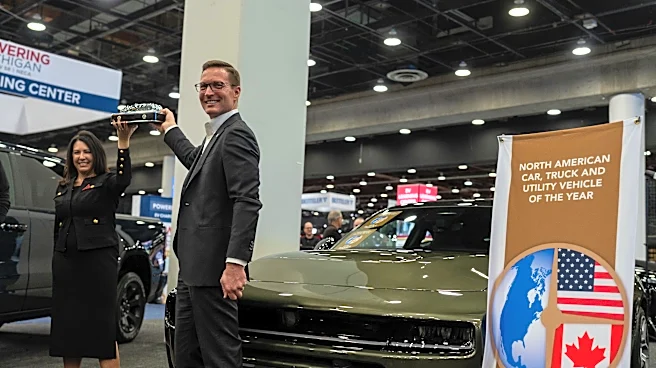




Judging by the headlines, the new Dodge Charger seems like it would be an auto industry darling: The new muscle car, since rolling out in 2025, has won awards such as the North American Car of the Year, TopGear U.S. Car of the Year and even the Detroit Free Press Car of the Year.
The sales numbers, though, tell a different story.
Through the first three quarters of 2026, Dodge sold only 8,786 of the new Chargers (both internal combustion versions and the all-electric combined), according to Stellantis' quarterly sales figures. The figure is a fraction of the volumes at which Dodge used to move the previous Charger, and the contrast is stark.
In 2023, Dodge sold 75,920 Chargers in the United States, according to the automaker's sales data — an average
of nearly 19,000 per quarter. Charger sales peaked at 24,604 in the second quarter of 2023.
That same year, production of the previous-generation Charger ended, with then-Stellantis CEO Carlos Tavares saying the model needed a refresh, and that the bulky engines that powered it were uncompetitive in a U.S. market with stricter fuel economy measures put in place by then-President Joe Biden.
It took a year, but in 2025 the old Charger was replaced by an uber-fast all-electric version in a brand-new, elegant body style. Sales of that vehicle were nonetheless sluggish, even in a market favorable to EVs with $7,500 rebates in place for the first three quarters of the year.
Now, in 2026, with a full range of Chargers on the market — an EV, two internal combustion versions and options for two- and four-door configurations — the speedy cars are still moving slowly.
The latest quarterly figures show Dodge sold only 3,669 Chargers in the third quarter of 2026 — less than one-sixth of the 2023 quarterly peak.
So the Free Press asked analysts: Is it time for Dodge to panic, or are consumers just warming up to a drastically different vehicle in a tough economy?
Time to panic?
For both Sam Fiorani, vice president of global vehicle forecasting at AutoForecast Solutions, and Stephanie Brinley, associate director at Mobility Global, concern is justified.
But neither saw the Charger as a lost cause.
Fiorani said the fundamental problem was that Dodge replaced a product that had a deeply established customer base with something substantially different.
"This car was so radically changed that Stellantis was going to have a tough time finding a new market for it," Fiorani said.
Indeed, the new Charger is a stark departure from the vehicle that preceded it. The previous Charger had been around for roughly 15 years in a form that buyers knew, giving Dodge years to build a following around its formula of rear-wheel drive, aggressive styling and available V-8 engines. Halo models, like the Hellcat Charger, became industry staples.

The new Charger, on the other hand, is wider and sleeker, and it's missing a key factor that Fiorani said made the previous Chargers desirable: A V-8 HEMI engine.
"(Dodge) would have rolled it out with a HEMI if the emissions laws allowed them to at the time," Fiorani said. Instead, the gas-powered Chargers, which make up the most of what Dodge sells and produces, feature a turbocharged inline six-cylinder engine called the "Hurricane" or the "Sixpack."
The decision to axe the HEMI was made, Fiorani said, due to strict federal fuel-efficiency and emissions requirements of the time.
"The Charger is a perfect example of how this market has changed over the last four or five years," Fiorani said. "The idea that this market was going to shift dramatically towards electric vehicles is embedded in every executive decision for the last decade, and this vehicle was launched as an EV to follow that path."
When buyers didn't jump at the EV Charger, and financial incentives for EVs were slashed by President Donald Trump in 2025, Stellantis had to make a change "to salvage what was left of this vehicle," Fiorani said. "And that meant putting in a gas engine and focusing on that — rather than the EV version."
That pivot produced the Hurricane-powered SIXPACK, a twin-turbocharged 3.0-liter inline-six that makes either 420 horsepower in the base Charger or 550 horsepower in the high-output version.
The new straight sixes outperform the HEMI V-8s they replace in power, acceleration and fuel efficiency. The problem, for some, is that they simply don't grumble like a HEMI.
Fiorani, who has driven the high-output six-cylinder, said the new Charger was objectively stronger than its predecessor in many respects.
"The new vehicle is modern and solid and competitive," he said. But it misses what Charger buyers want from the Charger, "which is the noise of that V-8."
Brinley reached a similar conclusion after driving a four-door Charger Scat Pack.
"I like the new Scat Pack engine," Brinley said. "But its consumers aren't warming up to it, apparently, as much as we would think, which is crazy because it has more power and is more fuel efficient."
The issue, Brinley said, may be less about the Hurricane's capability than about what Dodge customers expected a Charger to be: A rear-wheel drive, HEMI-powered muscle car.
There are plans to put a V-8 in the new Charger. The Detroit Free Press has seen a pilot of a forthcoming Hellcat Charger and confirmed the vehicle's existence with Dodge, though there is no public timeline for that vehicle's launch.
According to Brinley, putting a V-8 in the Charger is "not impossible," but it will be"difficult and expensive." The current Charger, she said, was not designed to hold the HEMI.
A V-8 could help encourage sales, but Brinley cautioned against expecting a Hellcat to transform the entire Charger lineup. The previous Hellcat was a halo product, meant to drive interest, not a high-volume model.
Dodge spokesperson Kristin Starnes, in response to questions from the Free Press, declined to discuss future product plans, but did say that the new Sixpack engine exceeds the performance of the 5.7-liter HEMI. The base engine produces 50 more horsepower and 73 more pound-feet of torque than the outgoing HEMI, and the high-output version's 550-horsepower engine also exceeds the output of the previous 6.4-liter HEMI.
Starnes pointed to improving sales as evidence that the rollout is gaining traction.
"In Q2 2026, Charger U.S. total sales increased 33% year over year, while Charger SIXPACK total sales increased 404% as availability expanded," Starnes said. "That momentum continued in the third quarter, with Charger SIXPACK total sales increasing 1,348% from Q3 2025 to Q3 2026 and Charger Q3 2026 retail sales increasing 22% versus Q3 2025."
The large jumps in sales percentages don't tell the whole story, though. The Charger sold just 3,669 units in 2026's third quarter. In 2022, the previous generation sold over 24,000 in the same time period.
Citing a deliberate strategy and a "phased" rollout of the vehicles, though, Dodge said it expects sales of the vehicle to continue increasing.
The company has more versions of the Charger coming, too.
Dodge unveiled the 600-horsepower Charger Super Bee Launch Edition in August on top of the forthcoming Hellcat. Dodge CEO Matt McAlear claimed earlier this year that the Super Bee, also powered by a punched-up Hurricane engine, will be faster than the original Hellcat Charger.
Production woes
But if Dodge wants to sell more units of the new muscle car, it needs to make them.
Stellantis confirmed that the Windsor Assembly Plant in Canada, where the Charger is built, would be temporarily shut down until early November. The company attributed the shutdown to evolving market conditions, including consumer demand and tariffs.
On top of the voluntary shutdown, the union whose members build those vehicles may soon go on strike. On Tuesday, Oct. 6, Unifor, the union representing Canadian autoworkers at Stellantis, announced it would be holding a strike authorization vote later this month as the union and Stellantis continue to disagree over the future of the Brampton Assembly Plant, near Toronto, where the previous Dodge Chargers were built.
Fiorani said the slowdown can indicate a lack of consumer demand, but also noted that Dodge "front-loaded" Charger production earlier in the year and may still have some volume for dealers.
Nonetheless, the new Chargers are "definitely not moving as fast as Stellantis wants them to," Fiorani said.
Brinley said there were reasons to be patient before calling the new Charger a flop.
Dodge has added multiple configurations and powertrains relatively quickly, and the product is still early in its life cycle. Slow sales, she said, may have been part of the game plan.
"I don't think they were expecting to get the same kind of volume. And certainly not as quickly as what you're getting out of a 15-year-old car," Brinley said, referencing the years of marketing that made the previous Charger familiar to buyers.
Price may be a factor, too, though Dodge's prices are about on par with market averages. The entry-level Charger starts at $49,995, which is slightly above the average transaction price of a new vehicle. The most expensive Charger, the fastest electric version, costs $64,990. The entry-level version of the previous generation Dodge Charger cost about $35,000 in 2023. Adjusted for inflation, that's about $10,000 less than the cheapest Charger today and may price out some of Dodge's previous customers.
Anecdotally, Brinley said passersby have been interested in the new Charger as she drives it. At the time of Brinley's interview with the Free Press, she was test driving a high-output Charger.
"It is drawing attention," Brinley said. "I have it out, and I do see people react to it positively and be interested in it. So there is an underlying interest."
The challenge Dodge faces, she said, is converting that interest into purchases.
It's typical for new models of popular vehicles to struggle at the outset. According to Fiorani, though, the current sales are particularly worrisome.
"There's no way (Dodge) expected sales to be this slow," Fiorani said. "The Charger is, by nearly every measure, a better vehicle today and it just doesn't appeal to the consumer the way it should."
Worrisome, though, is different from doomed.
"The Charger is so important to this company; it shares very little with any other model, and it's key to keeping the Dodge brand successful," Fiorani said. "So they need to do something."
Liam Rappleye covers Stellantis and the UAW for the Detroit Free Press. Contact him: LRappleye@freepress.com.
This article originally appeared on Detroit Free Press: Sales of the new Dodge Charger are dismal. Is it time to panic?