






Shelby Lanphear, 30, and her partner Travis Lanphear, 28, didn't realize how expensive being a parent would be.
The realization came buying formula for their now 1-month-old daughter, which can cost families over $100 a month.
That's why the new parents decided to start saving money elsewhere by shopping secondhand, at what's known as "Mom2Mom" sales, for their baby.
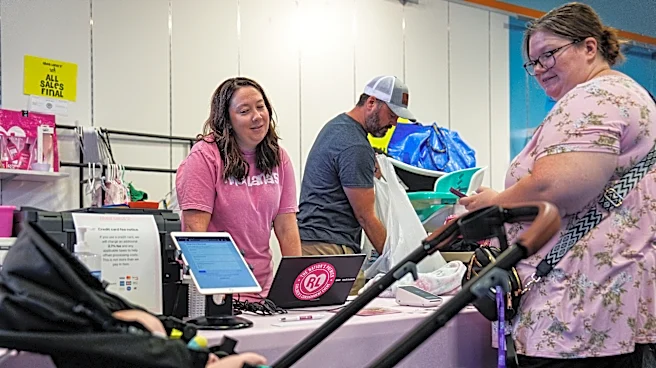
"I go wherever I can get a good deal for her," said Shelby Lanphear, who was recently perusing a sale in Jackson to get a head start on finding her daughter winter clothes.
The Lanphears and many other parents across Michigan say they are using these sales to balance their household budgets as the idea of buying new items that’ll be easily outgrown and left unused, or else quickly roughed
up, becomes less feasible.
There's no doubt that families in Michigan are feeling a financially squeezed. Asurvey from earlier this year found 41% of Michigan parentsof young kids saying in the last 12 months, they’d borrowed money, took on debt, or used payday in advance products to cover basic needs.
Mom2Mom sales take place both online, often on Facebook, and in-person at churches, childcare centers and malls. There's a website dedicated to tracking these one-stop-shops in Michigan for all things having to do with pregnancy, postpartum and kids. This sets them apart from regular thrift stores like Goodwill that have a broader, less kid-specific selection and less quality control, said Jessica Hedger, 41, of Garden City, Michigan.
“You know when you go to one of these you’re going to find the thing you’re looking for,” said Hedger, who runs her own Mom2Mom sales out of her daughter's childcare center.
Secondhand shopping has become more mainstream, especially for items like children's clothes, shoes, toys and gear, wrote Stanley Lim in an email to the Free Press. Lim is business professor at Michigan State University whose work includes analyzing retail logistics and customer behavior.
He points to four factors that have led to this shift, including economic pressure, good resale value on barely used kids' clothes, growing online venues like Facebook Marketplace and lessening stigmas around buying used.
"Inflation helped accelerate children’s resale, but the deeper reason it works is that children outgrow products faster than they wear them out. Digital marketplaces then made it much easier to transfer that remaining value from one family to another," Lim wrote.
Shopping Mom2Mom
A whole industry has cropped up around Mom2Mom sales, as evidenced by the continued growth of national children's secondhand consignment companies like Rhea Lana's and Once Upon A Child. Lim said sales at Once Upon A Child, for example, increased from $504.8 million in 2023 to $543.4 million in 2025, while its store count boasts 441 locations across the U.S.
Ashley Oteney opened a Rhea Lana franchise in 2025 in Jackson, where she holds her sales at the local Westwood Mall. Oteney wanted families to have a close-by, in-person option to buy secondhand kids items after going on her own journey with buying secondhand for her kids. She’d always been a bargain hunter for herself, but with her first kid she worried about germs and thought she needed to buy everything brand new. Then, the cost started adding up.
After her second kid, she "had the realization that just because it’s secondhand doesn’t mean it’s dirty in any sense,” Oteney said.
“Half the time you don’t get the chance to use something before [kids] have outgrown it," she continued.

That's why Jessica Ellis, 31, recently drove nearly 40 minutes to shop for her 2-year-old at Oteney's Rhea Lana Mom2Mom sale in Jackson. The sale's items are sourced from parents who partner with Oteney and get a piece of the commission on what sells. Oteney had about 50 resellers at the sale with merchandise ranging from some heavily discounted automatic breast pumps to pre-teen clothes.
"I like the quality," Ellis said. "It's not messy, things have been barely worn."
Olivia Hoch, 25, who was shopping the sale with her toddler, said she'd sent pictures of strollers at the sale to her friend who's having a kid.
"Car seats, strollers...there's no point in buying these items brand new," she said.
For some items, like car seats, buying used can pose risks. The National Highway Traffic Safety Administration suggests making sure used seats meet certain criteria before buying them secondhand.
Social media puts increased financial pressure on parents
In addition to being an inflation buffer, Mom2Mom sales give parents a chance to find nice things for their kids who grow increasingly picky as they get older as a result of online influencer culture, said Oteney.
“I noticed it more with my pre-teen son. He’s very specific with the things he wants because he saw it on commercial or he saw Mr. Beast wear it … I want him to have what he thinks is cool but I’m also not willing to spend outrageous among for that t-shirt or whatever it is,” she said.
Though a recent survey of over 1,000 American families found that secondhand shopping for kids is most common for those 2-years-old or younger who haven't formed preferences yet, and dips around 9-years-old, when kids tend to start becoming more aware of brands.
Children's resale on the rise, seems to be here to stay
Lim said what's perhaps most interesting about the popularity of secondhand shopping for kids is that it's not only viewed as an option by families with lower incomes.
"It is increasingly a normal value-seeking behavior across income groups, and younger parents are especially comfortable buying and selling through Facebook Marketplace, resale apps, and local Mom2Mom networks," he wrote.

The shift towards secondhand retail, and the expansion particularly in buying for early childhood and children's items, looks less like a post-pandemic phenomenon and "more like a structural retail change," he said.
Beki San Martin is a fellow at the Detroit Free Press who covers childcare, early childhood education and other issues that affect the lives of children ages 5 and under and their families in metro Detroit and across Michigan. Contact her at rsanmartin@freepress.com.
This fellowship is supported by the Bainum Family Foundation. The Free Press retains editorial control of this work.
This article originally appeared on Detroit Free Press: Rising prices, changing consumer behavior behind rise of Mom2Mom sales