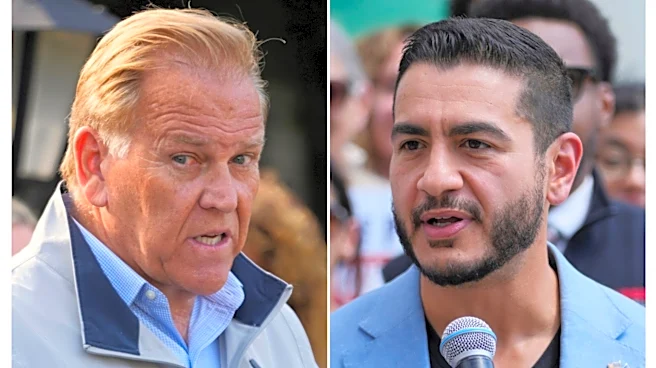


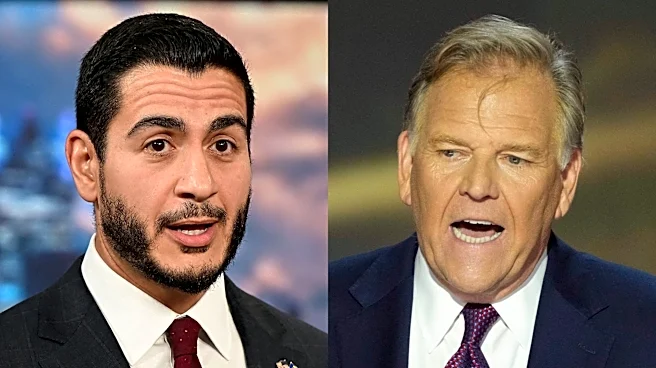
Mike Rogers and Abdul El-Sayed tried to discredit each other's fitness to serve us in the U.S. Senate by bringing up property they own outside Michigan.
Rogers said El-Sayed owns a home in the United Arab Emirates.
El-Sayed questioned why Rogers took the "McMansion" he owns in Florida off the market.
You'll have to decide how relevant their real estate holdings are. But I can tell you this much: It's pretty obvious that neither of them live in Detroit.
Because if they did, the minute one of them started talking about the other's mama, a donnybrook fit for the "Jerry Springer Show" would have broken out.
Don't go there
Whether Rogers' dragging El-Sayed's birth mother into the debate was a highlight or a new low in our political discourse depends on whether you're
the type of person who rubbernecks on the highway while passing a disabled car to see if you can help – or if you can get a glimpse of someone getting run over.

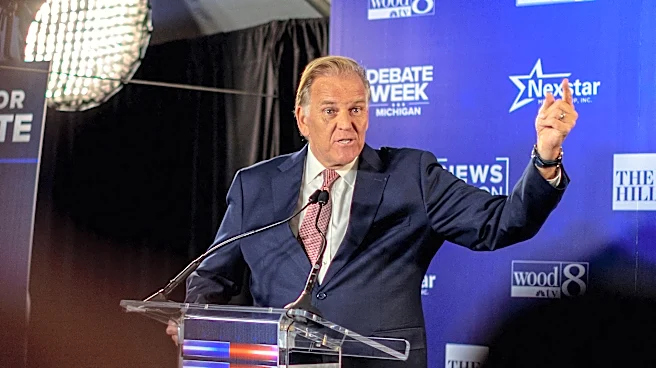
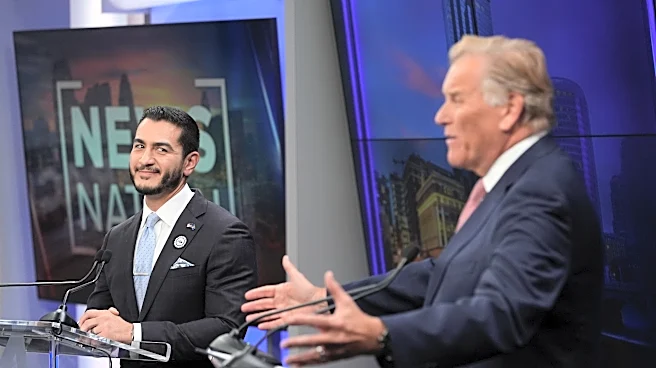
I could feel the tension building from the start of the hour-long debate Thursday, Oct. 10 at WOOD-TV (Channel 8) in Grand Rapids even as I watched from a comfy couch In a hotel room hundreds of miles away.
Like wrestlers circling, Democrat El-Sayed and Republican Rogers sized each other up, looking for the right moment to lunge and try to put the other in a headlock.
But in more than 30 years of covering government and politics, I can't recall ever seeing another candidate call out an opponent's mother – and never on such flimsy evidence.
Yet, 40 minutes into a debate notable for its vitriol and the referee, er, moderator's heroic attempts to keep the candidates on topic and on time – Rick Albin really deserved hazard pay for this one – Rogers' repeated insinuations that El-Sayed had ties to terrorist organizations erupted into a straight-up accusation when he said one of the reasons El-Sayed opposed Flock surveillance cameras on American streets is because he was afraid of what they might capture.
"And why would that bother you?" Rogers asked, rhetorically. "Well, if you have someone in your family that might be on the watchlist..."
"Are you going to go ahead and say I'm a, I'm a – go ahead and say it – you've been tiptoeing around it the whole time," El-Sayed interrupted. "Just say it. Say it. Go ahead and say it."
"Let's do this, let's open up this can of worms," Rogers replied. "I'll tell you what my mother did, she was a small..."
"Are you going after my mom?" El-Sayed said.
And it was on...
"Your mama's so..."
In an era when it seems like few things are off-limits in politics, it was still shocking to see a former congressman call out a doctor and Rhodes Scholar's mother.
Speaking on behalf of my fellow east siders – and I suspect for west siders as well – any sentence that began with a mention of my mother would not have been finished because my fist would have been in the other guy's mouth before he got to the first comma, let alone a period or exclamation point.
That, the good manners my mama taught me, and an inability to raise tens of millions of dollars, is why I'm not running for a seat in “the world’s greatest deliberative body” that, until recent times, was known for attracting some of the most eloquent orators in Our Great Nation.

"Are you going after my mom?" El-Sayed asked again.
"I'm not going after your mom," Rogers said.
"That's exactly what you're doing," El-Sayed said.
"What your mom was working at, I was going after that organization – that was indicted for funneling money to Al-Qaida. That's your mom," Rogers said. "My mom worked at a local chamber of commerce."
Snopes, there it isn't
Neither during nor after the debate did Rogers offer any evidence that El-Sayed's mother was a terrorist or involved in terrorist activities. El-Sayed's campaign has said that his mother was working at an Islamic relief agency to help orphaned children.
Setting aside for a moment that El-Sayed's parents divorced when he was young – and that he was raised in metro Detroit by his Egyptian-born father and Michigan-born step-mother – even the conservative Midwesterner news organization which first reported ties between El-Sayed's mother Fatten Elkomy and the Islamic American Relief Agency acknowledged that "neither Elkomy was ever charged with a crime or named as a co-conspirator" after the U.S. government accused the organization and several officials in 2004 of supporting Osama bin Laden, Hamas and other terrorist organizations.
The Columbia (Mo.) Daily Tribune in 2004 quoted Elkomy as saying: “I’ve been working there serving orphans and children with at least one deceased parent, and it breaks my heart they’re not going to get any help.”
Snopes, the rumor-busting website, wrote on Aug. 25: "The claim that Abdul El-Sayed's mother worked for a terrorist organization that provided financial support to Osama bin Laden, the Taliban and Hamas is misleading and missing context."
"While the Department of Justice convicted several of IARA-USA's former officers for engaging in prohibited financial transactions with Iraq, no charges of terrorism or knowingly supporting terrorism were ever brought against IARA-USA or its officers," Snopes reported.
Snopes also noted that "IARA-USA was one of many Muslim charities shut down in the wake of the United States' 9/11 counterterrorism efforts. Civil rights and nonprofit advocacy organizations criticized the government for discrimination and unfairly targeting charities with policies that had "little prospect of stopping terrorism and at the expense of important humanitarian and human rights work."
"It is more accurate to say that Elkomy worked for a charity with connections to another charity that was shut down after the Treasury Department accused it of directly supporting terrorists," Snopes added. "There is no evidence Elkomy herself was aware of these actions or was doing anything other than helping orphans, as El-Sayed's campaign claimed."
There was some substance
Perhaps the only thing that saved veteran political reporter Rick Albin, who moderated the debate, from having to separate the combatants is that El-Sayed lives in Ann Arbor and Rogers lives in White Lake Township, where mama jokes are a bit less common – and a lot less incendiary.

Rogers and El-Sayed disagreed on everything from whose plan would do more to increase costs and degrade health care. They each expressed skepticism over data centers and artificial intelligence. Rogers said local authorities should be able to decide whether to welcome data centers. El-Sayed said the government should have an ownership stake in AI companies to help prevent the technology from eliminating tens of thousands of jobs.
They did agree on some things, such as temporarily suspending the federal fuel tax to help lower the cost of gas.
They also agreed that it's time to stop the war in Iran and roll back some of President Donald Trump's tariffs on Canadian goods, though Rogers just came to that conclusion a few days before the debate.
They disagreed on universal health care, with El-Sayed claiming it will save families thousands and Rogers claiming it will cost them tens of thousands.
And they disagreed on the future of Immigration and Customs Enforcement (ICE), which El-Sayed wants to defund and Rogers wants to rein in.
Their greatest difference – which Rogers hopes will boost his chance of attracting Jewish voters – was support for Israel.
Rogers said he would support Israel in almost anything it does, short of using nuclear weapons, adding, "I've never heard them say that, though."
El-Sayed said he wants the money the U.S. spends on Israel to be used to help people in America. He refused to say whether he would provide military support to Israel even if the country was under attack.
When Albin pushed El-Sayed to give a definitive answer, he said: "I don't want our tax dollars buying weapons for other countries. I don't know what's so hard about that."
"That's a ‘No,’" Albin replied.
El-Sayed also declined to answer Albin's question about whether Iran or Israel was more dangerous, responding: "I think both of them have proven dangerous in their own way."
Style points
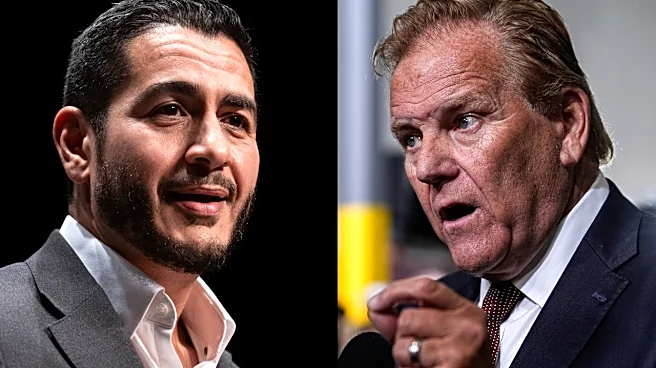
Voters looking for a contrast rarely get two more different candidates to chose from.
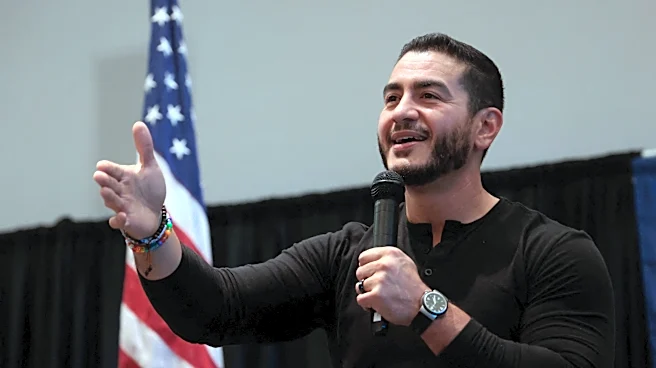
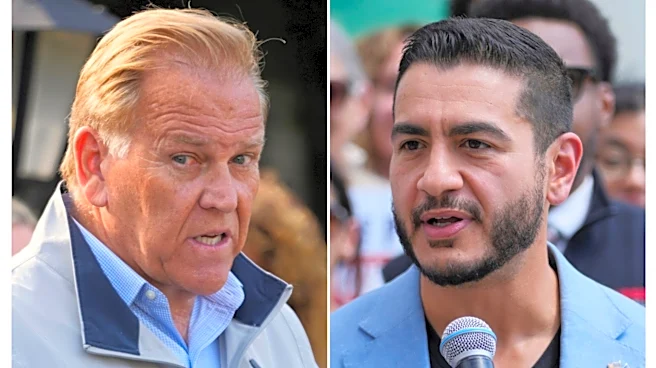
Both are former high school football players, but El-Sayed is younger, has dark hair, a beard and maintains an athletic build. Rogers has graying blond hair, is clean-shaven and husky.
El-Sayed has an extensive educational background and served as a public health official in Detroit and Wayne County. Rogers' history is rich with law enforcement experience, from serving in the military and working as an FBI agent before being elected to the state legislature and Congress.
El-Sayed speaks with a halting cadence best described as a mix between Barack Obama and Christopher Walken. He tends to keep his arms close to his body. He makes his points quickly and concisely, throwing jabs. Rogers occasionally stumbles over his words, with a tendency to use the bureaucratic parlance of a veteran lawmaker while gesticulating. Throughout the night, his comments were punctuated by the light thump and scratching sound of his arms brushing against the microphones on his podium. He makes his points broadly, throwing haymakers.
Both came with talking points and well-honed messages, frequently interrupting and talking over each other.
Both told Albin at least once that a question they didn't seem to want to answer was "pretty hypothetical" or "a ridiculous hypothetical."
And both seized every opportunity to get their licks in.
After refuting one of El-Sayed's points, Rogers quipped: "You learned that in Oxford, I guess, how to talk pretty." (Oxford is where Rhodes Scholars study in England.)
"I learned that at Michigan, where I actually went to school," El-Sayed parried, adding, "I don't just parade around with the Block M." (Rogers wears a University of Michigan sweatshirt in some of his ads.)
If you didn't rate either candidate highly for their manners or willingness to provide definitive or well-documented answers, at least give them credit for being consistent.
El-Sayed wrapped up by reiterating that Rogers was beholden to corporations and would not stand up to Trump.
Rogers said El-Sayed was beholden to liberal influencers and terrorist organizations.
If giving the candidates credit for being consistent in their red-hot rhetoric feels like damning with faint praise, consider that we might have had to score this as a prize fight if El-Sayed had told Rogers to keep his mother's name out of his (expletive) mouth.
M.L. Elrick is a Pulitzer Prize- and Emmy Award-winning investigative reporter, director of student investigative reporting program Eye On Michigan, and host of the ML's Soul of Detroit podcast. Contact him at mlelrick@freepress.com or follow him on Facebook at ML Elrick and Instagram at ml_elrick
This article originally appeared on Detroit Free Press: U.S. Senate candidate called out opponent's mama – but it was no joke