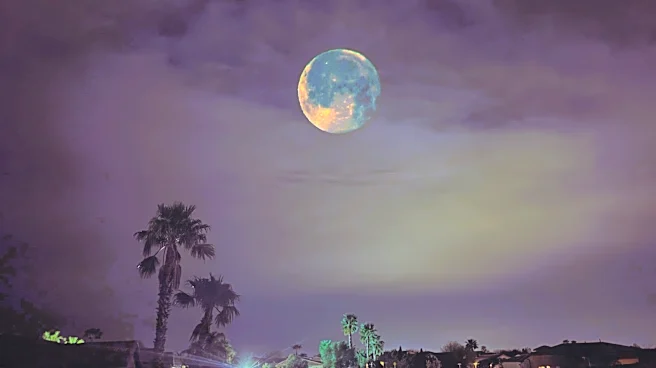



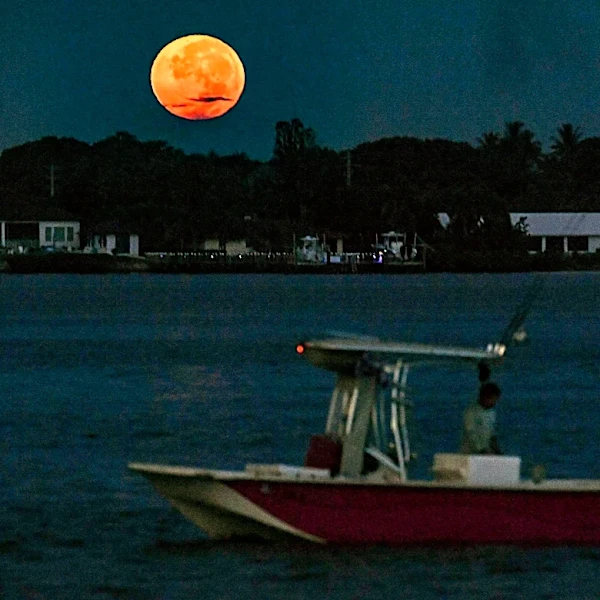




Michigan has just welcomed the start of fall and communities across the state will see the harvest moon illuminate skies this weekend with its lower appearance on the horizon making it appear larger and reddish when it rises.
The harvest moon will reach its peak in the early afternoon hours at 12:49 p.m. on Saturday, Sept. 26, according to the Farmers' Almanac. This full moon, known to rise around sunset for several consecutive nights and brighten the night sky, historically served to offer farmers a later harvest, according to the Old Farmer's Almanac.
While the moon tends to rise about an hour later each night most of the year, the harvest moon has a shorter time frame, thanks to its lower position on the horizon. Friday night, Sept. 25, moonrise
was 6:49 p.m. in Detroit. Saturday's moonrise is 7:10 p.m. and Sunday it will be 7:33 p.m.
Because the moon will rise near sunset, it also will appear red or orange as it rises into the night sky.
Mostly clear skies should allow for ideal visibility in most areas, while part of the western Upper Peninsula could see a chance of rain and clouds disrupting views of the full moon, according to local National Weather Services offices' forecasts.
Love skygazing? Shop telescopes here
Here's what to know about the harvest moon.
When will the harvest moon peak?
The harvest moon will peak at 12:49 p.m. on Sept. 26, according to the Farmer's Almanac.
What is the moon illusion?
At moonrise and moonset, the moon illusion takes effect, making the moon appear larger than it actually is when it is low against the horizon.
While the moon illusion is a well-known phenomenon, no one really knows why our minds believe the moon is suddenly larger.
"Depending on your mindset, this news might be unsatisfying, or it could be a reason to marvel at our mysterious brains," NASA said. "But despite the fact that people have been observing this illusion for thousands of years, we still don't have a rock-solid scientific explanation for it."
Why is it called a harvest moon?
The harvest moon is the full moon that occurs closest to the autumnal equinox, either in September or October, typically in September. However, this year, the full moon will be in early October, EarthSky says.
The proximity to the equinox creates the "harvest moon effect," as the full or nearly full moon rises near sunset for several nights in a row around the time of the harvest, creating bright moonlight from dusk to dawn, according to the Old Farmer's Almanac, Astronomy Magazine and EarthSky. This traditionally marked an ideal period for farmers to harvest their crops later into the night, the Old Farmer's Almanac said.
Is the harvest moon a supermoon?
No, the harvest moon will not be a supermoon.
When was the autumnal equinox?
The fall equinox — the end of summer and start of fall 2026 — occurred at 8:04 p.m. Sept. 22, the Old Farmer's Almanac said.
How far away from the Earth is the moon?
The average distance between the Earth and the moon is 238,855 miles.
At its farthest from the Earth, the moon is about 252,088 miles away and astronomers say it's at apogee.
When the moon is at perigee, or closest to Earth, it's 225,623 miles away.
When is the next full moon?
The hunter's moon will peak on Oct. 25.
Contact Jenna Prestininzi: jprestininzi@freepress.com.
This article originally appeared on Detroit Free Press: Ready for harvest moon illusion? Why satellite will appear extra large
Our editors independently choose our recommendations. Some content is produced with paid support from a third party, however our editorial decisions remain independent. If you buy through our links, the USA TODAY Network may earn a commission. Prices and availability may change.