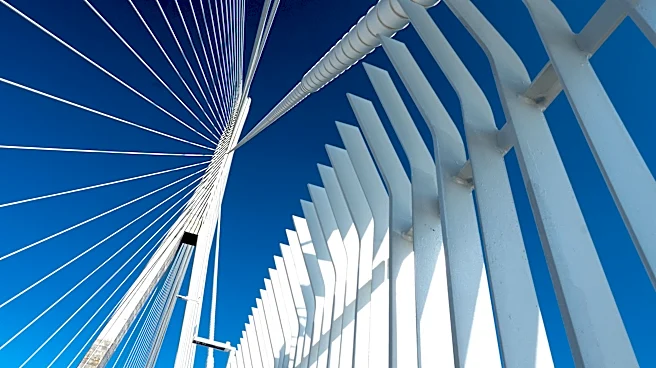






The Gordie Howe International Bridge spanning the Detroit River is now open, offering drivers a new way to reach Canada — and it could offer a deal for some people crossing the border.
Michigan is home to four Michigan international bridges: the Ambassador Bridge, Sault Ste Marie International Bridge, the Blue Water Bridge and Gordie Howe, as well as the Detroit-Windsor tunnel.
To cross the state's newest international crossing, the Gordie Howe International Bridge over the Detroit River, tolls for a personal vehicle start at $5.75 U.S. dollars. That's less than the nearby Ambassador Bridge and Detroit-Windsor Tunnel, but a bit more than you'll pay at the International Bridge and Blue Water Bridge.
Here's a quick look at how much each will cost
you in tolls:
Gordie Howe International Bridge fare is lower than nearby options
Canada and Michigan share joint ownership of the Gordie Howe bridge under a deal struck in 2012 and effectively signed off on by then-President Barack Obama's administration.
The one-way fare for a personal vehicle is $5.75 in U.S. dollars, or $8 in Canadian. A personal vehicle with a trailer is $11.50 U.S. dollars or $16 Canadian.
Passenger vehicles, large commercial trucks or oversized or hazardous vehicles are $8.75 per axle U.S. dollars or $12 Canadian. The bridge also offers a discount program offering 25% off tolls.
Ambassador Bridge adjusted tolls on Aug. 1
Thebridge dates to November 1929.Its 1,850-foot center span made it the longest suspension bridge in the world at the time. Its total length was 7,490 feet, with the U.S. and Canadian terminals 1 3/4 miles apart.
On July 31, 1979, after two years of negotiations, the Central Cartage Company of Detroit purchased the Ambassador Bridge, which is owned and operated by the Detroit International Bridge Company. Central Cartage was owned by a native Detroit family headed by Manuel J. “Matty” Moroun.
The one-way fare for cars, buses or motorcycles, $10 in U.S. dollars, $14 in Canadian — unless you have a premier pass, then it's $5.50 U.S. Autos, buses or motorcycles pulling a trailer are $20 U.S. dollars or $28 Canadian.
Commercial vehicles up to 145,000 pounds cost $12 U.S. dollars per axle or $9 with a valid A-Pass.
Wide and oversized bridge escorts are $135 U.S. dollars.
Sault Ste Marie International Bridge offers passage across Soo Locks
The 9,870-foot bridge, dating to 1962, crosses the St. Marys River to Sault Ste. Marie, Canada. The bridge is operated by the Sault Ste. Marie Bridge Authority appointed by the state of Michigan and the St. Mary's River Bridge Company.
For cars, light duty trucks and motorcycles, the cost is $4.60 in U.S. dollars and $6.40 in Canadian. With 1-axle trailer the U.S. rate is $6.90. Recreational vehicles cost $7.10 and $3.55 per extra axle in U.S. dollars.
For commercial trucks and buses with two axles the cost is $13 in U.S. dollars and $18 in Canadian.
The bridge also offers frequent user discounts.
Blue Water Bridge connects Port Huron and Sarnia
The Blue Water Bridge is a major international crossing over the St. Clair River at the southern end of Lake Huron connecting both Interstate 94 and Interstate 69 with Canada's Highway 402.
The original span, opened in 1938 and renovated in 1999, is a three-lane westbound bridge. The second span opened in 1997 and is a three-lane eastbound bridge.
The one-way for passenger vehicles is $5 in U.S. dollars, unless you have an EDGE Pass account that offers a 50-cent discount per crossing and access to an automated lane. Canadian rates vary.
For each extra axle, on a car, the costs is $5. Truck and buses are $5.25 per axle.
Detroit-Windsor Tunneloffers alternative for those afraid of heights
Owned jointly by cities of Windsor, Ontario, and Detroit, the tunnel is operated under two separate agreements. Windsor Detroit Borderlink Limited manages the Canadian side of the tunnel, and the Detroit side of the tunnel is managed by Detroit Windsor Tunnel LLC.
One-way fares are different depending on whether you are heading to or from Windsor.
Heading to Canada will cost $6.75 ($9.25 Canadian) while passing back to the U.S. is $4.70 or $5.90 with Nexpress. Regular rates are $8.25 and $9.
Vehicles with a trailer are $9 to Canada or $10.10 coming back.
Buses and 2-axle commercial vehicles are $10 and $14 to Canada. To return, fares in Canada are $11.75.
Motorcycles, scooters and e-bikes are prohibited.
What do you need to cross an international border?
Like all U.S.-Canada border crossing, those entering Canada require ID such as a passport, passport card, enhanced license, or NEXUS card to get across.
What is the Gordie Howe Bridge?
The Gordie Howe International Bridge, officials say, is already the largest trade crossing in North America.
The span has three travel lanes in each direction with a full-width, paved emergency lane going each way and the multiuse lane for cyclists and pedestrians.
The bridge features 24 primary inspection lanes/booths at the Canadian port of entry and 36 primary inspection lanes/booths at the U.S. port of entry, alongside 16 dedicated toll collection booths on the Canadian side.
Canada and Michigan share joint ownership of the Gordie Howe bridge under a deal struck in 2012 and effectively signed off on by then-President Barack Obama's administration.
Detroit Free Press contributed reporting.
Jalen Williams is a trending reporter at the Detroit Free Press. Contact him at jawilliams1@freepress.com.
This article originally appeared on Detroit Free Press: Heading to Canada? Where to get the best deal on border fares