





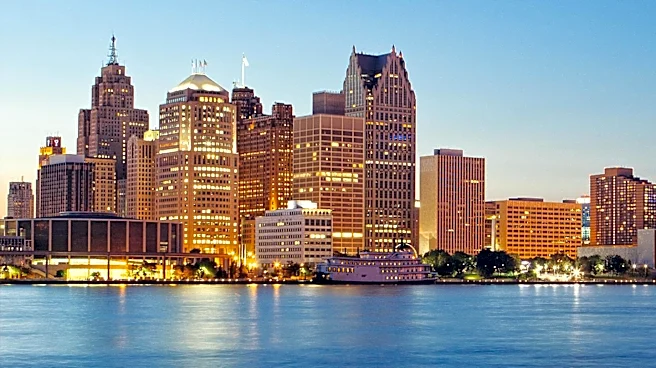

Bedrock and General Motors' $2.2 billion plan to redevelop the Renaissance Center and build out the nearby riverfront received a heavy dose of criticism Sept. 29 during a public hearing on one of the project's key incentives.
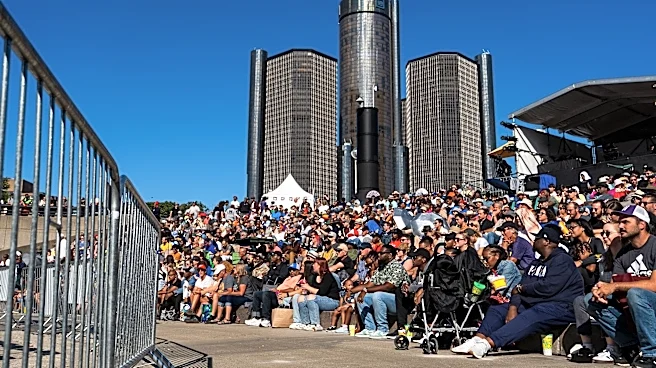
The hearing, held in the early evening at the Coleman A. Young Municipal Center, was on the development partners' request for a Transformational Brownfield.

The brownfield would work as a future capture of state-level taxes generated at the site over a period of 24 years, starting in 2027. The brownfield's estimated value for the project is $300 million.
Although the hearing happened before the quasi-public Detroit Brownfield Redevelopment Authority, whose members are expected to vote yea or nay in the coming weeks, the ultimate
say on the brownfield would later come from Detroit City Council.
The Sept. 29 public hearing drew a strong turnout from organizers and supporters of the Detroit People's Platform, a community activist group, and most people who spoke were against the brownfield.
The RenCen redevelopment team is seeking several other incentives besides the brownfield, such as tax abatements and a Renaissance Zone designation. The estimated total value for all of the incentives is $548 million over 30 years. However, the development, once fully completed, is expected to result in about $300 million in additional tax payments for the city over that period.
Bedrock and GM contend that even with all of the requested incentives, the RenCen project is so expensive to build that is is essentially a philanthropic gesture. The project's anticipated cash-on-cash return is just 1%, the developers have said.
But not everyone at the hearing shared that view on the developers' generosity.
“Philanthropy means giving something," said Eden Bloom of Detroit People’s Platform. "Bedrock and GM are not giving anything. They keep the land, they keep the buildings, they keep the decades of rising riverfront value and they are asking the public for $548 million to get there.
“In a majority Black city, moving half a billion of public support into private ownership is not philanthropy — it is public wealth extraction," Bloom continued. "If this is truly philanthropy, the developers should prove it by putting the civic space in public ownership, embracing municipal governance and improve revenue sharing with the city.”

Other speakers called on the authority to postpone its future vote on the brownfield until the project's Community Benefits process is done. That process began last month and could continue until late October with the finalization of a package of developer concessions and community gifts.
Linda Campbell of the Detroit People's Platform said the proposed housing needs deeper affordability to be accessible to most Detroiters, as well as more units that are bigger in size than studios or one-bedrooms.
The current plan calls for 934 new units of housing, with 205 reserved as "affordable" for those earning no more than 80% of the area median income, which is $58,700 for an individual or $75,500 for a family of three.
“Detroiters are being asked to subsidize a housing community that excludes them as residents, and most importantly, will not address the acute housing crisis that Detroiters face," Campbell said. “We are asking for the (brownfield authority) to delay the vote until we see if the community benefits agreement will offer mitigations regarding the housing.”
Rodney Pearson, publisher of the Detroit-based newspaper The Monthly Standard, questioned whether it is truly necessary to demolish two of the five original RenCen towers to have a successful redevelopment with a new amenity-filled riverfront.
“Tearing down buildings that are structurally sound really doesn’t make any sense," Pearson said. "Now what you can do is redevelop the buildings that are already there, and still have a Navy Pier project going forward — so you can have the best of both worlds. Everyone can win.”
Justin Bahri, vice president of public finance for Bedrock, addressed some of the public speakers' questions.
He said the development indeed meets the state's definition of a Transformational Brownfield plan and that other cities could use the program's limited capacity for new projects if projects in Detroit don't move forward.
He also emphasized that the developers aren't making any big profits from the project.
"The 1% cash-on-cash return, just to highlight again, is not income, it is the cash that the project generates," Bahri said. “These dollars are then reinvested in the project. It helps to keep the lights on. It helps to keep this project sustainable and preserved for future generations.”
A phased approach
The RenCen project would be built in phases, starting next summer and concluding in 2036.

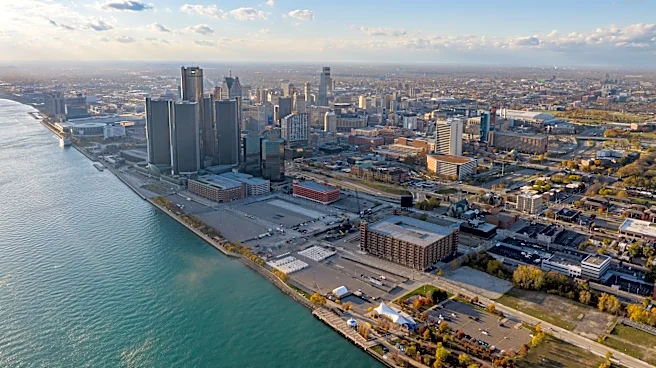
There are two general components: the $1.6 billion redevelopment of the five original Renaissance Center towers and the $624 million buildout of a 30-acre east riverfront site that is next to the RenCen.
Bedrock would contribute $1 billion in equity and debt toward the RenCen portion of the project, with GM contributing $250 million in equity, documents shows.
The tax captures in the Transformational Brownfield incentive, however, would only be applied to the first and second phase of the RenCen project — not the final phase that would renovate Tower 200 as modern office space.
And none of the Transformational Brownfield would be used for the $624 million east riverfront buildout. Bedrock is to contribute "substantial additional equity" toward that buildout, documents show.
The specific taxes that would be captured by the Transformational Brownfield would include:
- Sales taxes on the RenCen project's construction materials.
- State income taxes paid by the RenCen project's construction workers.
- State income taxes paid by future RenCen hotel and retail workers.
- State income taxes paid by future residents of the planned RenCen apartments.
The RenCen portion of the plan would:
- Demolish the complex's multistory podium and transform the 73-story central tower — currently a Marriott hotel — into a mix of 858 hotel rooms and 200 apartments. A "destination" restaurant would then be built on the 71st floor and a public observation deck on the 72nd and 73rd floors, documents show. (Work would begin in 2027 and conclude in 2032.)
- Demolish Tower 300 and Tower 400 that are nearest the riverfront. (Demolition starting in 2027.)
- Convert the 39-floor Tower 100 from office space to apartments. (Work would begin in 2033, conclude in 2036.)
- Renovate the 39-floor Tower 200, but keeping it office space. (Work would begin in 2034, conclude in 2036.)
Contact JC Reindl: 313-378-5460 or jcreindl@freepress.com. Follow him on X @jcreindl
This article originally appeared on Detroit Free Press: $2.2B Renaissance Center plan gets more criticism at public hearing