




As an Up North resort works to build a glamorous camping or "glamping" complex near a 68-acre impoundment on the Boyne River — complete with luxury cabins, a spa, a restaurant, equestrian center and more — it's also working to restrict the public's access to that area of the water and shoreline — and that doesn't float with some locals, river advocates or the Michigan Department of Natural Resources.

"You're going to need a platinum card to be able to access the river," said Brian Kozminski, a board member with the advocacy nonprofit Friends of the Boyne River.
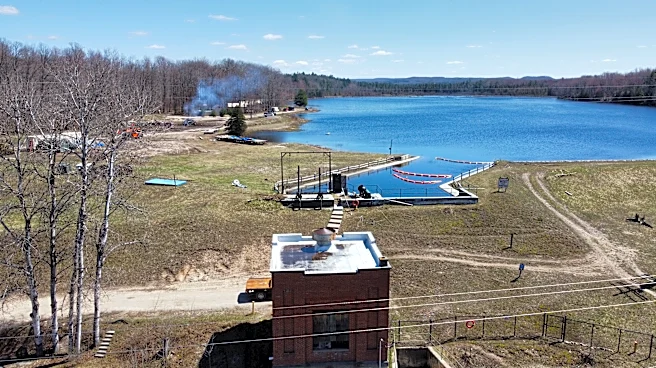
Since 1982, Boyne USA has operated a small hydroelectric dam on the Boyne River near its Boyne Mountain Resort in Boyne Falls. The dam provides about 8% of the skiing and golfing resort's
power needs, and also creates about a 68-acre impoundment of water behind the dam.
The dam was first built in the early 1900s and partially rebuilt in the early 1930s after it was damaged. Consumers Energy purchased the dam in 1950 and operated it for decades before selling it to Boyne USA in 1962. The utility decommissioned the hydropower components of the dam, and the sale agreement included a covenant that the dam would no longer be used for power generation. But Boyne officials successfully got the federal regulator of hydroelectric dams, the Federal Energy Regulatory Commission (FERC) to approve a resumption of hydroelectric generating activity in 1982.
Federally licensed hydroelectric dams in Michigan typically include amenities allowing the public access to fish, canoe or otherwise enjoy the nearby water body. It's even written into FERC rules: Article 13 of the agency's terms and conditions for license of a minor project "affecting navigable waters and lands of the United States" declares: "So far as is consistent with proper operation of the project, the Licensee shall allow the public free access, to a reasonable extent, to project waters and adjacent project lands owned by the Licensee for the purpose of full public utilization of such lands and waters for navigation and for outdoor recreational purposes, including fishing and hunting." A licensee, the article continues, can restrict the public's access only in areas "as may be necessary for the protection of life, health and property."
According to Michigan Department of Natural Resources officials, FERC originally determined as part of Boyne USA's hydropower license that the resort was required to provide limited public access to the tailwater below the dam and the reservoir area behind it.
But FERC later amended its determination of reasonable access to require public access to only the tailwater area of the Boyne River below the dam.

Over the last few years, resort officials have worked to change zoning designations at Charlevoix County's Boyne Valley Township to allow for its proposed "Kircher Collection" luxury camping complex, named after the resort's founder, Everett Kircher, whose family still owns and oversees the company. Cabins near the river and impoundment are already under construction, and a resort presentation at the September 2025 Boyne Valley Township Planning Commission included "plans to add: Family Hamlet, Fishing Hamlet, Sacred Lawn, Garden Hamlet, Destination farm to table dining, Guest House, Main House/Carriage House, Equestrian Hamlet, Spa Area, [and an] On-site circulation network."
When contacted by the Free Press, Boyne USA Vice President of Communications Stacie Harris declined to get into specifics about the riverbank glamping complex.
"This remains a concept in development at this stage with some work done including small cabins built as a camp, but no timeline [is] in place for any opening or operations," she said. "We'd rather share accurate, finalized details when we actually have them than speculate about something still evolving."
At about the same time, the resort installed fencing at the dam and surrounding property. Kozminski said it restricts the public's ability to travel the river.
"In our state public trust doctrine, the water belongs to the citizens of the state of Michigan," he said. "That's our argument: If we put in a boat in and we paddled from Boyne Falls, we should be able to paddle right through and go all the way down to Lake Charlevoix. To do that now, there’s a pretty high fence you would have to climb over.
"Last year, we met with the G.M. [of Boyne USA] and their P.R. person. They said they want to have a better relationship with the community. And two weeks later, all of a sudden, there were new fences built all the way around the property."
Harris said the fencing is "safety fencing" providing protection from the hydroelectric dam's "mechanical gates, spillways and significant elevation changes." She added that the resort "meets and exceeds the requirements of our existing license" with 10-foot easements along the north and south sides of the Boyne River directly downstream from the dam. "In practice, we have gone well beyond that requirement. We built and maintain public fishing and walking access on both banks of the river roughly a quarter mile below the dam."
A local Native American tribe has also weighed in for public access. In a letter dated July 18, 2025, to FERC, Douglas Craven, director of the Department of Natural Resources for the Harbor Springs-based Little Traverse Bay Bands of Odawa Indians, called access to the impoundment "one of LTBB's primary concerns."
"As a public trust resource, any restriction of public access to the reservoir would infringe LTBB's traditional way of life and rights to hunt, fish and gather in the 1836 Ceded Territory as reserved in the 1836 Treaty of Washington," he stated.
The DNR filed a complaint with FERC in September 2024 alleging Boyne was not providing required public access to the impoundment behind the dam. The DNR withdrew the complaint the next month "acknowledging that the 1982 license amendment clarified that public recreational access to the impoundment is not required under the existing license," Harris said.
The federal license for the Boyne River hydroelectric dam expired on Jan. 27, 2022, following a 40-year term issued in 1982, and the facility has since operated under annual extensions. Boyne USA filed an application for a new, 30- to 50-year operating license with FERC on Jan. 31, 2020. More than five years later, the license is still under consideration.
The DNR is using the FERC hydroelectric dam license renewal attempt by Boyne to advocate for public access, agency spokesman Ed Golder said.
"The DNR has longstanding interest in seeking public access to the entire Boyne River Hydroelectric Project for recreation purposes," he said. "The DNR has intervened and provided comments as part of the licensing process, including the need for expanded public recreational access."
Local congressman lobbies for resort
Boyne USA has enlisted the local member of Congress to its cause. In a May 22, 2025, letter to FERC, U.S. Rep. Jack Bergman, R-Watersmeet, whose 1st Congressional District includes Charlevoix County, requested a timeline from FERC when its decision on Boyne's license renewal application might be coming — and also advocated for keeping the public away from the impoundment.
"[A]ny additional public access conditions proposed by FERC — particularly those that would require access to the dam structure, impoundment or upstream private lands — could introduce serious safety and liability concerns, as well as potential environmental disturbances," Bergman wrote.
"As FERC evaluates public input and considers any future licensing conditions, I would respectfully request that full and fair consideration be given to the unique private land context of this project, as well as the proactive steps already taken by Boyne USA, Inc., to provide reasonable public access while respecting private property rights and ensuring environmental integrity."
Kozminski blasted Bergman for siding with the resort's push for exclusivity over the public's river access.
"They are making a mini Disneyland up here just for people who can afford to come up from downstate or out of state," he said. "It's not for the locals, and they don't want to have the locals. They don't want to have you and I paddling through the backyard, past their Turkish spa, as they are charging somebody $1,000 a night; to have you and I come floating by drinking Red Bulls with our T-shirts on."
DNR: State law provides for riverbank, waters access
In an Aug. 18, 2025, letter to FERC, DNR fisheries biologist Dana K. Castle pushed back on Boyne USA contentions before the agency that the Boyne River is "non-navigable." Castle noted that the documents the resort was relying upon for that assertion — from a Charlevoix County prosecutor's opinion and a DNR letter from the 1980s — have been superseded by the 1994 Michigan Natural Resources and Environmental Protection Act. The measure contains a provision allowing anglers and other users of a water body to "walk a route as closely proximate to the clearly defined bank as possible when necessary to avoid a natural or artificial hazard or obstruction," including specifically for a dam, fence "or other exercise of ownership by the riparian owner."
"Absent a court ruling definitively determining the navigability of the Boyne River, the Boyne River can be considered neither navigable nor non-navigable," Castle stated.

Impact on fish, potential for dam failure
Concerns about the dam go beyond public access. Many interveners in the FERC license renewal have cited its impacts on water quality and fish populations, and worries about how downstream areas would be impacted should the dam fail — a worry that came uncomfortably close to reality in many areas of Michigan,including Cheboygan, following record early spring rains and heavy snowmelt earlier this year.
The Michigan Department of Environment, Great Lakes and Energy (EGLE) provided a notice of violation to Boyne USA in September 2023 after an inspection found "sediment-laden water and unnatural turbidity downstream of the Boyne Hydro dam." The DNR the following year postponed annual stocking of brown or rainbow trout in the Boyne River due to sedimentation concerns. The stockings resumed the following year.
Craven, in the Little Traverse Bay Bands' July 2025 letter to FERC, noted the warm water passing downriver from the reservoir makes the lower Boyne River no longer able to support cold water species such as brook trout and arctic grayling, and that the dam inhibits the passage of migratory species that historically spawned in the river, such as lake trout, lake whitefish and lake sturgeon. He also cited safety concerns.
"Any failure would have major effects on downstream water bodies of significance to our community, including both the downstream portions of the Boyne River, Lake Charlevoix, and ultimately, Lake Michigan," he stated.
Visible signs of erosion to the north riverbank just downstream from the dam, and "curved trees" on that shore "may be indicative of slow earthflow or creep," possibly from longstanding leaks in components of the dam that were addressed only in recent years, Craven stated.
"As such, LTBB has major concerns about potential dam failure along the right embankment and we maintain that further study of the integrity of the dam is necessary prior to any relicensing decision," he stated.
Harris said FERC classifies the dam as low-hazard potential and its most recent dam safety inspections, completed in July 2025 "found no deficiencies requiring immediate action."
"This spring's flooding was a true stress test, and the dam performed as expected, the direct result of the capital we've put into the facility in recent years," she said.
She called the EGLE sediment violations "some brief aberrations in sediment produced when the dam was under service," adding, "under normal operationg conditions the dam is an important erosion and sediment control mechanism."
The Great Lakes Fishery Commission has identified the dam as one of 320 important barriers restricting migration of invasive sea lampreys, Harris said. She cited Boyne's own commissioned environmental impact study submitted to FERC that "verifies a thriving fisheries and aquatic resource environment."
Celeste Miller, FERC acting director of media relations, said the agency "cannot disclose the nature and timing of the Commission’s decision on the license application," adding that any pending decision will address comments filed on the project's environmental assessment.
Contact Keith Matheny: kmatheny@freepress.com.
This article originally appeared on Detroit Free Press: Locals: Boyne USA dam, "glamping" development impeding river access