





University of Michigan officials have announced a site decision on their proposed $1.25 billion data center project with Los Alamos National Laboratory — and their choice was met with outrage by Ypsilanti Township officials and local residents.
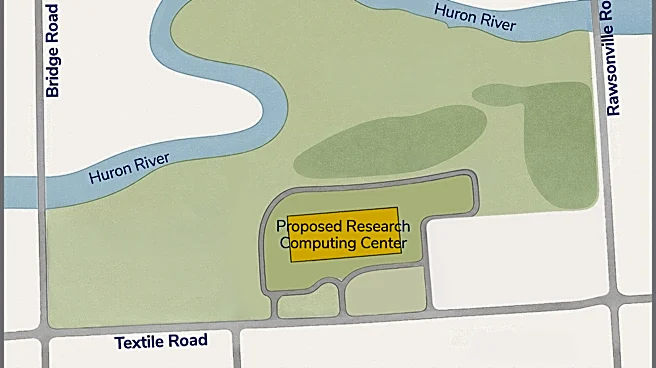
U-M has selected a 144-acre site along Textile Road, near Bridge Road, as the preferred site for what it's calling a "high-performance research computing center" project with Los Alamos National Laboratory. Based in New Mexico, the lab is a research institution focused on national security — including the manufacture of plutonium pits, the triggering mechanism in nuclear weapons.
"The Textile Road site gives U-M an opportunity to build a world-class research facility in a location that meets the project's
infrastructure needs while preserving natural features, creating substantial buffers from neighboring homes and parks and supporting responsible long-term development," U-M officials said in an Aug. 11 statement.
Ypsilanti Township officials referred requests for comment to township attorney Doug Winters, who blasted the university's site selection.

"On the banks of the Huron River, in an area that has acres and acres of woodland, is probably the most diabolical and devastating decision that a university of this stature has ever made — and for a data center where Los Alamos is going to be doing nuclear weaponry research for the next generation," he said. "It's an outrage and it's one that's going to put a target on the backs of the township forever."
In its announcement, U-M officials emphasized that the proposed data center "is not a military installation or weapons production facility," and pushed back on earlier Ypsilanti Township characterizations of the proposed facility as a "Tier 1 High Value Target Risk."
"No hazardous nuclear materials will be stored or used on-site, no weapons production will occur at the site and the facility will not conduct real-time defense operations," U-M officials stated. "The laboratory's work at the center will include computational modeling for nuclear stewardship — helping ensure the safety and reliability of the nation's existing nuclear stockpile without live testing — as well as broader national security research in areas such as energy infrastructure and cybersecurity."
The university student-run Michigan Daily, in a Jan. 30 article, quoted Patrick Fitch, deputy laboratory director for science, technology, and engineering at Los Alamos, who was present at the university’s open house on the project in Ypsilanti the previous day. When The Michigan Daily asked whether Los Alamos intended to use its portion of the data center to support nuclear weapons research, Fitch said yes.
"The short answer is yes, because aspects of a nuclear weapon [are] key to our simulation expertise," Fitch said. "We want this loop to include large investments in national security, so that spins back into the basic science, and what we learn here — that list of non-nuclear weapons stuff — spins into nuclear weapons."
Said Winters, "U-M has proudly declared itself to be a war partner with the Department of War, with the Trump administration. That's what they want to be known for now; that's the legacy they now wish to have."
U-M officials say the facility "will give U-M researchers access to advanced, large-scale computational resources, expanding the university's ability to tackle complex scientific questions and translate discovery into real-world impact."
The project expands on Los Alamos National Lab's first Midwest presence, "deepening its decades-long partnership with U-M," officials said, adding that the project is expected to create hundreds of jobs, attract federal research funding, strengthen industry partnership and "help position Michigan as a national leader in advanced computing and innovation."
State of Michigan provided $100 million for data center site
Winters said a $100 million grant from Gov. Gretchen Whitmer's administration was behind the Textile Road site selection.
"Boy, 144 acres of virgin land," he said. "They could have gone to a brownfield; they could have gone to anywhere in this state. But they chose to go there because they got $100 million from MEDC [the Michigan Economic Development Corp.]."
The MEDC in December 2024 announced its Michigan Strategic Fund board had awarded a $100 million Strategic Site Readiness Program performance-based grant to U-M to begin readying the Ypsilanti Township site for the joint project with Los Alamos National Laboratory. The project cost breakdowns outlined included an $850 million investment from U-M and $300 million from Los Alamos.
"This generous grant helps to position Michigan as a leader in national security, artificial intelligence, clean energy and advanced research," then-University of Michigan President Santa Ono said in a statement at the time of the MEDC grant award.
U-M officials, in their Aug. 11 site selection announcement, said the university, with partners including MEDC, "invested significant time and resources evaluating other potential sites," including the American Center for Mobility property at the historic Willow Run complex in the township, a former General Motors site. Township officials contended the preexisting industrial complex would avoid destroying pristine natural areas and ecosystems bordering the Huron River and township parks.
"Ultimately, however, the longtime industrial property proved impractical due to the comprehensive brownfield redevelopment requirements and complex real estate issues," U-M officials stated. "U-M, the Michigan Economic Development Corporation and other partners worked to determine whether the site could be made viable, but doing so would have required a level of local government partnership and support that ultimately was not achievable."
U-M officials added that the Textile Road location is already zoned by Ypsilanti Township for light industrial use, offers proximity to electrical and data infrastructure, and allows for flexibility and expansion while preserving natural features and "maximizing separation from neighboring homes and parks."
University officials also noted that Ypsilanti Township had previously approved a Textile Road site for a large Amazon distribution center.
"By comparison, U-M's research computing center will have a substantially smaller footprint and generate far less traffic and daily activity," U-M officials stated.
Local residents expressed their opposition.
"It's amazing that people who claim to be enlightened can ignore the voices of thousands of their neighbors," Ypsilanti Township resident David Bowman said.
Democratic U.S. Rep. Debbie Dingell, in a Facebook post, questioned the U-M and Los Alamos data center site selection.
"The University of Michigan's decision to build the Los Alamos data center in Ypsilanti Township is deeply disturbing," she said. "I have joined residents in repeatedly voicing our concerns on this for years. You cannot claim to value community input and then ignore the community when you do not like what it has to say."
University of Michigan Regent Paul Brown, in a statement, expressed his opposition to the data center site.
"The university has failed to engage in an adequate conversation with those most affected, and I cannot stand by and support this project being shoved down their throats in a way that looks like environmental racism."
Winters echoed the environmental racism claim, noting the proposed area has a higher percentage of Black and Brown residents and lower incomes.
"This is what they do; they pick and go into areas they believe will have the least political resistance, and to hell with the impact it has upon the communities," he said.
U-M announced it would host a community town hall meeting in Ypsilanti Township on Sept. 9 to discuss the planned research facility. Additional details will be announced later, officials said.
Contact Keith Matheny: kmatheny@freepress.com.
This article originally appeared on Detroit Free Press: U-M selects site for joint data center with Los Alamos Laboratory