





Before Elliott Hall became the first Black male partner at the prestigious Dykema Gossett Law Firm.
And before Hall became the first Black vice president at Ford Motor Company.
The pride of Begole Street on Detroit’s Old West Side simply wanted the opportunity to jump on and off the back of a truck as the vehicle delivered thousands of newspapers across the city.
And he was promised the job by a Detroit News station manager after Hall distinguished himself as an industrious “paperboy” who sold enough newspapers to earn trips out of the country.

However, for a young Black man planning his life during the 1950s, whose family hoped he could avoid following in his father’s footsteps as a career Ford foundry plant worker — where a good paycheck came
with a steep price due to dangerous and unhealthy work conditions — life was rarely simple or fair.
Hall learned this lesson shortly after graduating from Chadsey High School in 1956.
“I was stunned beyond belief,” the now 88-year-old Hall recalled feeling when that Detroit News station manager delivered a crushing message: “The union won’t accept colored boys; I can’t get you a job.”
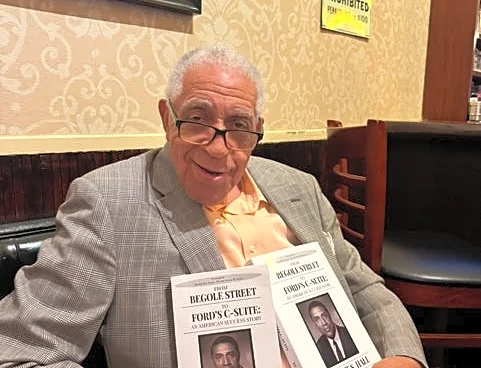
That chapter of Hall’s life and much more are covered in his recently published memoir, “From Begole Street To Ford’s C-Suite: An American Success Story.” At a location not far from where Hall earned his undergraduate and law degrees from Wayne State University, on Sunday, Oct. 11, Hall will talk about his memoir during a book-signing event at Source Booksellers, 4240 Cass Avenue, Suite 105, from 4:30 p.m. to 6 p.m.
“Writing this book gave me the chance to look back at my life and truly appreciate everything I achieved against the odds,” said Hall, whose younger self thought that a job as a newspaper truck “jumper” would lead to him becoming a newspaper truck driver and then a newspaper station manager, which at the time he said was his ultimate professional goal in life.
“Family, faith, hard work, integrity and the unforeseen hand of fate intervened — not once, but three times — to carry me into one of the most influential positions in corporate America," he continued. "I hope readers, especially young people, who don’t yet see the full shape of their own future, take heart from that.”

Hall has enjoyed a career that has encompassed law, civil rights, city government and the highest levels of the American automotive industry over a period touching seven decades. But his journey, particularly during the early stages, did not come without some rough patches.
This includes Hall’s early school days at Sampson Elementary, where a devoted speech teacher named Mrs. Ryan and the challenge Hall accepted from a couple of schoolmates to recite an epic poem helped him to overcome a stuttering impediment. And then there was the letter that Hall received one day in June 1957 from Eastern Michigan University, where he initially enrolled after deciding to give college a try after the unfortunate experience with the Detroit News.
"I was crushed! This letter from Eastern Michigan University was informing me that my GPA was insufficient for me to return to campus," said Hall, the second youngest of eight children born to Odis and Ethel Burton Hall, who was helping his father and brothers paint the family home at 6332 Begole Street (south of Tireman) when the mailman delivered the bad news. "The reality was that my emphasis on the trades in high school had not prepared me for the rigors of collegiate academics."
The letter from Eastern Michigan that Hall stuffed into his paint-stained khakis after reading was never seen by another person. But Hall says his family quickly sensed his despair and with his family's support and the family's religious foundation Hall describes in his book how he was able to come out of the "hermit-like existence" that he had retreated into for a spell and begin to dream again.
His comeback would begin by enrolling in classes at what was then Highland Park Junior College. At the same time, Hall became a voracious reader, devouring the pages of Time magazine and classic literature, including "A Tale of Two Cities" by Charles Dickens, "The Iliad and The Odyssey" by Homer and Herman Melville's "Moby-Dick."
As a result, a new-and-improved version of Hall arrived on the campus of Wayne State University in September 1959 after transferring from Highland Park Junior College. And this time Hall would not leave the university until June 1965, when he walked across a Cobo Arena stage in downtown Detroit with his law degree.
"That was a hallelujah day for my entire family and they made it all possible with their total support," said Hall, who also uses his book to thank a host of supporters and "angels" that played a major role in his success at Wayne State, including his Alpha Phi Alpha Fraternity brothers, who Hall credits for setting a high standard in the classroom for him to follow; William "Bill" Conyers, a member of Detroit's prominent Conyers family, who introduced Hall to the fraternity and later suggested that Hall go to law school; and Carl Stottlemyer, who taught Hall the study habits he would need to succeed in law school.
Hall's accomplishments at Wayne State made him the first person from his family to graduate from college. But it was another statistic that was on Hall's mind after he completed law school and passed the Michigan Bar Exam, and that statistic would shape the course of Hall's professional career and life.
"At the time, the number of Black lawyers was very low — less than 1% of all lawyers that were practicing in the United States," said Hall, who nonetheless still had high-profile role models in Detroit's legal community that were also products of his neighborhood, including Damon Keith, who was appointed a federal judge in 1967 and attorneys John and Nathan Conyers.
"In this great country, with all of this discrimination going on, I had been given the gift of a law degree to use to help others," he said. "My message to anyone is to never underestimate what you're able to do because God has given all of us gifts. But you have to have faith and a sense of morality and that means using your gifts to help people in need."

Hall's desire to "help people in need" has played out in a variety of ways, including providing pro-bono legal work throughout his career and lending his leadership experience as a volunteer board member to a host of charitable organizations that enrich the lives of Detroiters.
Hall also co-founded Neighborhood Legal Services of Michigan, is a past president of the Detroit chapter of the NAACP, and serves as historian at his beloved Tabernacle Missionary Baptist Church. And for his good deeds, Hall has received honors such as the Wayne State University Law School Distinguished Alumni Award, the National Bar Association President's Award, the American Jewish Committee Civic Achievement Award and the Detroit Urban League Distinguished Warrior Award.
However, there is one leadership and service position discussed in his book that Hall once coveted that he was unable to pursue after he became a Ford vice president. That aspiration was to succeed Coleman Young as mayor of Detroit, a call to duty that wound up being filled by Hall's longtime dear friend, Dennis Archer (elected as Detroit's mayor in November 1993), who wrote one of the two forewords that appear in Hall's memoir.
And although Hall never had the opportunity to serve Detroit as mayor, he says he has never lost his passion for a city that has given him "so much," which he will no doubt cover when he discusses his memoir published by Grosse Pointe Farms-based Two Sisters Writing & Publishing on Oct. 11 at Source Booksellers.
"Detroit is a 300-year-old city that seen some ups and downs, but I want to see Detroit continue to grow," said Hall, the proud husband of 50 years to Shirley Robinson Hall, whose distinguished public service record includes serving as U.S. Public Delegate to the United Nations 52nd General Assembly. "When I graduated from Chadsey in 1956, Detroit had a population of 1.8 million, so I would like to see our population come back strong, led by all of the young people that believe in Detroit. I would like to see them continue to believe in Detroit while doing things to help people in need. That would be the quintessential American story."

Scott Talley is a native Detroiter, a proud product of Detroit Public Schools and a lifelong lover of Detroit culture in its diverse forms. In his second tour with the Free Press, which he grew up reading as a child, he is excited and humbled to cover the city’s neighborhoods and the many interesting people who define its various communities. Contact him at stalley@freepress.com. Read more of Scott's stories at www.freep.com/mosaic/detroit-is/. Please help us grow great community-focused journalism by becoming a subscriber.
This article originally appeared on Detroit Free Press: A broken promise led to Elliott Hall's Ford success story and more