



Ford Motor engineer Tim Smith thought little of it when his bosses asked him earlier this year to consult with some representatives from Artists Equity — the studio founded by Ben Affleck and Matt Damon — about the creation of Raptor.
Smith and a team of about three dozen engineers had first conceived of and developed Raptor — Ford's high-performance, factory-built off-road version of the F-150, Bronco and Ranger — in 2006. The team faced many adversities to get Raptor made, including Ford's echelon killing the project six times. It finally launched on the F-150 in 2010.

Today, Raptor has a cult following. On Oct. 2, Ford said its off-road performance vehicles, including Bronco, Raptor, Tremor and FX4 packages, represented a quarter of its total
U.S. sales through September, an increase of 3.8 percentage points from a year ago.
Smith, who is Ford Racing's vehicle architecture engineer, answered Artists Equity's questions about Raptor. It was something he'd done many times before for promotional videos and that's what he thought this was about. But by mid-August, Smith said he sensed a bigger development was taking shape. He would be going to Hollywood.
"I figured out that they wanted me to go out there," Smith, who lives in Brighton Township, told the Detroit Free Press. "It was sort of like, ‘Oh, yeah, and we'll have you guys in it.’ It was kind of almost a throwaway comment, the first time they said it."
But a few weeks later, Smith and his colleague, Chris Paiva, the vehicle dynamics manager for Ford Racing, and a few other Ford engineers were flown to Los Angeles. They were soon rubbing shoulders with Oscar-winning director Affleck and actor Jon Bernthal.
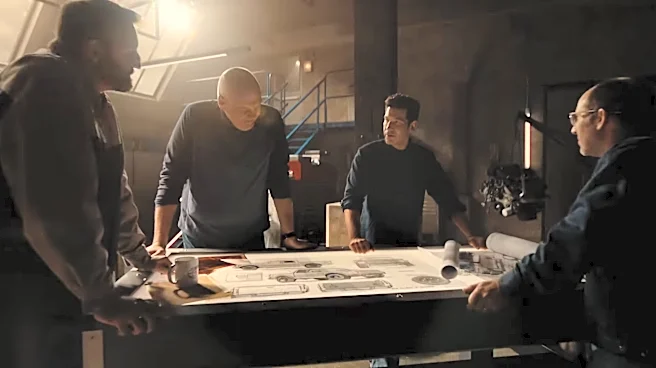
Affleck, a huge Raptor fan, directed a new television spot that tells the story of how a small team of engineers created Raptor. Smith and Paiva consulted on it and star in it, along with Bernthal, who is most famous for his role in "The Walking Dead." Paiva is still reeling from the experience.
"I never would have thought I would have ended up in Hollywood working next to A-Listers like Ben and Jon," Paiva, who lives in Novi, told the Detroit Free Press. "So being able to tell my friends and family, ‘I'm going out to Hollywood' and standing next to Ben Affleck, and they're like, 'No, you're not.’ I sent them pictures. It’s something I never thought I'd be able to do.”
The new TV spot
The 60-second spot is to debut Oct. 23 on Apple TV during F1 coverage of the United States Grand Prix in Austin, which starts at 1:30 p.m. Eastern Time. It will also air Oct. 24 on ESPN during the Ole Miss versus Texas game starting at 7:30 p.m. Eastern Time.
The spot, which can be previewed on YouTube, starts off with an F-150 Raptor racing through a desert driven by Bernthal who says, "How do you make a monster? It's not always loose brains and lightning. Eleven times out of 10 it's relentlessness."

Bernthal narrates the story of how a group of Ford racing engineers came up with the "wild idea" for a Raptor and all the challenges they had to overcome and their relentless drive to keep improving it to get the suites upstairs to sign off. It ends with Bernthal saying, "You see, making a monster, that's the easy part. Hard part? Stopping at just one."
It was about 13 months ago when Will Ford, general manager of Ford Racing, said he was connected with Artists Equity and quickly realized that was the group he wanted to tell the story of the Raptor. They "immediately grasped" how Ford's racing technology is transferred to off-road performance vehicles that sit in people's driveways, such as Raptor. Also, Bernthal and Affleck were the perfect combination of "great storytellers with an authentic understanding of what the product stands for," Will Ford told the media.
In fact, Brandon Pierce, creative director at Artists Equity, told a small group of media that when his team first met with Will Ford, "Ben Affleck, our CEO, was in this conversation and said the first time he rode in a Raptor was with Jon Bernthal on the set of "The Accountant." Jon would drive to the set in his Raptor and he took Ben for a spin. … He showed Ben how fast ... the Raptor was. Ben Affleck also now owns two Raptors, so the firsthand experience helped drive a little sales there.”
Affleck's tricked out Raptors
Paiva said he saw Affleck's Raptors and believes the actor's turn playing Batman, initially in 2016, influenced some of Affleck's aftermarket additions to the cars.
"It's got some pretty trick features that I won't disclose, because I don't want to get in trouble, but, he's full on and ... what I heard...was he sort of took a personal interest in directing this one himself, just because he thought it would be cool, and, again, he's a fan of the vehicle," Paiva said. "This is the same with Jon Bernthal. He owns three Raptors. He's got an original P415 that he bought way back."

"P415" is the internal Ford global program code for the first-generation F-150 SVT Raptor made between 2009 and 2014.
"He's like, ‘I couldn't really afford it then. But I went to buy an F-150 and it was sitting next to it, and I was like, 'What is that? I had to have it,' " Paiva said the actor told him.
Smith and Paiva flew out to Los Angeles in mid-September for the two-day filming of the TV spot and were immediately in a surreal world.
"A driver picked us up at our hotel. They took us to the studio. It was all catered, we had wardrobe, we had makeup, and then you go in, and the set was phenomenal," Smith said. "We had given them a lot of blueprints from where we worked at Roush, and they had visited, so they kind of constructed a Hollywood version of the space." The Ford Roush Building in Dearborn is where the Ford Racing team operates.
Smith said Affleck was obsessed with authenticity. So the Ford team helped locate actual parts used in the development of the Raptor nearly 20 years ago. Ford's engineers also served as consultants.
"I went in on Friday to review the set. I had a few changes to suggest, which is pretty cool to say, ‘Hey, this doesn't look great. This wouldn't have been this color,' " Smith said. "Then, like, five people come over, take it all off, take it out, and come in the next day and it's completely a different color, the right color. The Hollywood magic."
Artists Equity's Pierce said that while shooting the spot, the Raptor truck they used was going so fast through the desert, Affleck had to use another Raptor with a camera attached to it because it was the only vehicle that could keep up with the Raptor being filmed.
The inception of Raptor
The story of the Raptor is one suited for the movies because it almost didn't happen.
Ford's Brad Lammers, who lives in Canton, lead Ford's powertrain systems on Raptor from 2007 to 2012. He is currently the senior battery development manager for multiple electric vehicle programs at Ford. He recalls trying to get Raptor off the ground, which was not easy. At the time, the idea of putting a performance package on a pickup truck and then taking it off-road was totally novel.
"The inception was around 2007 or 2006 … we had it coming off (Mustang Shelby) GT-500 launch," Lammers said. "I joined the team in 2007 and I was dealing with the other performance products, but also was quickly pulled in because, this truck was going to be something unique in itself."
The 500-horsepower engine was a big deal at the time, Smith said. Ford had the car, but that small team of engineers at Ford Racing thought: "We want to have a car and a truck, right?"
"So it pivoted," Smith said. "What do trucks do well? Obviously, they can tow, they can haul, they can do jobs. OK, what are the fun things trucks do? Obviously, off-roading. Obviously, we all like going fast."

Lammers, Smith and Paiva all have off-road enthusiast backgrounds and enjoy snowmobiles and dirt bikes. That background helped because these engineers would became the Raptor test drivers.
"We were able to take the vehicles to playgrounds that we knew to go improve its capabilities." Lammers said. "But nobody else really had that driving background. That was a big part of it and being able to eventually start pushing the limits of what the vehicle is capable of, and so being, not only the engineers involved in the design and the launch, but also involved in the testing."
Raptor almost didn't happen
Once the group honed in on designing a fast, off-road truck, some in the company questioned the risk. No other company was doing an off-road performance truck at that time.
"So it took a while to get everybody on board and go in the same direction, and we even made a hype video, because not everybody can go out to the desert, right?" Smith said. "We kind of made a hype video on one of the trips showing how crazy the truck was, one of our prototypes, brought it back to the shop to play it for everyone. We were like, this is cool. You're gonna like this."
But by 2007, the housing market was crumbling, then a year later the great recession started and "gas spiked over $4 a gallon. So during this whole development process, the background was kind of bleak and we're working on this thing that, you know, isn't fuel economy forward," Smith said.
But they persevered and Smith credits "good leadership that kind of ran cover because they believed in the product" for keeping the program on track. By the time launch came, the economy had improved. But they had another problem.
"Internally at Ford, we were developing the 6.2-liter; that engine was supposed to have cylinder deactivation, some really high-tech componentry in it," Lammers said. "At the last minute, they decided that the engine wasn't ready, and we had to launch with the 5.4 liter three-valve tried and true engine. It had ample power for what we were trying to accomplish off-road, but it wasn't until the half model year after that when the 6.2 debuted."

It was a minor concession. If the 5.4-liter V8 engine had not been available, the business case for F-150 Raptor would have blown up. It depended on selling a certain number of units that year, so the truck had to launch on time to be financially viable, Smith said.
"There's all these little things like that, that if the direction had gone the wrong way, we might not have Raptors," Smith said. "Which is crazy to think about at this point."
Today the F-150 Raptor has a 3.5-Liter EcoBoost V-6 High-Output engine that generates 450 horsepower and 510 pound-feet of torque.
The work the engineers did on the new TV spot allowed them to take a walk down memory lane, they said. Smith even jokes how he saved files from that time that he probably should have deleted, but didn't because of the emotional tie to that project.
Lammers, agreed and said, "I kept a lot of the stuff from this program, too, because we didn't realize at the time we were making history. It was a very close group and so going back to memory lane, a lot of the stuff came back. A lot of the challenges, the adversities, but we overcame them and we launched an amazing product that now has this cult following. It was a great experience then and it's great to relive it now."
Jamie L. LaReau is the senior autos writer at USA TODAY Co. who covers Ford Motor Co. for the Detroit Free Press. Contact Jamie at jlareau@freepress.com. Follow her on Twitter @jlareauan. To sign up for our autos newsletter. Become a subscriber.
This article originally appeared on Detroit Free Press: How Ford Raptor engineers ended up in a Ben Affleck-directed TV spot