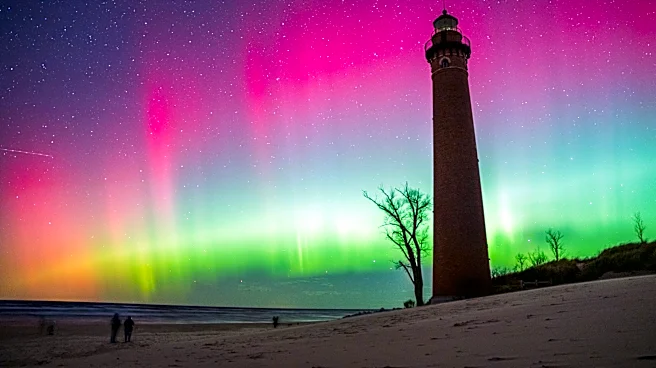








Michigan could close out the week with a strong northern lights showing both Thursday and Friday nights, if solar forecasts prove right.
NOAA is predicting a G1 or G2 geomagnetic storm that could produce a Kp index of up to 5 Thursday night, Oct. 8, leading to potentially strong aurora borealis, or northern lights, visibility in the Upper Peninsula and northern Michigan.
Kp is an index used to indicate the severity of the global magnetic disturbances in near-Earth space, NOAA said. Kp ratings increase from zero to 9. NOAA is predicting minor geomagnetic storm impacts.
NOAA issued a G2 geomagnetic storm watch for Friday night, Oct. 9, predicting a G1 storm with limited G2 activity. A geomagnetic storm is a worldwide disturbance of the Earth's magnetic field.
"G1 (Minor) to G2 (Moderate) geomagnetic storms are likely on 09 Oct with the arrival of a (coronal mass ejection) that was associated with a M1.4 flare from Active Region 4549 on 06 Oct. A high chance for additional M-class flare activity from Region 4549 will persist in the coming days," NOAA said on the Space Weather Prediction weabsite.
Want a closer look? Shop telescopes here
Consider heading to one of Michigan's dark sky areas in regions with clear, dry conditions, for a closer look at the lunar eclipse and colorful auroras. Clouds could disrupt viewing chances in some areas of northern Michigan and the U.P., per forecasts from local National Weather Service offices.
Here's what to know about the northern lights outlook.
When could the northern lights be visible?
The northern lights could be visible in northern Michigan and the U.P. Thursday night, Oct. 8 and Friday night, Oct. 9, per NOAA and the SWPC. NOAA is predicting a G1 geomagnetic storm Oct. 8 producing a Kp index of up to 5 and on Oct. 9, a G1 geomagnetic storm potentially becoming a G2 storm at some points.
Cloudy skies could limit visibility in some areas, according to local NWS offices.
What are the northern lights?
The northern lights, or aurora borealis, are waves of light created when the solar wind strikes the atmosphere, creating a display of moving lights in the night sky.
Why do the northern lights have different colors?
The color of the aurora depends on which gas is being excited by the electrons and on how much energy is being exchanged, NASA said.
Oxygen emits either a greenish-yellow light (the most familiar color of the aurora) or a red light; nitrogen generally gives off a blue light. The oxygen and nitrogen molecules also emit ultraviolet light, which can only be detected by special cameras on satellites.
Can't see the northern lights? Use your phone
If you're having trouble seeing the northern lights with the naked eye, try using your phone camera in night mode and hold still while capturing the photo. You might be surprised at what's dancing in the sky.
The Lansing State Journal contributed.
Contact Jenna Prestininzi: jprestininzi@freepress.com.
This article originally appeared on Detroit Free Press: NOAA predicts magnetic storm. Could northern lights shine?
Our editors independently choose our recommendations. Some content is produced with paid support from a third party, however our editorial decisions remain independent. If you buy through our links, the USA TODAY Network may earn a commission. Prices and availability may change.