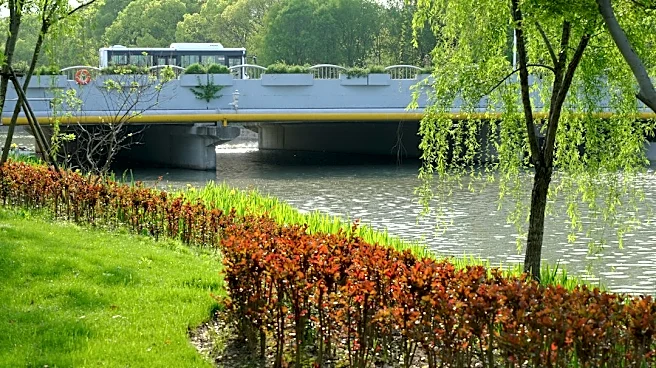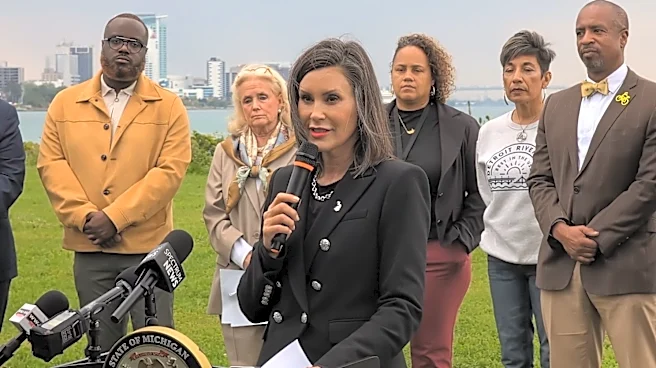






Gov. Gretchen Whitmer on Thursday, Oct. 1, announced a "Reclaiming the Rivers" initiative, including $89 million in funding to clean up and transform the Detroit and Kalamazoo rivers.
"This new investment will help clean up contamination, restore habitats and keep our water clean and safe," Whitmer said at a news conference on Belle Isle, surrounded by state, federal and local officials as well as local residents and river advocates.

"Our state is defined by water, it’s who we are. And it’s up to us to protect it – all of it, from our Great Lakes to our local rivers. ... Today’s announcement is just the next step in protecting Michigan’s most important resource."
The initiative is utilizing funding from at least $108 million secured by Michigan
Attorney General Dana Nessel in a settlement announced in May with Monsanto Company, a major manufacturer of polychlorinated biphenyls, or PCBs and affiliated companies Solutia Inc. and Pharmacia LLC.
PCBs are a group of human-made organic chemicals widely used in electrical equipment, hydraulic fluids and paints until the U.S. banned their production in 1979 because of toxicity risks. Because they persist and bioaccumulate in fatty tissues and the food chain, humans can still be exposed today primarily by eating contaminated fish, meat or dairy.
According to the federal Centers for Disease Control and Prevention and the U.S. Environmental Protection Agency, PCBs can cause liver and other cancers in humans, as well as immune system suppression, endocrine disruption, neurological and developmental defects, and reproductive disorders.
As a result of generations of industrial activity, PCB pollution is a significant historical and ongoing legacy problem on both the Kalamazoo and Detroit rivers. Both waterways are designated as federal Areas of Concern where PCBs linger in bottom sediments and bioaccumulate in local fish.
Under the agreement, Monsanto was to pay an initial $32 million in June and an additional $37 million by March 2027. The settlement also includes a contingency amount tied to the outcome of related legal actions, which guarantees the state an additional payment between $44 million and $176 million. Under these terms, Michigan will receive at least $108 million with a possible maximum amount of $240 million.
The Reclaiming the Rivers initiative is also utilizing $25 million from a late April state settlement with Eagle Creek Renewable Energy and STS Hydropower, related to a massive 2019 sediment spill into the Kalamazoo River, where a mismanaged reservoir drawdown at the Morrow Dam released an estimated 369,000 cubic yards of accumulated muck and sludge downstream.
"So we’re talking about a total of $129 million," said Phil Roos, director of the Michigan Department of Environment, Great Lakes and Energy, or EGLE.
"Even though we announced $89 million here, we’ve still got a lot more we can use on these and other projects."
The plan calls for $50 million of the funding to address PCB-laden sediment removals in the Detroit River, leveraging hundreds of millions in federal, private and philanthropic dollars toward the effort, Roos said.
Another $25 million goes toward river restoration projects in the Kalamazoo River watershed. "We will be able to address contamination and also really begin to restore the river to its natural functions," he said.
An additional $14 million will serve as a strategic fund for PCB cleanups and river restoration projects throughout the state.
Michigan is uniquely positioned to permanently transform two of its most important rivers, said Michigan Department of Natural Resources Director Scott Bowen.
"The Detroit and Kalamazoo rivers have incredible potential for recreation, economic development, fishing and wildlife habitat, but contamination has stood in the way," he said. "These investments give us the opportunity to address that contamination while creating new ways for millions of Michiganders to safely enjoy these waterways."
Detroit City Councilman Scott Benson, chairman of the council's Green Task Force, praised local, state and federal partners for work already underway on the Detroit River, including a $10 million joint partnership between EGLE and the EPA announced last year to begin design work and prioritization for contaminated sediment cleanup.
"By working together, government, advocacy groups and residents, we are assuring that the Detroit River becomes fully swimmable, drinkable and fishable," Benson said.
U.S. Rep. Debbie Dingell, D-Dearborn, called the Detroit River "a vital artery that has pumped life into communities throughout Southeast Michigan, from Detroit to Downriver ... and the Kalamazoo River has done the same in West Michigan." She noted that the U.S. Senate had recently passed the renewed Great Lakes Restoration Initiative funding legislation already passed by the House, with bipartisan support for reinstating the funding for Great Lakes region contamination hotspots.
Detroit resident Esperanza Smith, who lives near the riverfront and volunteers with the Detroit Riverfront Conservancy, called the cleanup funding "an investment into our future – not just for the city of Detroit, but the entire state of Michigan and the Midwest region."
"I have had the opportunity to see so many people of all ages enjoying the Detroit River, from fishing, kayaking, going for walks with their dogs, to going for a run. It reminds me how fortunate we are to have this waterway so close to home."
Contact Keith Matheny: kmatheny@freepress.com.
This article originally appeared on Detroit Free Press: $89M in funding announced for Detroit, Kalamazoo river cleanup