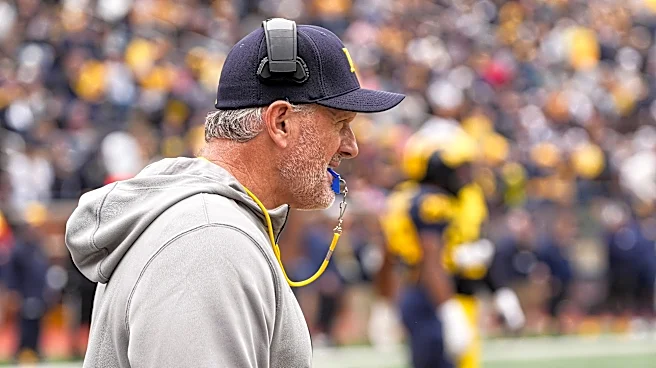



Long before the events that led to his personal downfall last December, Sherrone Moore exhibited questionable judgment. Back in 2024, Moore was a rookie head coach leading a Michigan football team in the throes of transition coming off its undefeated march to a national title and Jim Harbaugh’s departure.
Only one starter on offense, tight end Colston Loveland, was set to return. The entire defensive staff was new. From the outside, there was profound doubt about whether the Wolverines could prolong their run of success during the final chapter of Harbaugh’s tenure, when they won 40 of 43 games and three straight Big Ten titles.
As the opener neared, Moore said, “We don't really care about what other people think.”
The goal, he asserted, was the
same − “To win it all.”
Moore, who had worked under Harbaugh the previous six years, gave the impression that he thought it was achievable. After watching the team practice during the preseason, he told reporters he was bullish about Michigan’s prospects. With a hint of haughtiness in his voice, he crowed, “You're like, 'Oh yeah, we're gonna be good. You can feel it. You can sense it.”
But as it turned out, the Wolverines weren’t nearly as mighty as Moore led their fans to believe. They stumbled to an 8-5 record, falling out of College Football Playoff contention before November. Not even the stunning upset of Ohio State or bowl win over Alabama could save Moore’s first year from being seen as an abject disappointment. In retrospect, he made a major unforced error by seeding false hope with his ill-advised braggadocio.
His successor, Kyle Whittingham, has shrewdly avoided making the same mistake. At Big Ten media days last month, he went out of his way to temper expectations.
In his opening statement, he said, “I think we’ve got a good football team. I can't predict how good we can be or where we'll end up. I can say if we're playing meaningful games in November, that's probably for us a successful season, a chance to have something to build on.”
Since his arrival last December, Whittingham has refrained from making bold promises. He instead has struck a modest tone, changing the tenor of a program that for the longest time exuded arrogance with its boastful rhetoric. Almost every year, around this time, Harbaugh and Moore fanned the hype. So did their assistants.
But the 66-year-old Whittingham and his staff have taken a more measured approach with their comments.
“I don’t think we’re in the business of just talking about what we can do,” defensive coordinator Jay Hill said. “We’re in the business of letting our actions show it, and I think we have the team that will show it.”
Instant success – the type that includes double-digit wins, a CFP appearance and a trophy or two – isn’t guaranteed, though. To assume otherwise seems foolhardy given that this was a new venture for Whittingham, who spent the previous 21 seasons as Utah’s head coach. Whittingham called it a “reset for me.” The project he was undertaking was unlike any other he tackled before. After all, he had already worked at Utah for 11 years when he was promoted to the top job in December 2004. He knew the lay of the land there. Michigan, in contrast, was uncharted territory for him.
Over the past seven months, he worked to revamp the program, changing everything from the culture to the strength program to the schemes on offense and defense. It was a heavy lift. While Whittingham said progress has been made, he also told reporters recently that he won’t be sure how far they’ve come until conference play begins. The uncertainty is the most he’s faced entering a season since he became a head coach, he acknowledged.
It is understandable then that Whittingham would be hesitant to make any grand claims about this team. To wit, there is so much yet to be determined. Can quarterback Bryce Underwood rebound from a mediocre freshman season and fulfill his promise as a former No. 1 recruit? Will the defense quickly adapt to Hill’s system, which he claimed was the “most complicated … in the country?” Then there is the daunting schedule, which is loaded with six opponents ranked in the Top 25 of the US LBM Coaches Poll.

“You have Oklahoma in Week 2, Iowa in Week 4, then you still play Oregon, Indiana, Ohio State. Penn State is in there. Michigan State is going to be better,” Jake Butt, a Big Ten Network analyst, told the Free Press. “I imagine maybe part of his thought process is Kyle just saying, ‘Let’s focus on being the best possible team we could be today, and be better today, rather than worry about the end of November.'”
If that is indeed the case, Butt believes it is the kind of calculated decision a smart, experienced coach makes.
“He could absolutely be protecting his team in that sense,” said Butt, the former Michigan tight end.
As Whittingham knows, the burden of high expectations can be onerous. When Underwood proclaimed this June that he felt he was “the best player to ever come out of Michigan,” Whittingham wondered if the quarterback had opened himself up to some unnecessary scrutiny.
“May be in his best interest maybe to not put that pressure on himself in that way,” he said.
He knows how debilitating it can be. So he was careful not to subject his team to it this offseason by blowing a bunch of hot air about the Wolverines’ potential.
“I think in general it’s always a good policy for all of us to let your actions speak for themselves,” Hill said.
His counterpart on offense, Jason Beck, agrees.
“Just come in, work every day,” Beck said, “and the results will take care of themselves.”
Maybe, just maybe, the Wolverines will even flip the script and find a way to – gasp! – surprise people. If they do, the hype will come and it will be justified.
Contact Rainer Sabin at rsabin@freepress.com. Follow him @RainerSabin on X.
This article originally appeared on Detroit Free Press: Why the Michigan football hype machine is being cooled down