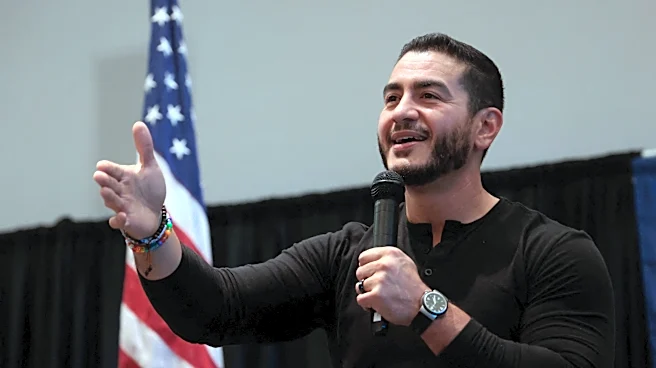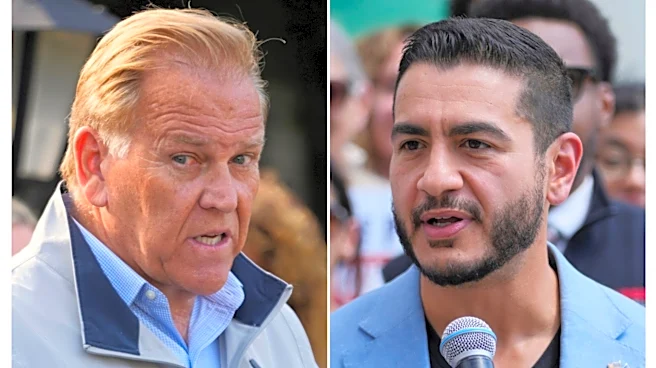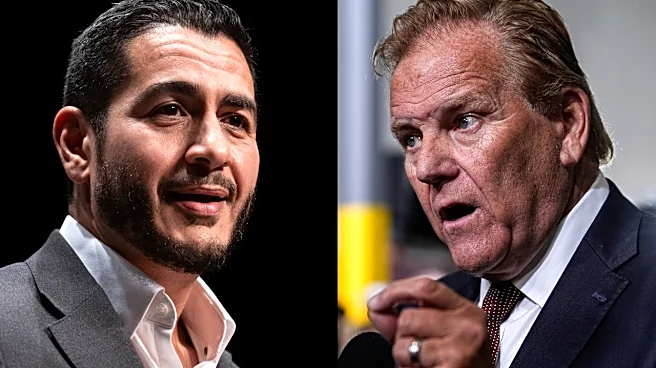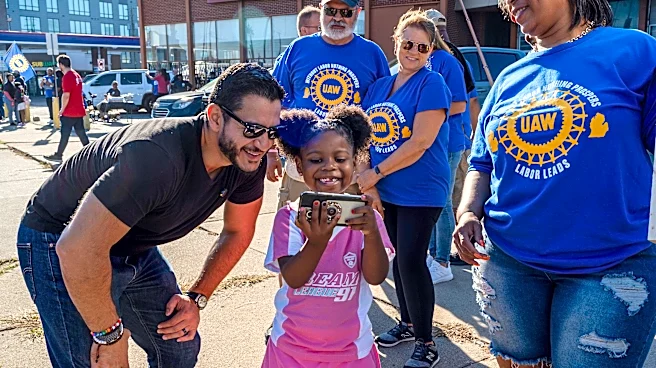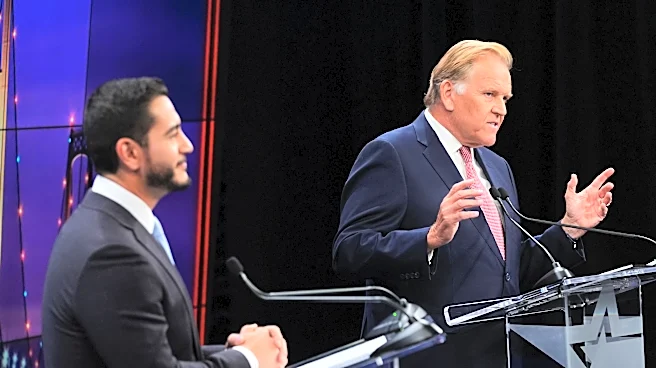

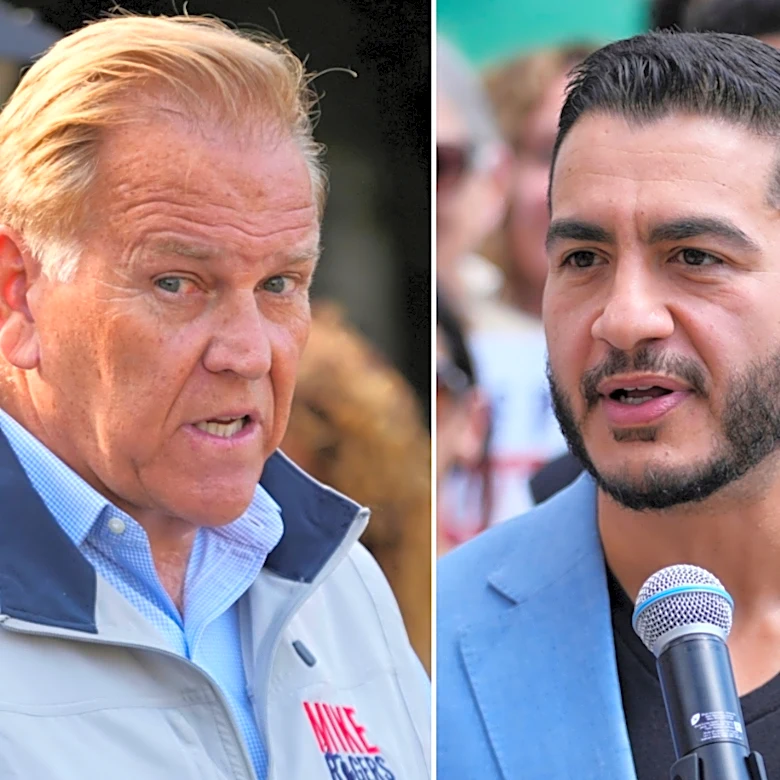

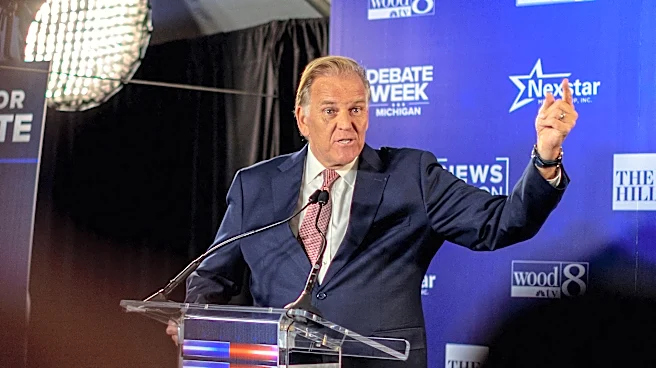
The first debate between Abdul El-Sayed and former U.S. Rep. Mike Rogers for Michigan's open U.S. Senate seat touched on a lot of issues — gas prices, the Iran war, trade with Canada, health care — but could best be characterized as a shouting match where the two interrupted each other and kept up a series of personal attacks.
For about an hour Oct. 8, WOOD-TV 8 moderator Rick Albin gamely tried to keep order during the first of two scheduled debates between the Democratic (El-Sayed) and Republican (Rogers) nominees in a race being closely watched across the nation, at one point chiding: "I'd like to be part of the debate, too."
But his pleas fell mostly on deaf ears as Rogers returned repeatedly to claims — largely misleading and lacking in important
context — that El-Sayed, who would become the first Muslim elected to the U.S. Senate, has ties to terrorist groups and is "dangerous." El-Sayed, for his part, argued with the former congressman about whether or not he owned yachts and how many and called him "weak" and "cowardly."
Albin even said the two continued to bicker during the one brief break in the studio in Grand Rapids. In three decades of being involved in political debates, he said, "I've never seen it continue during the commercial, but it did."
At one point, the back-and-forth devolved into a question as to whether either might attack the others' mothers, with each daring the other to do so.
"All right, let's open up this can of worms," Rogers said, before they dropped the subject.
"He wants this to be about anything but his own record," El-Sayed said.
"We cannot afford Abdul, and we cannot risk his ideology," said Rogers. "Don't listen to this guy."
With the election a little less than four weeks away on Nov. 3, here's some takeaways from the debate and the issues the candidates touched on, as well as some of the salvos each deployed along with them.
Health care came up early and with a surprise
One of the very first questions revolved around health care and El-Sayed, the former Wayne County and Detroit health director who is a supporter of a government-run program that ostensibly would cover all Americans, provided a surprise: He said, under his plan, "If families want to keep their private health care that’s absolutely fine by me," though it's far from clear how that would work.
Typically, the idea of a single-payer plan would be for it to cover all but the most expensive privately held insurance plans because private insurance would likely become much more expensive as most people opted for a government plan without premiums or copays covered by tax revenue.
Clearly, however, El-Sayed still wants such a sweeping plan, saying, "I want to guarantee every single person coverage, cradle to grave ... He (Rogers) wants you to have to pay $50 to see a doctor."
Though Rogers didn't immediately respond, later in the debate he came back to it, saying El-Sayed wants to "take away your personal health care" at a cost of "$20,000 per family" for his government-run program. It wasn't immediately clear where that figure came from, though there have been calculations in the past that employer-sponsored coverage costs about that much a year, with employers picking up the bulk of that cost.
The two also sparred repeatedly over what El-Sayed described as Rogers' ties to the pharmaceutical industry and his votes against allowing cheaper imports to be brought in from Canada. Rogers took issue with that assertion, saying that during his time in Congress between 2001-2015, he "pushed the acceleration of generic drugs."
"Trust me, the pharmaceutical companies were not happy about it," Rogers said.
El-Sayed declined to say whether Iran or Israel poses the bigger threat
As expected, President Donald Trump's war with Iran — which Rogers, who has Trump's endorsement, defended until two weeks ago when he abruptly said it needed to end quickly — was a hot topic for the debate; as was U.S. military support for Israel, which El-Sayed opposes (along with military support for other countries generally, arguing the money should be spent in the U.S.; El-Sayed has been a strong critic of Israel's counteroffensive in Gaza against Hamas, calling it "genocide" against the Palestinian people, though he has also denounced Hamas' attacks against Israel.)
El-Sayed, who said the war with Iran never should have been started, characterized Rogers' change of heart as a convenient flip flop given the unpopularity of the war and its effect on fuel prices, saying: "That's the kind of policy you're gonna get from a guy who wants to be a sock puppet for the Trump administration. No thinking, no thought, whatever Donald Trump says. Jump, he says, how high?"
Rogers, while saying it was time to end the war, again defended it, adding, "militarily, they (U.S. forces) have set back the nuclear program at least 20 years. They decimated their Army, Navy, their Air Force."
He chastised El-Sayed, however, for not specifically denouncing the Iranian Revolutionary Guard Corps when asked recently to do so by a student — the candidate having said it was not America's place to be part of that conflict. "If you can't condemn the IRGC, you have no business in the United States Senate," Rogers said.
Also asked repeatedly by Albin whether he considers Israel or Iran the bigger threat to the United States, El-Sayed refused to choose, calling the question "a ridiculous hypothetical."
He said that after the U.S. and Israel attacked Iran, that country expanded the war and began choking off the world's energy. "This is a situation I don’t think we should be a part of… Both of them have proven dangerous in their own way."
Rogers misleads about El-Sayed, links to terrorist groups
Throughout the debate, Rogers — as expected — came back again and again to suggest links between El-Sayed, through people who have contributed to his campaign and family members, including his biological mother, and organizations the U.S considers sponsors of terrorism, including Hamas and the Muslim Brotherhood.
"His biggest funders are from a group that supports the Muslim Brotherhood. He gets money from people who support openly Hamas, Hezbollah, Al Qaeda," Rogers said at one point in the debate. Roger later he hoped to "added he wanted support from "Anybody that wants to help my campaign "stop a guy who can't condemn terrorism in our own country because he's so close to the people who are supporting the Muslim Brotherhood."
The Muslim Brotherhood is a global Islamist organization that, while having some ties to groups that are nonviolent, is associated with other chapters that have encouraged violent means of countering secularist movements. The group also has been linked with Hamas, which is linked to terrorism and brutality. But there is no evidence El-Sayed voiced specific support for the Muslim Brotherhood and he has repeatedly denounced political violence of any kind.
The Free Press and other media outlets havedealt with these claims before and they are and remain misleading and lacking important context, despite Rogers' and Republicans' claims to the contrary.
The short answer is that many of these claims conflate organizations that relatives of El-Sayed or his wife have been associated with that have, in turn, been in the past linked to groups in the U.S. or the Middle East that have come under legal scrutiny at various points, especially after the attacks of Sept. 11, 2001.
But in no case has a member of El-Sayed's family been named as a defendant in a lawsuit. In one prominent case, involving the government's prosecution of the Holy Land Foundation and its leaders for material support of terrorism two decades ago, some of the groups mentioned were listed as unindicted coconspirators in legal matters where they had no chance to defend themselves from that label.
A judge did say they were enough links between the groups to warrant their inclusion in the list (which he nonetheless sealed) but they still weren't prosecuted, as groups, of any specific crimes. So, tagging El-Sayed as somehow linked to terrorist groups is a stretch.
That said, El-Sayed, who was born and raised in Michigan to Egyptian parents, and members of his family have voiced support for Palestinians hurt in the counteroffensive by Israel, and sympathy for people in the Middle East in many of the same ways other humanitarian groups linked to causes in that part of the world have done.
For his part, El-Sayed largely moved away from the claims, saying: "I'm interested in you (the voters). I understand gas is too expensive. Groceries aren't affordable... I want to solve that."
Tariff talk turns into balancing act for Rogers
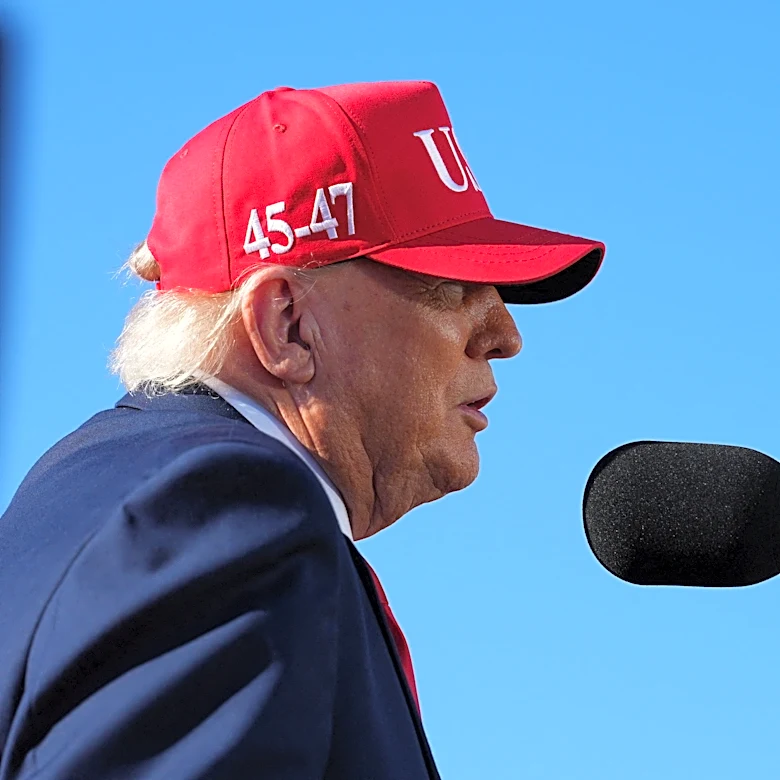
Trump's sliding approval ratings created a difficult needle for Rogers to thread — he's been an ardent supporter of the president since launching his first Senate campaign and appeared with him on the trail repeatedly in 2024. Rogers initially was supportive of the U.S. war in Iran, although he's recently said it should end. He's also previously defended Trump's tariff policies, but has since called for an end to the U.S.-Canada "tariff war" initiated by the president, which has led the two countries to raise import taxes on the other.
Michigan businesses, by the way, are particularly susceptible to the effects of those Canadian tariffs.
“There are tariffs that I think are too high and not good for us. We ought to get rid of those," Rogers said during the debate.
El-Sayed went after Rogers' stance, accusing the Republican of only pivoting his stance due to sliding poll numbers. For what it's worth, polling averages show a close race, though El-Sayed has led every poll taken in the race since mid-September.
“Weak, cowardly. Won’t stand up until his poll numbers drop," El-Sayed said.
Rogers did try to defend Trump's tariff policy while also calling for an end to the "tariff war" with Canada, arguing that manufacturing plants in Michigan have been able to add jobs and production because of them.
"He (El-Sayed) wants to undo it, because he can't see past his own political rhetoric," Rogers said. "We didn't change. What we said is, things move. We're trying to get it wrapped up. We want a deal on those tariff deals."
Contact Todd Spangler: tspangler@freepress.com. Follow him on Twitter @tsspangler.
This article originally appeared on Detroit Free Press: El-Sayed, Rogers snipe at each other in US Senate debate