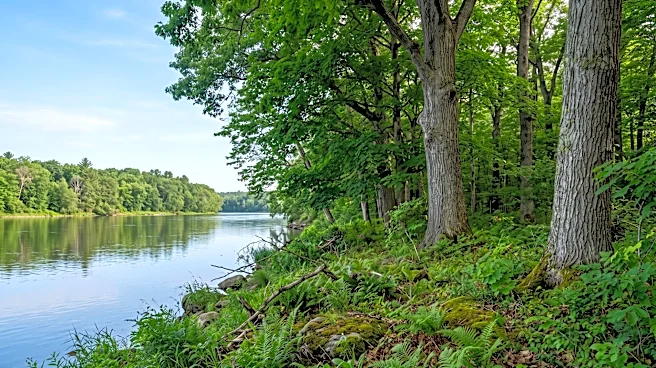







As Friends of the Rouge staff and volunteers conducted their last fish sampling of the year, at their last site to check on the Lower Rouge River earlier this month, what they saw in their nets caused a joyous outburst that caught the attention of passersby on the riverbanks.

"We were all screaming and so excited," said Lauren Eaton, monitoring manager for the nonprofit that works to promote and restore the Rouge River watershed. "And on the path along the river there were people walking by, seeing us react and saying, 'What did you catch? What's in there?'"
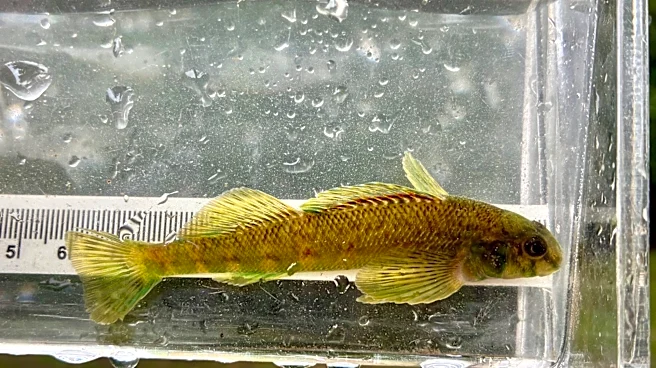
What was in there were multiple greenside darters. That's significant because according to state fisheries records, that little, 3-to-5 inch fish hasn't been seen in the Lower Rouge since
1924, more than a century. In fact, it hasn't been seen anywhere on the more than 125-mile Rouge River system since 1941.
The greenside darter is a species of freshwater, ray-finned fish from a species family which also contains perches and ruffes. It inhabits swift riffles − a shallow, fast-flowing section of a river or stream where the water surface is agitated and turbulent as it runs over coarse rocks, gravel, or boulders − in the eastern United States and southern Ontario.
Friends of the Rouge has conducted multiple fish surveys on different sections of the river every year since 2012. Using long, 12-foot-by-4-foot nets called seines, with floats at the top and weights at the bottom, surveyors place the net in a section of river, go upstream and agitate the river with their feet to drive fish into the net. The collected catch data is compiled and placed on the Friends website, and has been used in scientific research.
What makes the greenside darters discovery more mysterious is that it came on a section of river near Inkster and Dearborn that had been surveyed multiple times in the recent past, with no finding of the fish. "We think we would have caught them in the last few years if they were there," Eaton said.
"It's notable and it's really encouraging," she said. "The reason that we are finding them there is an improvement in water quality, because really nothing but water quality would have prevented them from being in the system. The Rouge was one of the rivers that caught on fire in the 1960s. We have worked very hard over the last decades to improve the health and improve the habitat."
John Buskiewicz, fisheries biologist for the Michigan Department of Natural Resources, oversees the Lake Erie Management Unit that includes the Rouge River watershed. He called the greenside darters discovery in the Lower Rouge a "rare find," and concurred that improved water quality and restored sediments and other habitat likely helped make it happen.
"Greenside darters are considered a biological indicator of water quality," he said. "They require clear, oxygen-rich water with rocky riffles in small to medium rivers with filamentous algae and aquatic vegetation. Their absence in the Lower Rouge River could certainly have been attributed to habitat degradation and pollution."
Eaton said when the Rouge was still heavily polluted, conservationists would joke with dark humor that fish entering the Lower Rouge from the Detroit River would "get a few gulps of Rouge River water and then just turn right around."
Historically the rouge had many species of darter, Eaton said. But before the recent discovery of the greenside, the Lower Rouge was down to only the johnny darter and rainbow darter.
Habitat improvement projects making a difference
Remediation projects on the Rouge River watershed in recent years have included:
- The Lower Rouge Old Channel project, completed earlier this year, the final phase of an $84 million cost-sharing partnership between the U.S. Environmental Protection Agency and Honeywell International, Inc. removed more than 100,000 cubic yards of contaminated sediment such as heavy metals, PAHs, and PCBs from the industrial navigation channel. It also included plans for installing 3,000 feet of seawall.
- Inkster Park Restoration: Backed by a $3.5 million federally funded project through the Great Lakes Restoration Initiative (GLRI) and managed by Wayne County Parks, this 17-acre initiative converts mowed lawn into diverse riparian and wetland habitats, removes invasive species, and replaces a flood-prone baseball field with a raised soccer field. Construction was started in 2024 and is slated for completion by the end of this year.
- Lower Rouge River Habitat Restoration: Bolstered by $4.2 million in Great Lakes Restoration Initiative funding provided by EPA in 2020, the Alliance of Rouge Communities undertook habitat restoration on the Lower Rouge River and wetland restoration in the Wayne County park system at Riverview Park, Sherwood Park, Bell Creek Park and Lola Valley Park. These projects were to help control invasive species, eliminate 10 debris jams which cause potential fish blockages and habitat degradation, create 10 fish habitat structures, and resulted in a total of 122 acres of restored habitat in the Rouge River Area of Concern. The alliance also worked on wetland restoration projects at Colonial Park and Venoy Park under a previous GLRI grant.
Species diversification improving on the river
Greenside darters can live 3 to 5 years, and spawning occurs in algae or moss-covered rocks in swift riffles, which coincides with the conditions where the fish were netted in the survey, Eaton said.
"The males have beautiful colors during the breeding season," she said. "They can be bright, bright green along their bodies and their fins."
Prior to industrialization, the Rouge River was home to 55 native fish species and nine non-native species, Eaton said.
"So the fact that we found 21 species (in our survey) at Ford Field Park in Dearborn on the Lower Branch is a wonderful thing," she said. "That diverse ecosystem is what you would expect to find in a healthy river. It's a testament to the rehabilitation of the river that's happening."
Friends of the Rouge offers frequent opportunities for members of the public to help protect and improve the watershed. To learn more, visit https://therouge.org/get-involved/volunteer/.
Contact Keith Matheny: kmatheny@freepress.com.
This article originally appeared on Detroit Free Press: A native fish not seen in the Lower Rouge River in a century is back