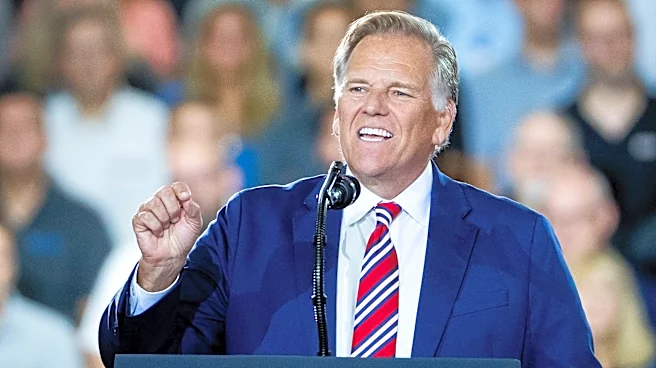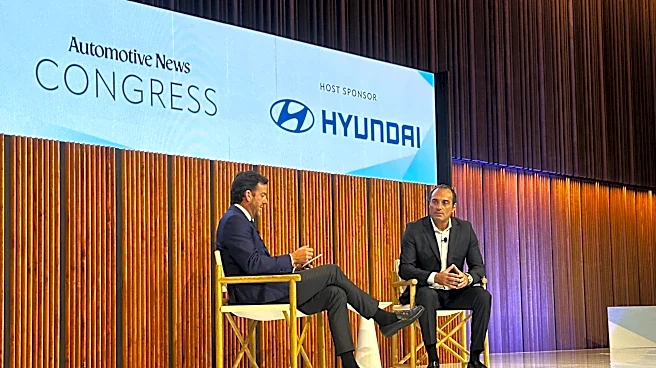





Antonio Filosa, the CEO of Stellantis, knows the automaker is in the middle of one of the industry's most closely watched turnarounds. On Wednesday, Sept. 30, Filosa expressed deep confidence in that turnaround before a crowd of hundreds in downtown Detroit.
Filosa, who took the helm of Stellantis — the parent company of Chrysler, Dodge, Jeep and Ram — in mid-2025 after the contentious tenure and resignation of former CEO Carlos Tavares, has been tasked with gaining market share and undoing mistakes made by former leadership that sank profits.
Chief among those mistakes, Filosa said, was the commitment to electrification that previously guided the company's strategy. The previous goals included lofty, EV-first ambitions that included a plan to sell
only electric vehicles in Europe by 2030.
Since Filosa took office, many of those goals have changed.
Under Filosa's leadership, Stellantis has reemphasized internal combustion engines (including the hearty, HEMI V-8, which it brought back to the Ram 1500 pickup lineup), unwound many of its electric vehicle projects, axed a few hybrid vehicles and promised to launch about 20 new vehicles in North America, many of which will be gas-powered.
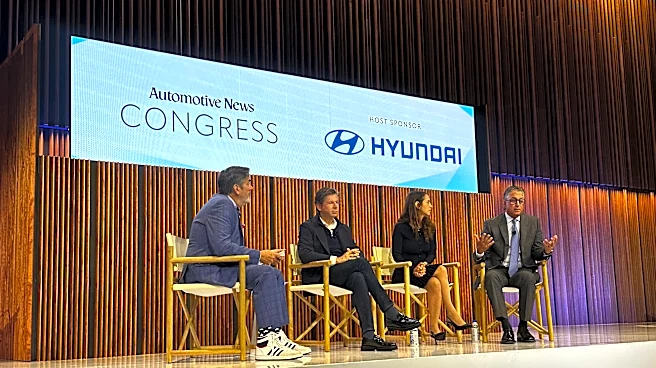
Filosa, speaking at the Automotive News Congress in Detroit, discussed the company's new direction and seemed confident the automaker would meet its 2026 financial targets of increased revenue and improved cash flow — no doubt an improvement over Stellantis' previous year, in which it posted a $26 billion loss.
How Filosa is trying to turn it around
Filosa paid some credit to the stark deregulation of the automotive industry put in place by U.S. President Donald Trump.
The Trump administration has significantly slashed fuel efficiency requirements that were essentially impossible to meet without an automaker offering at least a few EVs in its product lineup. Without those guardrails, Filosa said Stellantis can jump-start its rebound by focusing on producing vehicles that customers want.
"In listening to leaders and our customers, we understood that, if we keep doing what we were doing — so, producing electric cars — it was very important to offer also flexibility (for different powertrains)," Filosa said. "That is where the tweaks started happening, after we fundamentally switched our business model from being anchored, let's call it, to an ideology, to actually listening to our core customers."
That customer feedback focus is Filosa's plan in North America, an area he called the "fundamental region" for Stellantis where the automaker plans to make most of its money. Stellantis also does business in Europe, South America, the Middle East, North Africa and Asia.
But with more than 2,600 dealers in North America, Filosa is prioritizing the expansion of Stellantis' market share in the region.
To do that, he said, the automaker is going to offer a wider variety of vehicles.
"Our product offer today covers less than 55% of the market," Filosa said. "We will respond to the market; we will be touching more customers."
Stellantis set out this plan — to offer more vehicles and thus reach more customers — earlier this year at its investor day, when it did away with the automaker's previous goals of widespread electrification. The new vehicles coming include a new Ram ProMaster City van, three new Chrysler SUVs and two all new Ram trucks. Some of the new Chryslers, Filosa said, will start below $40,000, a price point in which Stellantis offers only one vehicle: the Jeep Compass.
What Filosa said a year ago
Just over a year ago, at a similar event for business leaders in Paris, Filosa gave a fireside chat where he made committments to bring back product (which Stellantis has done), hinted at a midsize Ram truck (now confirmed) and said he was anticipating changes to the regulatory guidelines on vehicle emissions that would make business easier for the Stellantis.
He was right to anticipate such news — on Monday, the Trump administration finalized a new set of rules regarding miles-per-gallon standards, which will no longer encourage automakers to rely so heavily on EVs. The Monday announcement was no surprise — it was effectively just a rubber stamp on a proposal to slash fuel efficiency requirements made months prior.
Nonetheless, Stellantis is using the greater freedom to continue making gas-powered cars that, Filosa hopes, people will buy and, in turn, return Stellantis to profitability.
KC Crain, the host of the chat and the publisher of Automotive News, asked Filosa what success looked like in the short term. Filosa immediately said that, by the end of the year, he is confident Stellantis will report an increase in revenue.
"As you know, in '25 we burned cash. We lost money," Filosa said. "No. 1 is to deliver on our guidance this year and we are completely confident — we are convinced that we will do that."
Liam Rappleye covers Stellantis and the UAW for the Detroit Free Press. Contact him: LRappleye@freepress.com.
This article originally appeared on Detroit Free Press: As Stellantis attempts rebound, CEO says he is confident in company