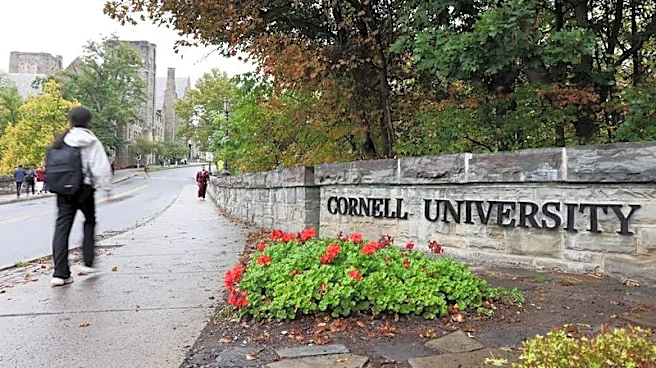







As you’ve likely heard by now, a former Cornell University student has filed a lawsuit alleging that in 2024, seven fraternity members drugged and sexually assaulted her over several hours, as a group text went out to fraternity brothers letting them know a woman upstairs in their own frat house was “free” for sex.
There is so much about this story that enrages me. As a woman in America. As a survivor of sexual abuse myself.
And let’s also look at the allegations involving the U-M hockey program. Sixteen former players are suing the university, alleging that sexualized hazing was part of the team’s initiation rituals for years. Their accounts,reported by the Detroit Free Press, describe abuse by their teammates and allege that the coaches and staff
knew enough to stop it. The university denies responsibility, and former coach Red Berenson declined to comment.
According to the lawsuit, players who said they did not want to participate in the hazing were told to “be a Michigan man” and “good teammates.” On Sept. 23, police responding to an anonymous tip found about 30 fraternity pledges ‒ most of them 18 ‒ in a filthy, hot basement near the University of Wisconsin-Madison.They were partially clothed, covered in food, condiments and liquids, and had visible injuries that police said were consistent with physical assault.
Of course, these cases involve different allegations and different forms of harm. But they raise questions about what people are expected to tolerate and what everyone around them is willing to excuse.
And I think about these lessons for a young man: If you want to be a part of the team or the group, keep quiet. Don’t complain. Don’t challenge the status quo.
What would you do if that text came to you?
When we talk about such acts, we focus on the people accused of perpetrating them. We don’t often talk about those who enable the abuse.
Since the Cornell story broke, what I can’t stop thinking about is the group chat. A message went out to 57 fraternity brothers offering sex with a woman in the house, and no one, it seems, came upstairs to ask what was happening, stop what was happening, or even bother to call the police. At U-M and Wisconsin, dozens of men knew what was happening.

That’s the part that has me gut-wrenched. How many men, who likely consider themselves to be good men, stayed quiet? How many men did nothing, enabling the harm to continue?
Which made me want to pose the question to readers here: What would you do if that message appeared in your texts? If those activities happened in your group?
Would you call someone? Intervene? Make sure others are safe? Or would you tell yourself it was probably a joke, that you didn’t know what was going on, or simply hope that someone else would handle it?
We tend to discuss sexual violence as though there are only two kinds of people involved: Those who cause harm, and those who are harmed. But there are also friends, fraternity brothers, teammates and coaches. People who hear something. People who see a warning sign. People who may not realize it, but are deciding whether the group’s comfort matters more than another person’s safety.
We’re socialized to avoid confrontation. To avoid calling out harmful behavior. A degrading comment often goes unchallenged. Written off as “just a joke.” When Donald Trump’s “grab them by the p---y” recording became public, it was dubbed “locker room talk” and he still went on to become the 45th president of the United States.I often think about what that asks us to accept about men, and how much we’re willing to let slide.
Responsibility belongs to the people who commit the harm. But people who witness the warning signs unfold also have choices.
Abuse isn't inevitable
If men want to call themselves good men, they need to be willing to have uncomfortable conversations with their friends. That includes asking why something is funny, why they’re defending someone’s behavior, or why a tradition that hurts people is still happening. Men need to hold other men accountable for both their actions and their words.
I wanted to do something, and that’s why I’m starting the C-50 Pledge. I’m asking men to speak up, and providing resources from RAINN and other organizations to help understand how. It exists to give people somewhere to start, with a commitment not just to speak up, but to get help and hold each other accountable.
I don’t know how much a pledge can change. But I do know that I want more people thinking about what they’ll do before they’re in a situation where someone’s safety depends on quick action in a socially complicated moment and I do want men to start having these conversations before intervention is needed.
I am tired of women having to share the worst things that have happened to us just to get people to care. And I’m tired of young men being told they have to put up with abuse if they want to belong.
Men have influence with their friends. I’m asking them to use it. Being a good man has to mean being willing to challenge another man, even when staying quiet would be easier. It’s time for men to understand that silence is permission.
Nikki Sapiro Vinckier, PA-C, is an OB/GYN Physician Assistant and the founder of Take Back Trust, a digital platform helping people navigate reproductive health care in this changing landscape. You can find her on social media @nikkivinck. Write a letter to the editor at freep.com/letters and we may publish it in print or online.
This article originally appeared on Detroit Free Press: Most haunting figures at Cornell, U-M hockey aren't perpetrators | Opinion