

I could teach an entire class at University of Michigan’s Gerald Ford School this fall on the U.S. Senate election in Michigan.
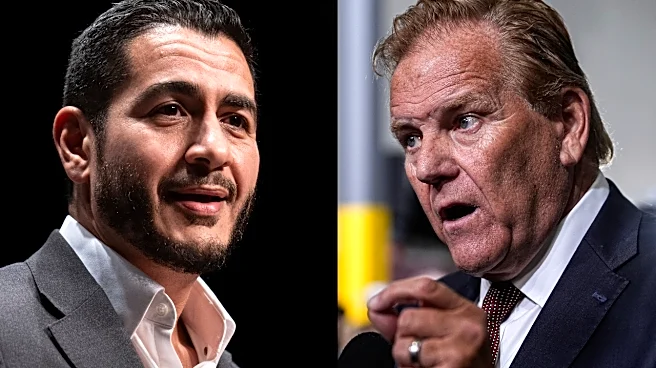
But while the outcome is very much in doubt, one thing is crystal clear – Republican hopes rest on Mike Rogers this November.
The 2026 election promises to be a blue wave, for several reasons. Most decisively, it is the midterm election in which Republicans hold the White House, U.S. Senate and House. That typically means a tough time for the party in power. In the previous midterm election in which Donald Trump was president, in 2018, Democrats gained 40 seats in the U.S. House and also added seven new governors.
While Secretary of State Jocelyn Benson cruised to victory in the Democratic gubernatorial primaryJTE5UL with
more than 80% of the vote, Republican John James struggled to crack 50% in his primary, even after securing Trump’s blessing. Barring some unforeseen event, Benson is an overwhelming favorite to win in November.
To avoid a complete Dunkirk all the way down the ticket, Republicans are pinning their hopes on Mike Rogers in the U.S. Senate race.
And with good reason. Two years ago, Rogers came within a whisker of victory, capturing 2,687,995 votes in his race against Elissa Slotkin, who won with 2,712,686 votes.
So Rogers begins the general election with a huge advantage – he does not need to win over any new voters. All he has to do is turn out the people who already voted for him in the previous election. Do that, and he stands a fair chance of winning, particularly if Democratic nominee Dr. Abdul El-Sayed underperforms Slotkin.
In addition, Rogers has three other factors in his favor.
The elephant in the state ‒ er, room
First, the Democratic Party is engaged in quite a fight over Israel, particularly because of the war in Gaza being waged by Israeli Prime Minister Benjamin Netanyahu. AIPAC, the American Israel Public Affairs Committee, and its affiliated super PACs spent roughly $60 million to defeat El-Sayed in the Democratic primary, and will likely do the same again this fall ‒ this time, in support of Rogers.
The second factor benefiting Rogers is that El-Sayed will have to reckon with racism.

We saw an example of this play out in the Republican primary in Michigan’s 8th congressional district. In that race, GOP candidate Amir Hassan was endorsed by Trump, and raised more than $700,000. Nevertheless, Hassan lost to a candidate, Tom Smith, who raised less than $2,000 and who had dropped out of the race a month before the election.
And the race wasn’t even close; Smith defeated Hassan 50% to 33%.
It’s hard to believe racism and bigotry did not play a role in well-funded, Trump-endorsed Hassan’s defeat.
El-Sayed has three short months to figure out how to navigate this insidious issue.
Republicans want to win
Rogers has one last arrow in his quiver: Control of the U.S. Senate. Democrats are desperate to regain control of the upper chamber and thwart the last two years of Donald Trump’s presidency. To do that, the party would need to add four seats.
But that strategy only works if Democrats hold all the Senate seats they now have, including the seat for which Rogers and El-Sayed are running, currently held by Democrat Gary Peters. If the Republicans can flip this seat from blue to red, then Democrats, realistically, have no chance of regaining control of the Senate.
The Republican Senatorial Committee in D.C. has figured this out, which is why they are all-in on Mike Rogers for Senate. They had already planned to spend $45 million in support of Rogers, and now that El-Sayed has defeated U.S. Rep. Haley Stevens in the primary, I expect that number to double.
Suffice to say, if you thought there were a lot of political ads on TV in the primary, you ain’t seen nothing yet.
If Rogers wins, it provides a huge lift to candidates down ballot, especially Republican attorney general candidate Doug Lloyd, running against Washtenaw County Prosecutor Eli Savit, and U.S. Rep. Tom Barrett in his 7th Congressional district race against progressive William Lawrence. A Rogers win would also provide significant air cover for Republican candidates running for state Senate and state House, who otherwise would be in danger of being swamped by any blue wave in November.
El-Sayed has a few things going for him
But it’s not all chocolates and puppy dogs for Rogers and the Republicans.
Dr. Abdul El-Sayed has several things going for him as well.
For example, 60% of voters disapproved of Trump in a poll by Civiqs this August. And polling averages reported by the Free Press show 59.9% believe America is on the wrong track.
Add to that the fact that Rogers, who has wrapped himself around Trump, must defend $4-a-gallon gasoline, higher grocery prices, a stagnant job market, home mortgage interest rates just under 7% and an increasingly unpopular war in Iran. Not to mention Trump’s tweets, tariffs and tantrums.
A tall order.
Black voters will play a decisive role
While El-Sayed’s struggles with the Jewish vote are well-chronicled, of even greater significance will be his ability to win Black voters. Haley Stevens dominated the Black vote in the primary, winning Wayne County and the city of Detroit by decisive margins.
Let’s be clear: There is no question that El-Sayed will win more Black voters than Mike Rogers, I’d guess with 90% to 10%.
It’s not the margin El-Sayed needs to worry about – it’s the turnout. How many Black voters will cast a ballot this November – 38%? 45%? 56%?
El-Sayed needs a huge turnout of Black voters in Detroit, Flint and other urban areas to offset Rogers’ strength out-state.
Slotkin popularized her strategy of “losing better” by driving up Democratic turnout in red areas of the state. El-Sayed needs a strategy of winning bigger, by driving up margins in blue cities and counties, much as Gretchen Whitmer did in her successful 2018 gubernatorial race.
Victory may rest on this obscure organization
Two years ago, Rogers lost this U.S. Senate race by 19,006 votes. This August, El-Sayed won the Democratic U.S. Senate primary by 15,697 votes. If the November election is that close, the Achilles heel in Rogers’ campaign plan risks being exposed – the state party.
State parties are the outfits that maintain voter lists, message the party faithful, then target and turn out supporters.
The state Republican Party is a shell of its former self, just recently selling its longtime Lansing headquarters due to a lack of funds.
Michigan Democrats have a much more robust and fully-funded state party to support their candidates, communicate to their voters and get out the vote.
In a tight race, this obscure and often overlooked organization could be the difference-maker.
Contributing columnist Rusty Hills is a past chair of the Michigan Republican Party, and is a lecturer at the Gerald R. Ford School of Public Policy at the University of Michigan. Submit a letter to the editor at freep.com/letters, and we may publish it online and in print.
This article originally appeared on Detroit Free Press: Michigan GOP has 1 path to survive a blue wave: Mike Rogers | Opinion