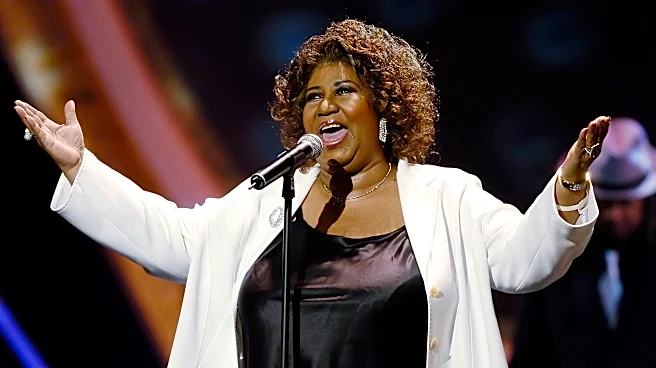




In summer 2023, when a Detroit-area jury ruled that a hand-scrawled Aretha Franklin document was a valid will, you’d have been forgiven for assuming the late Queen of Soul’s estate saga was at last nearing an end.
That sense of closure seemed even more definitive several months later, when Oakland County Probate Judge Jennifer Callaghan delivered her interpretation of the will and its division of assets among Franklin’s heirs, including four sons.
Yet today — eight years to the week since Franklin’s death — the probate battle continues to drag on, quietly but contentiously, playing out in a constant churn of legal filings and hearings in Callaghan’s courtroom.

Recent disputes include the fate of many reel-to-reel music tapes found in Franklin’s
home, some of them unmarked, along with video reels containing never-seen footage of iconic performances.
The fight has pitted brother against brother, namely the late singer’s youngest son, Kecalf Franklin, and her second-youngest, Ted White II, a musician known professionally as Teddy Richards. Attorneys for the two heirs did not respond to Detroit Free Press requests for comment.
Eldest sons Edward and Clarence Franklin have remained low-key, with no game-changing court filings in recent months.
All told, it's an unfortunate second life for a Detroit star widely regarded as one of the most important and beloved artists of the modern era — a woman whose groundbreaking work shaped the sound of popular music.
The conflict has now persisted longer than similar high-profile music estate cases such as Prince's, which lasted six years, though it has a while to go before matching the 15-year court fight waged among members of James Brown’s family after his 2006 passing.
As of this writing, the Aretha Franklin probate docket is brimming with more than 1,400 motions, petitions, briefs, rulings and other actions filed since her death on Aug. 16, 2018. At least a dozen lawyers are still active in the litigation, as seen on a recent order issued by the judge. Each of the sons enlists a music attorney and a personal attorney.

Callaghan was fairly new to the bench when she was assigned the Franklin case. Eight years on, she has risen to become Oakland County’s chief probate judge, occupying a courtroom at the opposite end of the building where news media regularly swarmed to cover the Queen of Soul proceedings during that initial phase.
The drama these days may not be as gripping as it was back then, when details first surfaced about the assorted furs, jewelry, cars and homes Franklin left behind. In 2019, the case was sensationalized in headlines around the globe by the sudden emergence of three apparent wills, including the one ultimately sanctioned by the jury: a 2014 handwritten document found tucked between couch cushions.
But the squabbling continues. Sons White and Kecalf Franklin continue to argue over finer points, such as the nuances of the will that prevailed at trial three years ago, still drilling down on their mother’s word usage, indentations and strikethroughs in papers that were signed "A. Franklin" with a smiley face.
Their disputes include the funding mechanism for their oldest brother, Clarence, who has special needs and is under guardianship. They’re also quarreling about copyright shares for Aretha hits such as “Dr. Feelgood” and “Think,” along with the review of hundreds of personal items housed in 11 storage units in metro Detroit, including a vintage Ford Thunderbird and Mercedes-Benz.
White has also objected to his brother Kecalf’s alleged unilateral installation of security cameras at the storage spaces.
One issue where the brothers have aligned involves a protest of legal fees submitted earlier this year by the current court-appointed estate executor, Andrew Mayoras, a Troy attorney who co-authored the 2009 wealth-planning guide "Trials & Heirs: Famous Fortune Fights!" and hosted the Reelz documentary series "Fortune Fights.”
A hearing on that matter is scheduled for Thursday, Aug. 20.
It’s one of the few topics to have unified the brothers in recent years. Perhaps the most notable was the licensing of their mom's 1968 hit "Think" for use by Kamala Harris in a 2024 presidential campaign ad, which they unanimously agreed to provide free of charge.
For music fans, the most intriguing current issue might be dozens of reel-to-reel studio tapes and video recordings possessed by Franklin, including some that were stored under a dining room table and in a bathroom at her Bloomfield Hills home.
Not all of the music reel boxes are notated, which means they may include anything from unreleased master recordings to working studio mixes, known as “runoffs,” dubbed by producers for her listening at home.
Meanwhile, the stored video archive includes a variety of unreleased shoots, including dress rehearsal film from Franklin’s famed 1998 “VH1 Divas” performance, footage of her 2003 concert at Freedom Hill Amphitheatre in Sterling Heights, and reels capturing her star-studded 1996 “Christmas at New Bethel” gospel event in Detroit.
In petitions filed this year, White contends the music and video reels are being housed in “less than adequate, low security storage,” and he wants them relocated to a facility “better suited” for preservation.
The judge is expected to rule soon on the tapes, including the possible appointment of a Nashville-based audio restoration specialist, Catherine Vericolli, to assess them.
Franklin's posthumous matters weren't always this chaotic. In the first year after the singer's death, her niece Sabrina Owens, a University of Michigan executive then serving as the estate's executor, seemed to be handling business efficiently and effectively.
Under Owens' watch, three major Aretha film projects were greenlit: the Jennifer Hudson-starring MGM biopic "Respect," the eight-part TV miniseries “Genius” with Cynthia Erivo, and the documentary "Amazing Grace," which chronicled Franklin's 1972 gospel bestseller of that name.
But the three wills, which Owens discovered and submitted to the court, soon shifted the vibe. They contained conflicting instructions about Franklin’s final wishes. Each version stood to benefit some heirs over others.
Owens resigned as executor in 2020, citing her frustration with the family animosity that exploded after discovery of the handwritten documents.
"I'm amazed it's still going on," said David Bennett, Aretha Franklin's personal attorney of several decades, who disconnected from the case after Owens' departure.
Under Michigan law, Franklin's sons had been set to receive an equal split of assets after her passing. But the discovery of the handwritten wills sent things haywire.
"At the very beginning, we said to everybody: 'We found (the wills), here they are, sit down and come to an agreement as to what they say,'" Bennett recounted this week. "Then they got attorneys. And for whatever reason, they just could not talk to each other anymore."
"Everybody wanted something to the exclusion of somebody else," Bennett added. "Which is the reason there is probate court."
Jennifer Rozelle is an Indiana estate attorney and the host of "Legal Tea," a podcast that regularly analyzes celebrity scenarios as examples — and precautions — for everyday folks. On the music front, she has explored the post-death situations of Jerry Garcia, Amy Winehouse, Lou Reed and others.
"It’s unfortunate, and it’s somewhat common," she said of the prolonged family battles that ensue after the deaths of high-profile figures.
"One of the things I like to mention is: A lot of people see these celebrity cases, including Aretha’s, and think, 'Oh, they have so much more money to fight about.' They think it’s not pertinent to what could happen to their family, and I challenge them to think quite the opposite."
While an eight-year probate saga like Franklin's would be exceptionally long in what she called "normal people land," it's not unprecedented, Rozelle said.
Eventually, some day, the judge will finally close the folder on Aretha Franklin's probate case, a resolution that will come when the bickering has stopped, the distribution of assets is agreed and — most notably in her situation — management of her music rights and royalties is permanently settled.
"If her estate is still open, that tells me all the issues aren’t resolved," Rozelle said. "And it can’t be closed until the assets in the estate are out of the estate’s name."
Contact Detroit Free Press music writer Brian McCollum: 313-223-4450 or bmccollum@freepress.com.
This article originally appeared on Detroit Free Press: Eight years after Aretha Franklin's death, estate saga quietly drags on