

Would you buy a vehicle made by a Chinese car brand?
If you said "probably not," you're right there with a group of a few dozen other people who were asked that question while at an annual seminar held by the Center for Automotive Research (CAR) in June.
Then, those folks rode in one and it changed their minds — sort of, some still had reservations around national security and geopolitical concerns.
Of course, the whole question is hypothetical at the moment. High tariffs on imported Chinese-made cars, put in place by former President Joe Biden and kept there by President Donald Trump, keep the sales of such cars offshore.

But as the Detroit Free Press reported in January, Canada is lowering its tariffs on Chinese cars and will soon allow a limited
number of the vehicles to be sold there. Mexico has allowed the sale of Chinese cars since 2020 and the Chinese brands now comprise 20% of the nation's total car sales. According to AlixPartners, Chinese car brands are expected to comprise 30% of the global new vehicle market by 2030.
Industry experts and automaker executives believe it is only a matter of time before Chinese cars will be sold in the United States.
In fact, U.S. automakers are already competing against them in global markets and with Chinese automakers seeing a 72% increase in global market share since 2020, according to CAR data, the worry is that the Chinese vehicles with their high-tech content and lower price tags — thanks to the Chinese government subsidizing their production — it will mean Chinese cars could overtake the U.S. auto market in a way that is similar to how Japanese small cars did in the late 1970s.

“China’s advantage is not simply lower costs, it is the result of a deliberate strategy built on scale, subsidies, supply-chain control, speed, excess capacity and global sales ambition," Elizabeth Krear, CEO of the Center for Automotive Research, told the Detroit Free Press. "U.S. automakers and policy makers need to understand the full competitive system, not just the vehicles that show up at the border."
Those were the key findings in CAR's new white paper, "China’s Automotive Surge: The Six ‘S’ Framework Underpinning China’s Global Competitiveness."
Or — as Ford Motor's Executive Chair Bill Ford said in July at an Axios event in the nation's capital: "We have to go toe to toe with China. We can’t expect to keep them out forever, and we have to be able to beat them at their own game.”
Ford's focus on beating the Chinese is so intense, it has even formed some alliances with Chinese automakers recently in other countries. But the alliances were enough to stoke the ire of U.S. Secretary of Transportation Sean Duffy on Tuesday, Sept. 8, who sent a letter to Ford expressing concern over Ford's relationships with Chinese companies and his dismay over Ford's lengthy timeline for bringing production of the Lincoln Nautilus from China to the United States. Ford leaders fired back andtold the Detroit Free Press the letter blindsided them because Ford has had an open dialogue with the White House.
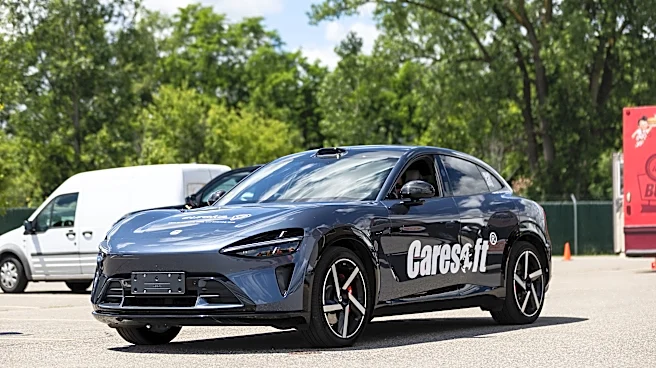
A Xiaomi YU7 luxury SUV
At CAR's annual 2026 Management Briefing Seminars in June, the organization decided to conduct a "Demo Day" in Ypsilanti. The idea was to see if firsthand exposure to a Chinese-made vehicle would change consumer perceptions and increase purchase interest for the 40 participants in the demonstration.
The vehicle they used for the demonstration test was a 2025 Xiaomi YU7 MAX fully electric midsize SUV. CAR had the luxury trim version, which starts at about $46,000. The car was all-wheel drive and can travel about 470 miles on a full charge. The demonstration was held at American Center for Mobility in Ypsilanti and it was sponsored by engineering and technology services company Caresoft Global, which provided the Xiaomi YU7 — pronounced: shy-ow mee yoo-seven.

If the car rings a bell, it should: Ford CEO Jim Farley has talked about it a lot. Ford has been studying the Chinese automakers for years and Farley drove a Xiaomi SU7, a full-size hatchback sedan, for many months as his personal car. He described the vehicle last fall in an interview as "high quality, great digital experience." He said he drives the Chinese car because "they're the competition and to beat them, you have to know them."
Last fall, as the Detroit Free Press reported, Farley gave a new warning about the Chinese competitors, characterizing their cars as an "existential threat" to U.S. automakers.
"They have enough capacity in China with existing factories to serve the entire North America market; put us all out of business," Farley said.
The test drive
Krear said the demo day, which was June 15, was a new component of the seminar and designed to complement the conference program with hands-on vehicle and technology demonstrations. The experience included select ride-and-drive opportunities on American Center for Mobility’s closed course outside of a traditional conference setting.
For safety reasons, Caresoft personnel drove the Xiaomi YU7 with up to three seminar attendees riding as passengers. The Caresoft team went over the vehicle’s technology, design, and features with the passengers.
The conference attendees who participated in the demonstration ride are professionals connected to the automotive and mobility industry, including those who work for automakers, suppliers, technology companies, government, research, and other industry organizations, Krear said. Still, only eight of the 40 people had previous experience riding in a Chinese-branded vehicle.

Before riding in the vehicle, the participants were asked to rate their interest in purchasing a Chinese branded car. They rated it on a scale of one to five, five being the most interested. The participants on average rated their interest at 1.92.
After riding in the vehicle, when asked to rate their interest in purchasing a Chinese branded car, the score rose to 2.68, a 40% increase, CAR reported.
Krear said the participants were impressed by the vehicle's amenities, digital integration, ride quality, performance, and finishes.
Krear said the ride in the Xiaomi made "their willingness to consider one go up. But they also still had a concern because the questions ... on the consumer mind are: Is this something that is a level playing field? Should I be supporting Chinese manufacturers?"

There were some concerns over national security and data collection by a Chinese company, too, Krear said.
"There's policy in place right now to protect against that with some of the software," Krear said. "I think that even if we did allow Chinese manufacturers, if that playbook changes in the future, there will still be regulations around some of the cybersecurity and electronics communications."
Can U.S. automakers compete?
While Farley and Bill Ford have concerns about the Chinese-branded cars' threat to the U.S. auto industry, Krear said the Detroit carmakers have the goods to compete against Chinese automakers. For one thing, there is brand loyalty among U.S. car buyers, especially in the segment of the best-selling vehicles that U.S. automakers build: pickups.
Also, Detroit carmakers have well-established dealership networks that have built customer relationships and can readily provide vehicle service. If the Chinese carmakers did enter the United States, it would have to establish a dealership network from scratch.
"U.S. brands absolutely have a competitive edge," Krear said. "So not only is it the brand that consumers have grown to know and love and trust. But it is also really having that dealer network within their community that they can leverage. Obviously, China does not have that dealer network now, and that will also take years."

Marketing expert David Vaucher, founder and managing director of Vaucher Analytics, a strategy consulting firm which helps legacy automakers be more competitive against Chinese vehicles, said Detroit automakers should borrow a play from luxury brands such as watchmaker Rolex — that is to create a story and heritage around the brand that makes it so special that people will want to pay a premium for it.
"That's the advantage. China does not have decades of built-up heritage, but you sometimes wouldn't know that," Vaucher told the Detroit Free Press. "If I'm Ford, I'm hammering this over and over and over again that, 'Hey, we build cars in America. We've been around with your grandparents. We've gone racing.' You make boutiques, you send race cars to the dealerships. You make it so that a customer says, 'I'm buying history here. I'm not just buying a car.' "
Ford has been doing quite a bit of that lately. It has hammered home the idea that it builds more cars in the the United States and employs more factory workers than any other automaker and it continually reminds the world Time named Ford the nation's most iconic company in January.
Also, as the Detroit Free Press reported on Aug. 24Ford opened its first-ever public retail store at its transformed World Headquarters campus on Oakwood Boulevard in Dearborn. The store will allow employees and the public to buy Ford-branded merchandise. Attached to the store is an area that will offer immersive experiences and exhibits about Ford's heritage and its racing history.
Beyond the marketing, Krear said U.S. automakers have the "innovation, engineering talent, manufacturing capability and brands to compete with anyone in the world."
"We should lean into those strengths, continue to innovate, and leverage the North American supply chain and common parts to use capital more efficiently and improve competitiveness," Krear said.
On top of that, she said, U.S. automakers must continue to work with government policymakers to ensure they compete on a fair playing field, not against the subsidies the Chinese government provides allowing them at lower prices.
Jamie L. LaReau is the senior autos writer for USA TODAY Co. who covers Ford Motor Co. for the Detroit Free Press. Contact Jamie at jlareau@freepress.com. Follow her on Twitter @jlareauan. To sign up for our autos newsletter. Become a subscriber.
This article originally appeared on Detroit Free Press: How a demo drive in Ypsilanti changed some minds about Chinese cars