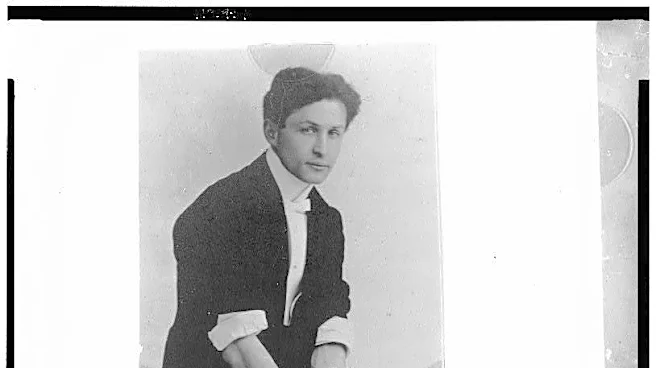







He was a vaudeville performer from the late 1800s and early 1900s — a time of no Internet, no TV and not even radios for most Americans. Yet say his name in 2026 and most everyone, young and old, know about the Hungarian-born immigrant who became an American legend: Harry Houdini.
This Oct. 31 marks the 100th anniversary of magician, illusionist and escape artist Harry Houdini's death in Detroit, marked by events in the Motor City and around the world — including a Halloween seance to (once again) attempt to reach Houdini from beyond the grave.
"It's fascinating that a full century after his death, Houdini is still the go-to magician reference," said Jeremy Dimick, director of Collections and Curatorial for the Detroit Historical Society.
"From
a sports perspective, Houdini's name comes up all the time — every time a quarterback escapes from the pocket; anytime a relief pitcher gets out of a bases-loaded jam, they call him Houdini," said Joe Posnanski, a journalist and author who wrote the biography "The Life and Afterlife of Harry Houdini" in 2019.
As Detroit arose as a great American city at the start of the 20th century, an automotive superpower and the global epicenter of the second Industrial Revolution, Houdini rose to become one of America's and the world's most iconic performers. The escape artist and magician had a more than 30-year relationship with Detroit, performing there 19 times, from a bottom-of-the-bill unknown to headlining the marquee after gaining global renown.
Some of the more legendary escapes of Houdini's career came in Detroit — including emerging from shackles after a November plunge from Belle Isle bridge into the Detroit River in 1906 and writhing out of a straitjacket while dangling from his feet off the roof of the Fyfe Building in Grand Circus Park in 1922.
"Houdini had a very close relationship with many cities, but I think Detroit is second to none when it comes to those cities," Posnanski said.

And it was in Detroit on Halloween 1926 that Houdini's death-defying career came to a sudden — and some say, mysterious — end. He died of complications from a burst appendix and severe infection that may or may not have been caused or worsened by a college student's punch to his stomach in Montreal, Houdini's performance stop before Detroit. The story goes that Houdini, among many challenges, claimed his strong stomach muscles could withstand the punch of the strongest man, and that J. Gordon Whitehead, a student at McGill University in Montreal, punched Houdini in the stomach before the magician was prepared.
Was that really the fatal blow that brought about Houdini's death days later in Detroit? As with all things Houdini, the circumstances are shrouded in a puff of magician's smoke, facts swirled with myths, legends, half-truths and exaggerations.
A child immigrant who grew up in poverty
Born Erik Weisz (later spelled Ehrich Weiss) in Budapest, Hungary, in 1874, Houdini was the son of a Jewish rabbi who brought his family to America when Houdini was 4 years old, seeking opportunity and escaping anti-Semitism. The family settled in Appleton, Wisconsin, and endured tough economic times.
Drawn to performing and the circus life from an early age, Houdini at 9 years old performed trapeze and contortion tricks in a local neighborhood circus in Appleton, billing himself as "Ehrich, Prince of the Air." When Houdini was around 11 years old he took an apprenticeship with a locksmith in Wisconsin, helping him develop an understanding of internal lock mechanisms, how they worked and how to open them.
Houdini ran away from home in 1886 at age 12, hopping a freight car out of Milwaukee due to his family's severe poverty and with a desire to ease the burden on his parents. He traveled and did odd jobs, making his way to New York, where his family later came and reunited with him.
Around 1890, during his teenage years, he read the autobiography of French magician Jean-Eugene Robert-Houdin, and the book turned Weiss' casual interest in magic and performing into an obsession. As he sought out magician's work he took the stage name Houdini, mistakenly believing adding the -i to the end meant "like Houdin" in French. He chose Harry as the first name as an alliterative, Americanized version of his nickname, Ehri.
Houdini performed locally with a friend and co-worker for a few years, and later with his brother, Dash, as The Brothers Houdini. But then Harry married Wilhelmina Beatrice "Bess" Rahner in June 1894 and she became his permanent stage partner, calling themselves The Houdinis.
"When he first got into magic he was doing all the same tricks everybody else was doing," Dimick said. "He was doing a lot of card magic, making birds disappear — not literally pulling rabbits out of a hat, but that sort of magic."
Performing in Detroit for the first time, as the handcuff escapes evolved
It was at this time, in 1894, that The Houdinis brought their act to Detroit, performing card tricks and simple magic.
"In those days, if he's billed at all, he's all the way down at the bottom of the bill," Dimick said. "In Detroit, he's playing these spaces called the Curio Hall at the Wonderland Theater. The Curio Hall was just a bunch of acts literally in a hallway. They were in these little recesses and people would walk past all of these acts going on in the Curio Hall to get to wherever else they were going in this Wonderland Theater complex. People would wander by and watch or not."
Performing in those spaces meant Houdini was doing his act on the hour, every hour, all day, Dimick said, adding: "It was tough work, but it was really good for somebody in his position where he's honing his craft and trying to move up in the world."
While touring with a small circus, Houdini started putting to use his gathered knowledge of locks and how to pick them, combined with his physical dexterity, and began incorporating handcuff escapes into his act. It was different, and it started getting people's attention.
"The popular attraction in the bijou theater is the Houdinis, in a very clever sleight-of-hand performance, including the box mystery and the slipping off his wrists by Harry Houdini of any pair of handcuffs," the Detroit Free Press wrote in the middle of a small blurb highlighting that week's performers at Wonderland on Sept. 21, 1897.
Houdini would promote his ongoing theater engagements by getting himself in the news, performing handcuff escapes for local police departments. The Free Press that September in 1897 recounted Harry Houdini visiting Detroit Police Department headquarters at the invitation of Superintendent John Martin, where he gave an exhibition on freeing himself from handcuffs for detectives.
"No cuffs were too new or too old for Houdini to remove from his wrists, when permitted to step out of sight a few moments," the Free Press reported.
"Three pairs were put on him at once, all of different makes, and he took them off in about three minutes. It was suggested that he must have keys for the cuffs concealed on his person, whereat he allowed a pair of handcuffs to be locked on his wrists and the key holes to be sealed and marked so that they could not be tampered with without evidence of it appearing. He removed those as quickly as the others.
"Capt. McDonnell had an old pair of cuffs used in 1812. One of them was locked and he had lost the key for them. 'I will unlock that for you if you wish,' said Houdini. Stepping out of sight for a moment, he returned with the cuff open."
"The officers were very much interested in the performance, and Supt. Martin declared it was a good object lesson. 'I have no faith in handcuffs,' said Houdini. 'Any man who will study them sufficiently can remove from his wrists any handcuff ever made.'"
Three days later, on Sept. 28, 1897, the Grand Rapids Press reported Houdini doing the same handcuff-escaping exhibition for the Kent County Sheriff's Department — again getting viral promotion for his local theater stint.
"The young magician has little to say of his method of getting away from the cuffs," the paper reported, quoting Houdini: "'It is not sleight of hand, it is not picking the locks as you can see by the untampered seals over the key holes, and there is no magic about it. I have simply made a study of handcuffs and I have learned a trick to get out of all of them as fast as I want to. That is my business and I make my living by keeping my secret to myself.'"
Career-altering advice, a trip to Europe, and fame
Martin Beck, the co-founder and head of the prestigious Orpheum vaudeville circuit, encountered Houdini struggling in a beer garden and dime museum in St. Paul, Minnesota, in 1899. Beck gave Houdini a big break, booking him on Orpheum's high-end vaudeville circuit, and some career-altering advice: Ditch the conventional magic act and stick with the escape artistry.
Beck booked Houdini on a tour of Europe in 1900. But Houdini arrived in London in May to find no bookings and little interest in his act. So to convince theater owners that his escapes weren't a gimmick with fake handcuffs, he did what had brought him viral attention in Michigan and other U.S. states: Houdini arranged to escape from handcuffs at Scotland Yard.
According to historical accounts, Superintendent William Melville, the head of Scotland Yard's Special Branch, handcuffed Houdini around a stone pillar or to a piece of furniture, mockingly stating that British cuffs were the "last word in scientific manacles" and could not be beaten. Within a matter of minutes, Houdini slipped free from the handcuffs and presented them back to a baffled Melville.
Impressed by the demonstration, C. Dundas Slater, manager of London's prestigious Alhambra Theatre, immediately booked Houdini. The Scotland Yard stunt generated massive word-of-mouth and press attention, transforming Houdini from a jobless American performer into an overnight sensation. His initial short run at the Alhambra was extended into a highly lucrative six-month engagement, launching his career as an international superstar.
"Houdini was a genius at self-promotion," Posnanski said. "Every time he would do something in Europe, he would send word back home and it would appear in the papers: 'Our guy Houdini is wowing them in Munich.' And when he came home, it was, 'The toast of Europe, Harry Houdini.' He was beginning to make a name for himself in the U.S., but he never would have become the Harry Houdini we all know now if not for his time in Europe."
A viral marketer a century ahead of his time
In the summer of 1905, Houdini returned to the U.S. from Europe a far more renowned entertainer than when he'd left. He booked performances with the prestigious B.F. Keith string of top-end theaters throughout North America, including the Temple Theater in Detroit — "the vaudeville destination in town," Dimick said.
The Nov. 23, 1905, edition of the Detroit Free Press includes letters back-and-forth between Houdini and officials with Partridge & Blackwell, a prominent packing and shipping company in Detroit.
"Gentlemen," wrote Houdini:
"Having heard that the packers and shippers of Partridge & Blackwell are skeptical regarding my having escaped out of packing cases into which I have been nailed by expert builders and packers, and that your packers claim it would not be possible if they were permitted to do the nailing, I hereby challenge them to produce an ordinary packing case of one inch lumber and three-inch flat headed wire nails, into which they can nail and rope me up, the attempt to take place at the Temple Theater Friday afternoon, Nov. 24. Should they succeed in preventing my escape, it will be my first defeat. Signed, Harry Houdini."
Partridge & Blackwell's response was also published: "We beg to accept your challenge, and have selected several of our most efficient men to construct the box and to do the nailing and the roping."
Houdini, of course, escaped from the crate at that Friday's performance at the Temple Theater.
At a later engagement in Detroit, Houdini similarly accepted the challenge of another packing company that stated it wouldn't fail as Partridge & Blackwell had.

"Houdini really mastered that," Dimick said. "He really figures out to blow up the idea of crowd work, of crowd involvement — working local officials, local businesses and local landmarks into all the stuff he does to make it feel really relevant, really personable and relatable to the people in a town.
"Those packing crate escapes, that could be your neighbor. So then it's, 'I've got to go see this guy; my buddy's going to build the crate and then the magician is going to try and break out of it.' It's really smart."
On a later tour, the Detroit Creamery Company challenged Houdini to escape from its large, sealed milk bottle, and they would bring the milk to put inside.
"So the Detroit Creamery Company brought a full team of horses and a delivery wagon and parked it right in front of the theater," Dimick said. "The businesses figured it out too, this symbiotic relationship where people would be willing to play along with Houdini if there was something in it for them as well."
Said Posnanski, "He was 100 years ahead of his time when it came to promoting himself."
An icy plunge off the Belle Isle bridge into the Detroit River - or was it icy?
As imitators of Houdini's handcuff escapes began to emerge, he worked to stay ahead of the pack. One of Houdini's most famous stunts ever came in Detroit. On Nov. 27, 1906, with a throng of thousands watching, Houdini plunged 25 feet off the Belle Isle bridge into the frigid waters of the Detroit River, wearing two pairs of police handcuffs.
"The funny thing is, it was completely free," Dimick said. "They didn't charge anybody to come and see this; it was just promotion for his actual show at the Temple Theater. So again, a viral stunt to draw attention to his actual paid performance."
The Detroit Free Press reported that Houdini with a flourish made out his will prior to the jump in the Detroit River.
"Houdini first stripped himself of all clothing except his trousers," the Free Press stated on Nov. 28, 1906. "A life-rope 150 feet in length was attached to his body, one end being fastened to the bridge. Then the cuffs were placed upon the intrepid man's wrists and securely locked. Houdini shivered in the raw wind as he stood upon the railing of the draw. He looked determinedly at the tumbling waters twenty-five feet below, yelled a reckless 'Goodbye' to the awe-inspired throng and dived headlong to his fate.
"Soon his head appeared above the surface of the water, but only for a moment. He dived again, and the crowd held its breath, fearful of the result. Suddenly one of the wizard's hands appeared free above the surface. Then came the head and the other hand, and cheer upon cheer arose from the eager mass of persons on the bridge.
"Houdini was picked up by a waiting boat and brought ashore where he was besieged by a host of spectators who insisted upon showering him with congratulations."
The Free Press further reported Houdini that afternoon performed his regular show at the Temple Theater, escaping from a packing crate.
In Houdini's later retellings of the Detroit River escape, he claimed he entered the water from a hole cut in the ice, then floated away from the hole. Trapped under the ice, he survived by finding small air pockets as he freed himself and finally found his way back to the surface. This account made it into early Houdini biographies and was famously portrayed in the 1953 movie "Houdini" starring Tony Curtis and Janet Leigh.
There's one small problem with that account.
"There was no ice in the Detroit River," Dimick said. "It was definitely cold, because it was November. But at the museum here we have the Lake Carriers Association books, which keep track of the shipping season, when boats could get through and when boats couldn't get through. And there were boats going through the Detroit River until December of that year.
"I don't think Houdini ever let the truth get in the way of a good story."
Houdini "absolutely mastered" the publicity machine around making himself famous, Dimick said.
"He did such a good job of blurring the lines between reality and magic, of living in that margin where you never know really what is true and what is false about him," he said. "And if you get into that zone, well, anything could be true. Maybe he did exist under ice on a river for a half an hour, and swim all the way down to where the Ambassador Bridge is now before he was discovered."

Taking his act over the edge in Grand Circus Park
Temple Theater house manager C.G. Williams gave Houdini "a handsome loving cup, made of live oak with silver bands and silver handles. It is inscribed, 'To Harry Houdini, from the management of Temple Theater, for breaking all records of attendance. March 14, 1908,'" the Detroit Free Press reported that month.
Houdini's prime was a perfect pairing with evolving life in Detroit, Dimick said.

"It's a really unique time period for the city," he said. "It's this transition from only having leisure time one day a week, on Sunday. Because of the eight-hour workday and five-day work week that's coming along with a lot of the factory work that's coming online right after the turn of the 20th century, there is suddenly this time available for people in an urban setting to have fun on weeknights also, because they are out of work at 5 p.m. or 6 p.m. Now suddenly you have all this time where you can go take in a show or can go to a Tigers game.
"Because of the shift work becoming so prevalent in the city, it creates a really unique environment for the Detroit audience to latch onto vaudeville. At least in that sense, we were way ahead of the curve."

Houdini's Detroit appearances became more sporadic entering the late teens and the 1920s, as he spanned the globe performing. A Detroit Evening Times article in January 1915 noted Houdini was returning to the Temple Theater "after a three years' tour around the world."
Houdini began shifting his focus away from full-time physical escapes toward writing books and entering the film industry around 1918.
"He gets into movies and starts reasoning that, I could do a stunt once in a movie and then they just show it over and over again in thousands of cities throughout the country," Dimick said.
In one of Houdini's signature stunts, he escaped from a straightjacket while suspended from his feet over the roof of the 180-foot Fyfe Building in Detroit on Oct. 9, 1922 — yet again a free performance to promote what was actually paying him, the showing of his new movie "The Man from Beyond" at the nearby Madison Theater. The Detroit Free Press reported that 40,000 people crowded into Grand Circus Park to watch the escape.
"By 1922 he was already at the pinnacle of his fame," Posnanski said. "When Houdini came to town, it was much bigger than the circus coming to town; t was the most famous person in the world coming to your town. People would go out and be like, I'm going to tell my grandkids one day that I saw Harry Houdini escape from a straitjacket. By then he was enormous."
Debunking spiritualism, mediums became a Houdini priority
By 1924, Houdini had shifted much of his attention to debunking spiritualism, a religious and social movement based on the belief that the spirits of the dead continue to exist and can communicate with the living, typically through a medium during seances.
"There is a strong theory that I've come to agree with that Houdini would have loved to find a way to break through that wall and talk to people who had passed," Posnanski said. "But in his experiences, what he found was that the people that were doing these seances were con men and con women. They were fooling people. He could see how they were doing it, and he learned what tricks he didn't know."
Houdini had learned many of the medium's tricks during his years with traveling circuses, Dimick said.
"It really rubbed him the wrong way that they were taking advantage of people that way, preying on extremely desperate people and extracting money from them," he said.
Houdini's performances in the last years of his life would be a bit of his magic and escape act to get the audience in the door, along with a lecture debunking spiritualism.
"The medium community hated Houdini," Posnanski said. "He was out there every day just exposing and debunking their work, and he had a much, much larger platform than any of them."

Less than a month after his death, on November 21, 1926, the Detroit Free Press in a eulogizing column noted the importance of Houdini's war against spiritualism scams:
"While he was among the most interesting entertainers of his age, his greatest service no doubt was in exposing those who attributed their magic to Divine guidance and imposed on a credulous public. He was the nemesis of all such, and they came to fear him, for all magic dissolved before his scrutiny. It is regrettable that he failed to leave a record of his discoveries to serve as a check on future imposters."
Montreal, the stomach punch, and an ill Houdini
Like his best escapes, the circumstances of Houdini's illness and eventual death in Detroit leave people grasping for understanding and not quite finding it.
Houdini performed a week-long engagement at the Princess Theatre in Montreal from Oct. 18-22, 1926.
The Detroit Free Press' story after Houdini's death on Nov. 1, 1926, reported:`
"He [Houdini] attributed his fatal illness to two blows to the pit of the stomach given him by a student at McGill university, Montreal" on Oct. 22, before his final Montreal show.
"Two of them visited him at his dressing room in Montreal and asked Houdini if he, as a magician, would feel a blow in the stomach. 'Certainly not,' Houdini replied. Before he was aware of the boy's intentions and before he could brace himself, one of them gave the actor two short-arm punches in the stomach, it is said."
The alleged puncher was later identified as McGill University student J. Gordon Whitehead. In a sworn affidavit he gave for the New York Life Insurance Company in March 1927, Whitehead admitted punching Houdini in the stomach in his dressing room, but said it was at the magician's behest, during a conversation about the strength of his stomach muscles.
"I struck Houdini quite moderately and he smiled and laughingly said – 'Why, hit me!' I hesitated and he repeated – 'Hit me,'" Whitehead stated in his deposition. "I struck him a second blow slightly harder than the first, – he gave not the slightest indication of any discomfort at either of the blows. Both blows were struck on the left side of his body and above the navel."
Whitehead stated he conversed with Houdini again on two occasions the next day. "Houdini did not on any of these three occasions refer to the incident of my blows as having incommoded him in any respect, or caused him any pain," he said.
Backus, the Princess Theatre manager, expressed skepticism that the college student’s punch caused Houdini's death, noting that Houdini was visibly in poor health before he ever stepped foot in his Montreal dressing room. But Sophie Rosenblatt, a nurse traveling with Houdini's tour to tend to health conditions of Houdini's wife, said in her sworn deposition that Houdini didn't exhibit signs of stomach pain or illness until after Whitehead's stomach punches.
"[Houdini] stated that it was the first time in his life the blows really hurt him and he twinged," Rosenblatt testified. "He stated that he was lying down when the blows were struck and that he was not prepared for them."
Houdini struggled through the last Montreal show on Oct. 22, and on the train ride to Detroit took a turn for the worse. Rosenblatt had Houdini's manager, H. Elliott Stuckel, arrange for a doctor to meet them when the train arrived in Detroit. Houdini had a temperature that rose to near 104 degrees.
Despite his health crisis, Houdini went on with his opening performance Oct. 24 at Detroit's Garrick Theater.
"He has chances to go to the hospital between getting off the train that morning and the show that night, but he's just trying to soldier through it because there is a clause in his contract: If the theater goes dark, he's going to have to pay the theater money for the revenue they lost by canceling the show," Dimick said.
Houdini labored through his full, two-hour show with intermissions between three acts. By the show's conclusion, Houdini could barely walk and was taken to Detroit's Grace Hospital, at the corner of Willis Avenue and John R Street.

Houdini spent the next week in the hospital, with daily media reports expressing optimism for his recovery. As the week progressed, however, the outlook turned grim. On Halloween, Sunday, Oct. 31, 1926, Houdini died. He was 52 years old. Houdini's death certificate later listed his cause of death as streptococcal peritonitis from a ruptured appendix.
"Harry Houdini came Sunday to the one shackle he could not fathom in life. He died in Grace hospital at 1:30 o'clock yesterday afternoon after a week's illness," the Detroit Free Press said in the lead paragraph of its story reporting on Houdini's death.

Dimick expressed skepticism that the college student's stomach punches brought about Houdini's illness and demise.
"If you take as true that he got punched in the stomach and it ruptured his appendix, wouldn't boxers or MMA fighters or even football players constantly be having their appendix ruptured by blows to the stomach?" he said.
Dimick noted that the depositions came as part of an insurance company's investigation as Houdini's wife sought compensation.
Said Posnanski, "I think there is a very good chance that Houdini did not connect with what was really happening to him, the peritonitis and the thing that eventually killed him — that he connected it to the punch and refused to acknowledge it."
Houdini is buried - and the attempts to contact him commence
Houdini’s body was embalmed at the W.R. Hamilton & Company Funeral Home in Detroit and placed into a specialized, airtight bronze coffin with a glass lid that he had recently commissioned for an upcoming "buried alive" stage stunt.
On the evening of Nov. 1, 1926, the coffin was taken to Michigan Central Station and placed aboard a train to New York. Accompanying were Bess Houdini along with two of Harry's brothers, a sister, a niece and Luther E. Goble, manager of the Temple Theater where so much of Houdini's Detroit lore unfolded.
Houdini's funeral was held on Nov. 4, 1926, at the Elks' Clubhouse on West 43rd Street in New York City, and he was buried in Machpelah Cemetery in Queens. More than 2,000 mourners filled the venue to pay their final respects.
During Houdini's funeral service, a member of the Society of American Magicians, a group for which Houdini had served as president for several years, stepped forward and symbolically snapped a wooden magician's wand in half. The ceremony signifies that the magician's earthly powers have ended and the magic spell is broken. During the breaking, a formal recitation was spoken: "The curtain has at last been rung down. The wand is broken."
Not even a week after Houdini's death, the Detroit Free Press was reporting prominent mediums who declared they would attempt to contact Houdini in the great beyond. Houdini had reportedly established a code with his wife so that she would know if it was actually him speaking to her or yet another scam artist's trick.
"You could see them lining up after Houdini died: 'I'm going to be the one that's going to contact Houdini' — and now there's no rebuttal from Harry," Posnanski said.
Bess Houdini embraced the attempts as well, Dimick said.
"She still had to make a living," he said. "She kind of played along with it, with these official Houdini seances."
In a live broadcast on the 10th anniversary of Houdini's death, from the roof of a hotel in Hollywood, Bess Houdini and a group of magicians made another attempt to contact Houdini, without success. Bess declared that if he didn't communicate with her within 10 years, it was never going to happen.
Houdini's a cultural touchstone to this day
This Halloween, at the American Museum of Magic in Marshall, at the exact time of Harry Houdini's death, museum and community officials will hold another seance attempting to contact the long-past escape artist. Near them will be some authentic items from Houdini's act, including handcuffs and a "spirit horn" he used. A kosher bagel with lox and cream cheese will be lowered into a milk jug from which Houdini used to escape, with participants hoping for a bite of the sandwich, a toot of the horn, any sign that Houdini is there.
It's the third such attempt to contact Houdini at the museum, following a 1978 seance by museum founder Robert Lund and an event to mark the 90th anniversary of Houdini's death in Detroit in 2016.
Why does a vaudeville performer from more than a century ago so endure in the modern American culture?
"Houdini's performances were about escape," said John C. Sherwood, a member of the American Museum of Magic's board of directors.
"It was about dealing with problems and fighting back; the metaphor of being chained up and locked into something that one couldn't escape from — and yet he would escape, he would triumph. That theme of fighting back against oppression resonates down through the ages."

Houdini was an immigrant with very little formal education who overcame prejudice and poverty to achieve wealth and global renown.
Said Dimick: "Houdini himself would have loved the idea that people are still talking about him a century after he died."
Contact Keith Matheny: kmatheny@freepress.com.
This article originally appeared on Detroit Free Press: 100 years ago this Halloween, Houdini could not escape his death in Detroit