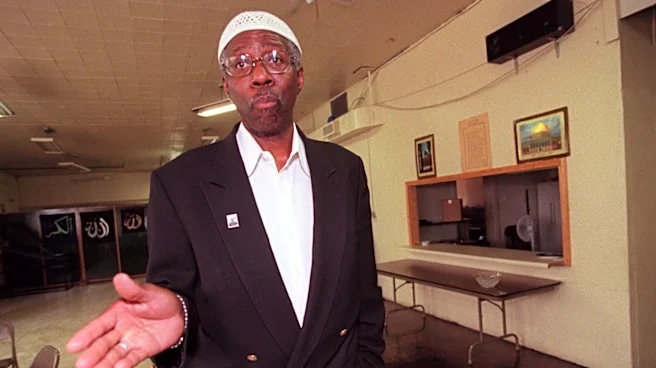






Tall and soft-spoken, but firm in his beliefs, the late Imam Abdullah El-Amin of Detroit was known for his interfaith work and bridge building. And now, there's a Detroit street sign honoring him with his name outside the mosque he cofounded and led, the Muslim Center.

The sign, which reads "Imam A. El-Amin Way," is on Woodrow Wilson Street at the intersection of Davison Avenue, sitting above a street sign with the name of the former president. The blue street sign was approved in 2025 by the Detroit City Council, which honors community leaders with street signs named after them. Family members and supporters of El-Amin recently gathered to unveil the sign at a ceremony remembering the late Muslim leader, who died in 2023 at the age of 78.
"My
father believed that if you saw something that needed to be done, you did it," El-Amin's daughter, Zarinah El-Amin, said. "This street sign is not only a tribute to his life but an invitation for all of us to continue serving our communities with compassion and purpose."

The unveiling of the street sign on Aug. 29 comes at a time of renewed concern about surging anti-Muslim sentiment as the 25th anniversary of the Sept. 11 attacks approaches. And the race for U.S. Senate in Michigan has sparked some tensions between Muslim and Jewish communities.
Called the "gentle giant," El-Amin's life and words offer lessons on how to help ease current tensions, encouraging Muslims in Michigan to connect with others while staying true to their faith. After Sept. 11, he spoke often to the media and to groups about how Islam is a religion of peace. In 2012, El-Amin hosted a group of Jewish leaders at his mosque to promote harmonious relations between the two groups.
“People think we’re supposed to be at war all the time and be antagonistic," El-Amin told the Detroit Free Press about Jews and Muslims. "But we see each other as brothers and sisters."

El-Amin was born as RasBerry Holland III in Little Rock, Arkansas, to Christian parents who migrated to Detroit in search of a better life. He converted to Islam in 1976 but still often worked with Christian pastors in Detroit on social issues. He also worked to improve relations among Muslims, playing a key role in Shias and Sunnis coming together to sign an agreement 20 years ago, in 2006, to mend fences during a time when sectarian tensions were growing in metro Detroit after the Iraq War.
El-Amin was the first executive director of the Council on Islamic Organizations of Michigan (CIOM), which is now the Michigan Muslim Community Council. He also was the imam of the Muslim Center, a predominantly Black mosque with a growing membership of African immigrants that opened in 1983. He spoke out on social issues, promoting family values and religious behavior, but was also adamant about the rights of Muslims and African Americans. After FBI agents shot dead Muslim leader Imam Luqman Abdullah in 2009 in a Dearborn warehouse, he openly questioned the agency's actions.
Outside of his religious duties, El-Amin was a medical technologist at hospitals and labs in metro Detroit. He founded a funeral service for Muslims, Crescent Janazah Funeral Service. And from 1994 to 2001, he was the Neighborhood City Hall Manager under Detroit Mayor Dennis Archer.
El-Amin "dedicated his life to serving others, and this honorary street sign ensures future generations will know his name and the values he stood for," said Ann Johnson, program manager of Dream of Detroit, which helped organize the sign unveiling.
Contact Niraj Warikoo: nwarikoo@freepress.com, X @nwarikoo or Facebook @nwarikoo
This article originally appeared on Detroit Free Press: New Detroit street sign named after Michigan Muslim interfaith leader