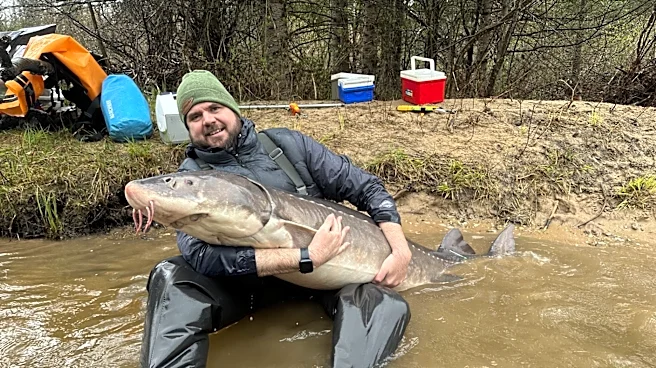







They're the mysterious swimming giants of the Great Lakes region — lake sturgeon. They can grow up to 8 feet long. Fossil records show that their ancestors swam the earth more than 130 million years ago, meaning they existed alongside dinosaurs.
Scientists knew these fish were long-lived, but the estimates were in the 80 to 100 years range. The oldest known specimen was captured at Lake of the Woods on the border between Minnesota and Canada in 1953 and estimated at 152 years old.
New research by the Michigan Department of Natural Resources, Michigan State University and other partners, however, finds that lake sturgeon are much, much older than was earlier understood — ages that are difficult to comprehend.
"I feel pretty comfortable saying that
lake sturgeon can live to be 400 years old," said Edward Baker, DNR research station manager with the Marquette Fisheries Research Station, and coauthor of the peer-reviewed study reassessing lake sturgeon longevitypublished this spring in the Journal of Fish Biology.
That would mean there are lake sturgeon swimming in the Great Lakes region today that were hatched in the 1620s — when the pilgrims were first founding Plymouth Colony in North America.
"It was definitely one of those goosebump moments of, wow, it does make sense that sturgeons live a very long time, but to this level, it was unexpected to me," said Scott Colborne, an assistant professor in MSU's Department of Fisheries and Wildlife, and a coauthor of the study.
A better way of counting age than growth rings
Researchers know less about lake sturgeon than other fish because they were overfished to near-extinction by about 1900.
"They fortunately hung on in the Great Lakes until the present time, but they were not an important part of the fish community in terms of harvest or recreational opportunities or anything like that," Baker said. "Because they are a bottom-dweller and their abundance is so low, people very rarely encountered lake sturgeon."
It was only in the mid-1990s, when the state of Michigan put the sturgeon on the state threatened species list and actively started managing for its recovery that the fish gained prominence in its numbers and in the public's consciousness.
The way researchers typically determine a fish's age is by counting rings on its bony structures such as a scale, fin ray or otolith, a small bone of a fish's inner ear. "We count annual growth rings, just like you do if you cut a tree down," Baker said.
While that works well with most fish, it was known to not work as well with very long-lived fish like lake sturgeon.
"I've been thinking about this issue throughout most of my career; I started with the DNR in 1995 and started working on lake sturgeon at that time," Baker said.
Researchers had nearly a half-century's worth of data on lake sturgeon catches and tagged fish. "You catch an individual fish, tag it, and 20 or 30 years later catch it again and it's hardly grown," Baker said.
But by calculating mean and annual growth of males and females at various times they were recaptured, a more accurate formula emerged. Baker said he utilized methods applied to calculating the age of Greenland sharks, which determined they may live to more than 500 years, making them the oldest living vertebrates on the planet.
Baker started testing the data from lake sturgeon populations on Black Lake in Cheboygan County in the northern Lower Peninsula "and came to the conclusion that yeah, the fish in Black Lake are hundreds of years old," he said.
Baker then started reaching out to colleagues with similar data from other sturgeon populations, and confirming similar ages in other places.
"I was taken aback for sure," he said. "I suspected that we were underestimating sturgeon longevity by looking at growth rings from hard parts, but I didn't think we had fish swimming around that could have been here before the United States was a country.
"I kept questioning, am I doing the math right? Is everything adding up? But when you add in Scott's expertise and the expertise of all of the other coauthors, and then you run it through peer review, it's legitimate for sure."
While discussing the research with a member of the Grand Traverse Band of Ottawa and Chippewa Indians, Colborne said he was told that tribal lore estimated that lake sturgeon in that area of northern Michigan would live to be 400 years old. What may have once sounded like fanciful folklore was being shown as scientifically factual.
"Here we were using modern analytical approaches, and they were pointing us toward something that indigenous communities had long understood — that these fish live incredibly long lives."

Findings mean sturgeon management should be 'very, very cautious'
As part of their research, the scientists estimated the age for the largest observed individual lake sturgeon from each population.
"In Black Lake, 427 years old is the age we got for the oldest, largest male we encountered there," Baker said.
Even looking at variability in the model, the lowest possible age for that fish was more than 300 years old, Colborne added.
The findings make the lake sturgeon the longest-lived freshwater fish species in the world. But why species like the sturgeon or Greenland shark live so much longer than other animals is still cloaked in mystery. Baker noted that species like the sturgeon, Greenland shark and coelacanth, a fish thought to have gone extinct 65 million years ago until a live specimen was caught off the coast of South Africa in 1938, all date back to the time of the dinosaurs.
"One of the common features among these fish that we now know live long lives is that they have been around, evolutionary speaking, a very long time," Baker said.
There's significant variability in different sturgeon populations as well, Baker noted. On the St. Clair River, the sturgeon data indicates fish live only about 80 to 100 years, what was commonly assumed was the overall fish life expectancy in the past. "The oldest fish are from the Black Lake system and the Sturgeon River up on Lake Superior," he said.
More research is needed to understand the incredible longevity and perhaps reexamine ages of other long-lived fish species. From a fisheries management perspective, the DNR and others must remain protective of these living links to history.
"You can't have animals that survive to be 300 to 400 years old unless their annual probability of survival is very, very high," Baker said. "One of the other things we know about lake sturgeon is that their natural reproductive rate is very, very low. So it's not surprising that what did the sturgeon in across the Great Lakes around 1900 was harvesting them indiscriminately. We clearly can't do that.
"Because they are living so long and their survival is so high, we have to be very, very cautious about how much harvest we allow."
Contact Keith Matheny: kmatheny@freepress.com.
This article originally appeared on Detroit Free Press: Great Lakes giant sturgeon may live centuries, new research suggests