





At a National Confectioners’ Association Convention held in Detroit in 1916, a resolution was approved to recognize the second Saturday of every October as “Candy Day.”
On this day, according to the National Day Calendar, the association encouraged Americans to patronize "their local candy shops, bakers and druggists for the highest quality confections.”
Candy Day would be short lived due to the commercial rationing of sugar during World War I. However, the concept would return during the early 1920s through what is known today as Sweetest Day, which is now celebrated on the third Saturday in October.
While Cleveland is generally recognized as the city where Sweetest Day originated, organizations with names like the Detroit Retail Confectioners,
Detroit Wholesale Confections Club, Detroit Jobbing Confectioners Association and the Michigan Confectioners Club made sure that Detroit was one of the primary hub cities for the holiday from its very early beginnings.

One of the existing businesses during that time with offerings that helped to support the growing popularity of Sweetest Day in Detroit was Bashor’s Confectionery, a seller of homemade candy, which was located on the corner of Kercheval and Van Dyke from approximately 1922 through 1926.
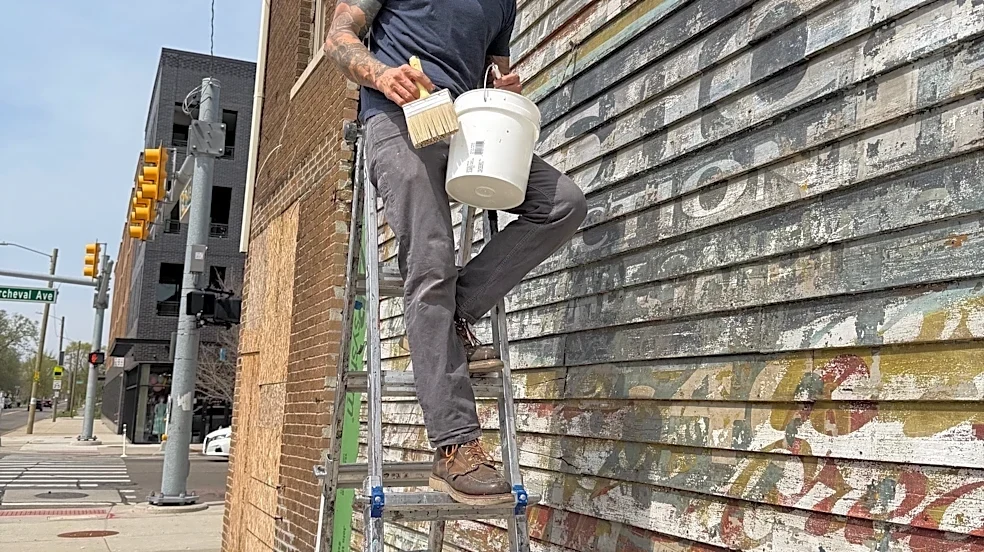
And all of this is known because of Detroiter Mark Serra, who has spent several months bringing a ghost — or more accurately, a “ghost sign” — facing Van Dyke back to life after it was discovered by the current owners of a building located at 8002 Kercheval.

“This whole wall was covered in brick veneer — it was a brick wall — and when the owner of the building now took that brick veneer off last fall they uncovered the (Bashor’s Confectionery) sign,” said Serra, who in addition to creating handcrafted signage and designs for present-day businesses, also specializes in the preservation of ghost signs, which are hand-painted commercial signs applied directly to a building surface that remains after their original use has ended.
Serra continued: “Damon (Gabriel), who owns Gabriel Hall (a Creole restaurant, bar and music venue) that is going to be opening here soon, found me online. The idea is that we get this back to a place where it becomes a conversation piece, and then we want it to last so that it can be a conversation piece for a lot of years.”
And at lunchtime on Oct. 15, the sign was indeed a conversation piece as Serra was explaining the project to Colin Healey, a resident of the West Village neighborhood where the building and sign stand, who was walking by. Healey had lots of questions about the sign that he had been holding on to for weeks.
A few minutes later, Serra provided a sign update to a driver passing by on Van Dyke, who happened to be Garnet Terri James, owner of Terri’s Cakes, at 16331 E. Warren.

However, when Serra explains what he is doing to preserve the ghost sign to passersbys, he also often talks about more than one company, because Bashor’s Confectionary was not the only long ago Detroit business that used that building wall to advertise.
“This wall has seen a few different businesses come and go as you work your way through the paint,” said Serra, who also uncovered an advertisement for “Famous Jersey Brand Ice Cream,” including a hand-painted sundae that has withstood the test of time.
And underneath that, from an earlier layer of paint, is an advertisement for “Frank Furniture Co.,” a business nearby that offered “liberal credit terms” to prospective customers.
“I think it’s important that this becomes a timeline that is worth preserving, and that we make it a part of the fabric of this community again,” said Serra, who through extensive research, believes the building was built around 1906. “These (ghost signs) represent unintentional time capsules that tell the commercial history of a neighborhood. And as you keep digging, you find out that there is so much more to be learned—about the sign itself and the neighborhoods where they exist.
"These are more than just cool old signs, they teach us about what people were doing and the way people spent their money.”
Serra, whose intent with the Bashor Confectionary sign is to retain as much original material as possible while allowing the sign to be understood in its current condition, says he also hopes to pay tribute to the creators of the sign that represented the street artists of their day.
“I think about the guys doing this a hundred years ago and earning their living this way,” said Serra, who hopes to wrap up his work at 8002 Kercheval before real cold weather hits Detroit. “If you look really closely at the wall now, you will see the original pencil scratches from the sign painters. They would scribble something out and then do it with the brush. It’s really the antithesis of what is happening today — with everything being mass produced, and quick, and disposable.
"In this, you can see the personality and care that went into the work. So when I’m done, I hope the neighborhood will have something that they will be proud to walk by everyday.”
Scott Talley is a native Detroiter, a proud product of Detroit Public Schools and a lifelong lover of Detroit culture in its diverse forms. In his second tour with the Free Press, which he grew up reading as a child, he is excited and humbled to cover the city’s neighborhoods and the many interesting people who define its various communities. Contact him at stalley@freepress.com. Read more of Scott's stories at www.freep.com/mosaic/detroit-is/. Please help us grow great community-focused journalism by becoming a subscriber.
This article originally appeared on Detroit Free Press: Sweetest Day origins and one man's passion to save a 'sweet' ghost sign