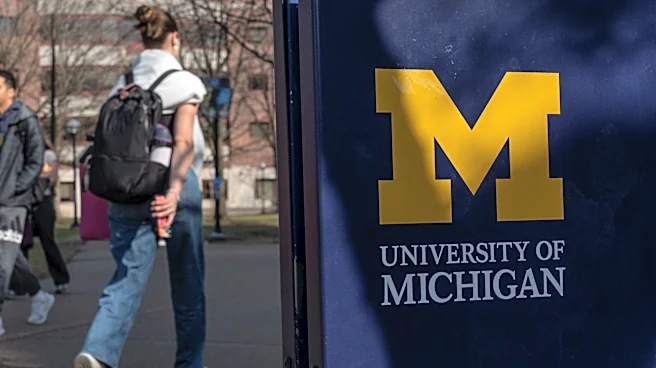







Starting in the fall of 2027, thousands of first-year University of Michigan students won't see grades on their first-semester transcripts.
The university's College of Literature, Science and the Arts (the largest of U-M's 19 schools and colleges) is developing a pilot program that will designate all first-semester grades as pass or no credit on students' transcripts. Students will still receive traditional letter grades and feedback from professors, but those grades will not appear on their external transcripts or count toward their GPAs.
U-M said the goal of the program is to help students adjust to the demands of college, encourage them to take classes outside their comfort zones and reduce the pressure that can contribute to mental health
problems.

"We believe that covering grades will help students start strong and curb the mental health crisis unfolding among college-aged individuals," the university says on its website.
The program is still being developed, and U-M declined to make a university official available for an interview. Instead, the university pointed the Detroit Free Press to an article published in the University Record, the university's official news publication.
The proposal to "cover" first-semester grades was first announced during Dean Rosario Ceballo's 2025 State of the College address. Since then, Ceballo and LSA leaders have worked with faculty, staff and students across U-M to develop the pilot. The proposal has generated support from LSA department chairs and program directors, the University Record article says.
University professors told the Detroit Free Press that today's students face a different kind of academic pressure than previous generations. They have grown up with smartphones and social media and with an increasingly intense focus on achievement metrics. That environment can make grades feel more consequential, they said, particularly for students already struggling with anxiety, depression or other mental health challenges.
The pilot program, which is not optional, doesn't eliminate grades altogether. Students will still know how they performed in every class. U-M will also retain their actual grades internally for academic advising, scholarships and awards, and for students who use them in applications for internships, majors outside LSA and other academic or professional opportunities, the university says.
Disrupting the 'school game'
Derek Peterson, a history professor at U-M and a former chair of the faculty government, supports the pilot program. Peterson said he has seen overwhelming demand at U-M's Testing Accommodation Center, where professors send students who need additional time or other support during exams. To him, that is one indication of the mental health challenges facing students.
"It's a sensible policy that doesn't undermine the purpose of higher education," he said. "Instead, it gives students an on-ramp into a university that otherwise demands a great deal."
Peterson said he plans to continue giving students traditional grades and feedback. The difference, he said, is that students who don't perform well in their first semester will have time to address those problems without carrying a poor first-semester GPA through the rest of college.
The idea that U-M, a public university that exists to lift students of Michigan, should let students fail "is really a failure of our mission," he said.
Susan Blum, a professor of anthropology at Notre Dame who edited the book "Ungrading: Why Rating Students Undermines Learning (and What to Do Instead)," also praised U-M for trying the approach on a large scale.
"They're doing this really audacious thing," she said of U-M. "I think that's great because, as most of us who work in higher [education] will admit when we're being honest, a lot of things are not working."
Blum said many college students have become focused on achievement — particularly grades and test scores — rather than learning for its own sake.
"Many people admit that, yes, our students are high-achieving because they've learned to play the school game," she said. "So this disrupts it a little."
Blum said she also believes nostalgia for a time when grades were more meaningful is misplaced.
"Grades have never been consistent," she said. "Grades have never been fully meaningful. So holding on to them is not going to solve any problems."
This experiment isn't new
U-M isn't the first university to implement some form of grade covering. U-M pointed to the California Institute of Technology, Swarthmore College and Wellesley College as universities with some form of grade-covering programs.
The Massachusetts Institute of Technology has offered some form of pass/no record for first-year students since 1968, helping facilitate students' transition to MIT, Kimberly Allen, an MIT spokesperson, said in an email. She noted that the grade for each student is determined independently of other students — not on a curve.
Still, the idea has drawn criticism from some who argue that college should teach students how to deal with pressure and failure, rather than shielding them from it.
Former U.S. Rep Mike Bishop, a Republican who represented Michigan's 8th Congressional District, for example, wrote in a post on LinkedIn that he finds this "policy shockingly off the mark." Bishop said college should prepare students to handle the pressure, competition, setbacks, and even failure they'll find in the "real world."
"Getting rid of letter grades does not prepare students for life," he said. "It shelters them from it."
Contact Adrienne Roberts: amroberts@freepress.com
This article originally appeared on Detroit Free Press: U-M to hide some first-semester grades, citing mental health crisis