





It may be sitting in your kitchen, and it's used in food at restaurants across metro Detroit – salt extracted from miles below the surface of Michigan and refined on the shores of the St. Clair River.
Detroit's labyrinth of salt mines garners a lot of attention, while St. Clair's distinction as a maker of salt is less known.
The Diamond Crystal Salt Company has been refining salt along Michigan’s Thumb Coast for 140 years. It’s a preferred brand among chefs for how quickly it dissolves. The company has been introducing new products and redesigning packaging to attract more home chefs.
Diamond Crystal, owned by global food and agriculture giant Cargill, is wrapping up a $100 million investment at its St. Clair factory to modernize its operations
and expand production of its signature flaky kosher salt.
"We are making it available to consumers to reach more people," Asheesh Choudhary, Cargill's senior vice president and managing director of salt, told a small group of food writers invited to a rare tour of the facility.
All in the flakes
Chemically speaking, all salt is sodium chloride. But, measure for measure, all salts are not the same. They are refined into different textures depending on how they are used.
There's kosher salt, a coarse salt that comes in grains and flakes – many without additives.
Table salt is a fine-grain salt with additives that make it free flowing so it doesn't cake up. It's available iodized for people who have iodine deficiencies, and non-iodized.
And then there’s sea salt, made from evaporated seawater and has trace amounts of minerals. It's available in a fine or coarse grind.
Diamond Crystal is known for lightweight, hollow pyramid-shaped crystals that the company says have about 50% less sodium by volume than table salt.
Its kosher salt flakes weigh less than, say, Morton's kosher salt and contain less sodium. Comparing nutrition labels, a quarter teaspoon of Diamond Crystal weighs 0.7 grams and has 280 milligrams of sodium while a quarter teaspoon of Morton's weighs 1.2 grams and has 480 milligrams of sodium.

Recipes will often call for a specific amount of a certain brand of kosher salt because they are not interchangeable. If you swap one for another in the dish, those differences change the flavor of a dish.
"As a chef you certainly develop preferences of what you like," he said. "At a certain point, you can recognize the difference very easily by touch, by the weight, by appearance of salts," said Drew Sayes, certified master chef and culinary instruction at Schoolcraft College.
Sayes is a Diamond Crystal salt user and has had vendors substitute it for a house brand.
"In kitchens, consistency is important and finding that product that works well for you is critical to your operation."
The Michigan basin
Diamond Crystal's Alberger method for manufacturing salt was patented by John and Louis Alberger, along with Charles Moore and Horace Williams, when the company formed 140 years ago.
But the process really started millions of years ago, when the land that is now Michigan sat south of the equator below sea level, and the weather was tropical, said William Harrison, a retired professor emeritus from Western Michigan’s geology department.
"You were getting these various kinds of deposits forming over that long period of time called the Silurian time period," Harrison said.
As it got hotter and drier, water receded. "The interior part of the basin got separated from the rest of the world ocean," Harrison said. "When that happened, it started evaporating and it evaporated down until it pretty much dried out, and then you got all these salt layers."
This happened thousands of times over millions of years: Trapped seawater repeatedly evaporated, leaving massive salt deposits.
"Because of this we get these hundreds and even over thousands of feet of these salt deposits in some places underground," Harrison said.
Harrison compared it to standing on the rim of the Grand Canyon and looking down.
"You can see up to 5,000 feet of rock layers, sandstones and shales and limestones," he said. "And so, we have that same kind of thing here underground in Michigan. It's just that it's not exposed like it is in the Grand Canyon."
The Michigan basin, which spans much of the Lower Peninsula, including Detroit’s famed salt mines.
The mines, Harrison said, make up an "underground city" that stretches miles with tunnels and byways under southwest Detroit, Melvindale and Allen Park, even below the giant tire along eastbound Interstate 94.
"The salt production at times in the state of Michigan has been half of all the salt that's ever been produced in the United States," Harrison said.
A briny process
Diamond Crystal's method for manufacturing salt starts in wells about 2 miles south of the plant. Recycled water is pumped into wells about 2,200 feet below the surface into underground salt deposits. There, water dissolves the salt and creates brine. That brine flows back to the plant through underground pipes.
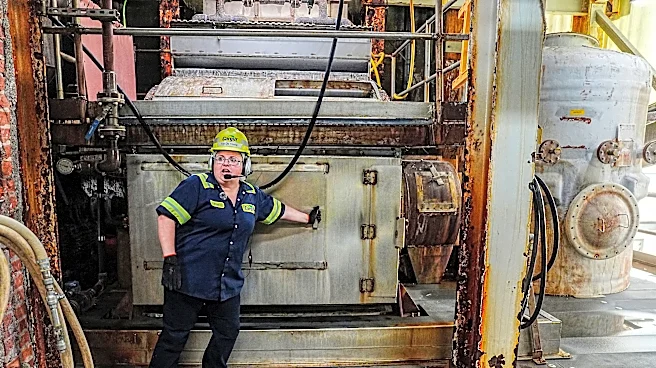
After undergoing a quality screening, it is heated in giant pan, where it circulates at extremely high heat until the water evaporates, said Connie Huth, who leads salt operations for Cargill.
As the brine evaporates, hollow pyramid-shaped crystals that look like bubbles, form on the surface.

"Once those crystals are big enough, they start to sink and the rakes in the pan are continually moving them around until they are heavy enough to fall into the next part of the process," Huth said.
Once these salt crystals form, they go through a drying process and part of that looks like something you might see at an arcade.
"Think of it as a giant air hockey table," said Kathryn De Young, production and processing superintendent, who led the tour. "It’s a gentle way so the crystals are not damaged."
Once the crystals dry, they slip through layers of screens with openings sized for specific Crystal Diamond products: coarse, flake, fine and its newer retail baking product, flour salt. From there, products are conveyed to packaging.
The company’s four-year $100 million investment expands the site’s footprint by 50 acres, adding space for processing and improving infrastructure at the plant where 192 people work.

Over the last few years, the company has also redesigned its retail packages and sizes for consumers. Available at more than 13,000 retail locations and Amazon, its retail kosher salt for home cooks is sold in 16- to 48-ounce sizes.
In 2023, Diamond Crystal introduced baking salt, a fine salt that dissolves quicker, melting into dough and batters.
Last fall, Diamond Crystal launched a line of flavored kosher salts: lemon, black lime and sweet heat – used as a seasoning, rubs, marinades, sprinkling on baked goods or even flavoring the rims of glasses for Bloody Marys, margaritas and other cocktails .
Why the shape and weight matters
Salt is a culinary workhorse.
Chefs and cooks learn how to use it with an exact touch and feel of every salt grain or flake so they can control how much they are using, whether they are adding final seasoning to a dish, showering a slab of meat or using salt to bring out a flavor of a food, rather than just adding it as an ingredient.
"It's not just tasting. It's not just smell and it's not just sight but even how something feels and being able to kind of figure out the correct volume by feel sometimes," Sayes said.

Over time, he said, you know how much you are grabbing from your container of salt.
"When you pick the grains up with your fingers, you’re going to know what a tablespoon is," Sayes said about kosher salt. With finer salt, he said, "you get less control."
Sayes also prefers kosher salt because it’s typically free of additives, like the iodine in some table salt, saying the flavor is cleaner.
"It's a little bit nicer to use for dry cures, rubs and brines because it distributes more evenly and doesn't get overly salty because of the grain structure," he said.
Diamond Crystal Salt Co. doesn’t hold public tours of its facility. But you can visit the St. Clair Historical Museum and Research Center at 308 S. 4th St. inside the former First Baptist Church. The museum has dedicated a room to Diamond Crystal that features photos, artifacts, schematics and promotional materials, according to the museum's website.
Contact Detroit Free Press food and restaurant writer Susan Selasky and send food and restaurant news and tips to: sselasky@freepress.com. Follow her on X, formerly Twitter: @SusanMariecooks. Subscribe to the Eat Drink Freep newsletter for insider scoops on food and dining in metro Detroit.
This article originally appeared on Detroit Free Press: Why chefs swear by this Michigan-made salt