








Sometimes, I pop into a store just to explore another retail landscape even when I have absolutely no intention of buying anything. So, I had to scan the racks — and those price tags — when I spotted the newish RealReal storefront dotting a side street in downtown Summit, New Jersey.
We were on quick trip visiting family. And the odds of my dropping $535 on a pre-owned Hermès scarf were as tiny as a size 2 pair of jeans, whether I was watching that vacation spend or not.
Still, I had to take a peek.
The RealReal is all about the hunt and the deal for secondhand luxury. It has a charming story that begins with the founder launching the e-commerce platform out of her San Francisco kitchen in 2011 and almost seamlessly flows to a NASDAQ-listed company
that sold a bit more than $2 billion in goods, as measured by a term called gross merchandise value, via its platform in 2025.
RealReal states that it is the world’s largest online marketplace for authenticated resale luxury goods.
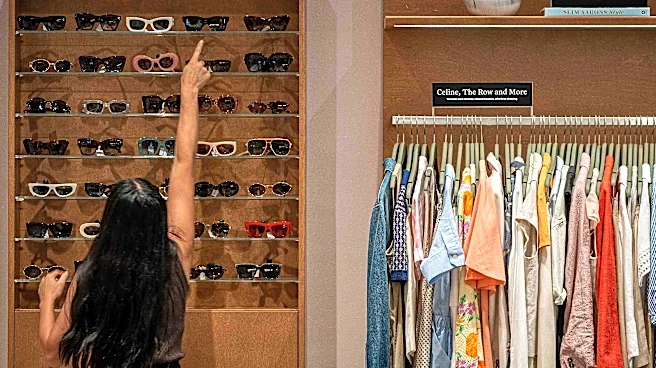
The Summit store opened in the summer of 2025, as the 16th store nationwide, blending "sustainability and luxury with a deep, moody palette of burgundy and brass tones," according to the news release, "contrasted by light wood flooring and a glowing statement fixture for a warm yet elevated feel."
I soon learned, or rather relearned, at least one consumer tip on my very quick dash into the 3,000-square-foot store with a security guard at the door.

No matter where you're shopping, take this step before buying
The tip: Shop around no matter where you go to get the best deal on price. Take time to compare that online price to the price tag you're seeing in the store. Sound advice whether you're shopping for luxury at the RealReal or back-to-school at Target or Kohl's.
Here's what I discovered on my quirky stop into the charming New Jersey store.
Oddly enough, a quilted black Chanel Tortoise Box Bag caught my eye. Price tag: $3,725.
I wanted to know the bag's story, so I went online to do a little research after I left the shop. What could make a used handbag worth as much as some new water heaters?
I discovered that the bag is roughly 30 years old, dating to the 1996-97 collection by Karl Lagerfeld, according to various luxury consignment websites.
As I searched online, I discovered something else: RealReal had a very similar bag priced online at $3,352.50 — a savings of $372.50 or 10% — around roughly the same time as I spotted the bag in the attractive store in Summit, New Jersey.
Would RealReal price match? Unlike Target, RealReal does not have a price match policy if you see a lower price online than you spot in the store.
Similar items can vary in price online or in stores, many times based on the condition. The same item, based on a stock keeping unit number, is priced the same online and in stores, according to the company. If an item in the store is purchased online, RealReal will collect that handbag, jacket, jewelry or other item from the store to process for shipping to the customer, according to a spokesperson.
The RealReal currently has 18 stores, including a new store that opened in West Palm Beach, Florida, a relocation of a previous store. No RealReal stores exist in Michigan.
Millennials and Gen Z consumers tend to like buying discounted items from luxury resellers but the same's true of some of their parents who like to shop for themselves or their families. Many who no longer adore some of their designer duds like to use these sites to sell their castoffs.

Many of us might think about comparing prices for new items, but we might overlook the strategy when shopping for previously owned clothes or goods.
How we saved a few dollars to big bucks on some recent purchases
What has amazed me over the years is how often I am shocked when I spot a different price online than in the store. I have to repeatedly remind myself to check prices being offered at both spots.
I saved a bit less than a dollar on a nonslip rug pad with a comparison pricing exercise this summer when in a Target store. Sometimes, the savings can be a few dollars on one item.
Target notes online: "We’ll match the price if you buy a qualifying item at Target and then find the identical item for less at Target.com, in Target stores or with a Target Circle deal (deals that apply automatically upon identifying yourself as a Target Circle member). Price matches may be requested at time of purchase or within 14 days after purchase."
Earlier this summer, my husband bought an electric lawn mower at a local hardware store. Later, I exchanged texts with my dear friend in Kentucky about electric lawn mowers in general. My friend Mary Pat replied at one point "smart he got it on sale."
My first thought then: "What sale?"
My husband didn't get the lawn mower on sale. After talking to my friend and searching a day or so later online, though, we found that the lawn mower — still yet to be used — was indeed on sale for a limited time online at that same retailer.
Granted, we've been married nearly 31 years, but my husband somehow felt that once you bought something like a lawn mower that was it. Game over. Honey, game still on.
He went back to the store, requested the lower price and saved roughly $120.
Thank you, Mary Pat.
Savvy shoppers highly recommend downloading the app for some major retailers, such as Walmart, Target, Kohl's or Kroger, to clip digital coupons and use the app for in-store and online price comparisons of the same item.
Look, I get it. Sometimes, we're all so busy working and taking care of people that we barely have enough energy to hit the store — let alone scan bar codes to comparison shop. Some evenings, simply clicking to buy to load up a cart online is way too much.
Yet, comparison shopping can save real money over time. Saving an easy $5 or $10 here and there can be a real boost to a shopper's morale too.
Steps to take when comparison shopping
Open the app before you start shopping or hit the register. Study the online price, which can be lower than the in-store price, before heading to the register. You can scan the barcode with the app to do some price comparisons.
Often a cashier or service desk representative can match that online price on the spot. If needed, you might order the item online and agree to pick up at the store as another way to snatch a lower price.
Take time to understand the different rules that retailers have when it comes to matching prices.
Walmart, for example, has a rather detailed outline of its price match policy for shoppers who would like to get the same price for an item they're about to buy at a Walmart store in the United States at the price of the identical item advertised on Walmart.com.
Walmart notes the request for a price match must be made early in the game with the customer being required to inform the Walmart associate of the price discrepancy at the time of checkout.
Walmart spells out one such restriction noting: "Some price match transactions require a Walmart supervisor approval, which could lead to an extended transaction time to validate the eligibility of the requested price match before the price will be matched. We reserve the right to limit quantities to one per customer, per item, per day."
The identical item — size, model, quantity, brand, or color — must be currently in stock and available to buy on Walmart.com at the time the price match is requested.
Walmart, like some others, isn't going to price match a competitor's online or in-store prices. And you're not going to get a lower price at the store when Walmart.com prices are part of special events "including but not limited to clearance, Rollback, Black Friday or Cyber Monday deals, or other limited-time promotions."
Walmart also clearly states online that it will not match prices from other Walmart or Neighborhood Market stores.
Among other restrictions, Walmart also notes that the "price match of items sold on Walmart.com are not available in Alaska, Hawaii, or Puerto Rico."
Not surprisingly, perhaps, Walmart indicates that the Walmart store manager on duty has the final decision on any price match request made by a customer.
Saving money does take more time most of the time
Edgar Dworsky, who runs the consumer education website Consumer World said that over the years, he has spotted inconsistencies between prices listed online and listed at the store for various retailers.
In general, he said, many items tend to be cheaper online lately but that's not always 100% true.
He has also seen some price swings where prices for the exact same item will vary from store to store in a given area for the same retailer.
Being a consumer these days, he said, admittedly is tough when there are all sorts of ways to be hit with higher prices or even miss out on a special deal.
Dworsky suggests some shoppers could benefit from using an online service called CamelCamelCamel to spot whether a deal is really a deal. The site tracks the price history of millions of products sold on Amazon.
For fun, I plugged in Chanel Tortoise Box Bag into CamelCamelCamel. I did not imagine I'd find that vintage bag there and I did not spot the same bag I saw on the shelf in Summit, New Jersey, which admittedly looked in great shape even when I opened it to examine the bag's condition inside.
To my surprise, though, CamelCamelCamel did have photos of several "pre-loved" Chanel bags but did not have pricing data information for the purses I saw online.
Would I buy that black Chanel Tortoise Box Bag if I spotted it for even less? Absolutely not.
Oh, ask anyone who knows me and they'll confirm that I love my purses. But I'm more of a Coach Outlet or TJ Maxx kind of gal. My bargain is far closer to $35 than $3,000.
Contact personal finance columnist Susan Tompor: stompor@freepress.com. Follow her on X @tompor.
This article originally appeared on Detroit Free Press: It's a shocking way to save cash by taking an extra peek at prices