



Everything you’ve heard about Michigan’s U.S. Senate race is true: An extremist is asking voters to send him to Washington, masking an agenda far out of step with Michigan's mainstream under the pretense of normalcy. If elected, this man would urge America down a dark path, changing the shape of our nation, perhaps irrevocably.
But that man is not Abdul El-Sayed.
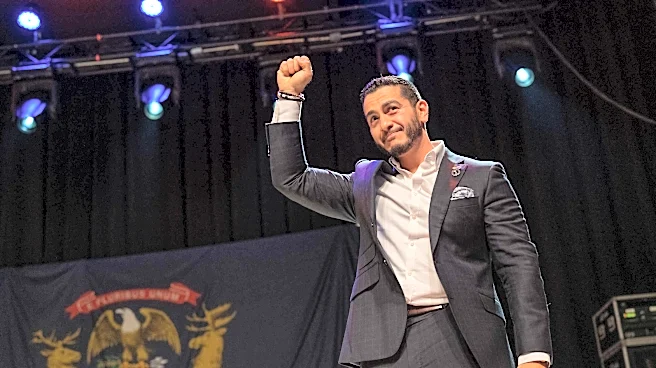
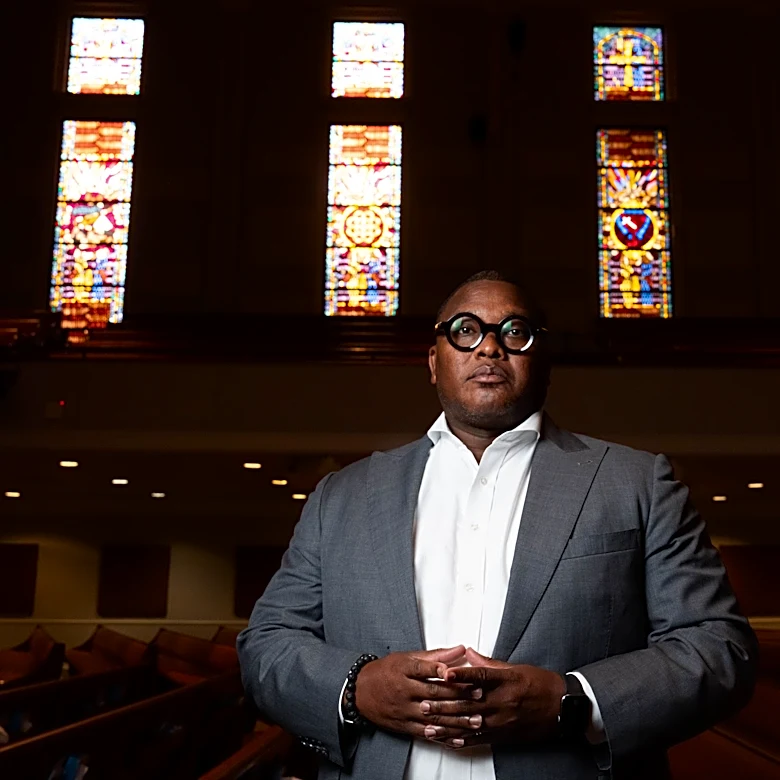
El-Sayed, the Democratic candidate for Michigan's open Senate seat, is a charismatic public servant with an American-as-apple-pie biography: Born in Oakland County, he’s a former high school football player, a University of Michigan graduate who trained as a doctor and married his college sweetheart.
An unabashed capitalist who champions universal health care, views foreign policy through
an America-first lens and believes corporate spending in politics must end, El-Sayed has tapped into voters' frustration with a government that takes more from us, and delivers less.
He ran a remarkable primary campaign, winning an upset victory against U.S. Rep. Haley Stevens, D-Birmingham, who had the backing of Michigan's Democratic establishment and nearly $60 million in outside spending. His message to voters – the status quo can change and government can work for us – is imbued with an optimism often absent from this era of American politics.
El-Sayed, whose parents were born in Egypt and immigrated to this country, would also be the first Muslim to serve in the U.S. Senate. His detractors imply, or say outright, that El-Sayed’s faith and ancestry are disqualifying. But America is a nation of immigrants and freedom to worship as we choose is written into this country’s founding; such attacks are noxious and ill-conceived. You might even say they’re un-American.
And so far, they’ve backfired.
Now, as the Nov. 3 general election nears, El-Sayed, 41, is neck-and-neck with Republican Mike Rogers, 63, a former member of Congress and a consummate insider whose tenure in political office began when El-Sayed was in grade school ‒ and whose politics have taken a dark turn as he’s embraced President Donald Trump’s norm-shattering agenda.
On Nov. 3, Michiganders should vote to send ABDUL EL-SAYED to the U.S. Senate.
Rogers wants voters to believe that El-Sayed is an extremist. But Rogers is a vocal supporter of a radical regime that is working to delegitimize LGBTQ+ Americans, strip the contributions of Black and Brown Americans from our national history, restrict the rights of women to access not just abortion but contraception, place tariffs on our closest allies with devastating economic consequences, deport millions of Americans and conduct an immigration enforcement program that has led to the unjust killings of American citizens.
We find no indication that Rogers would check Trump’s romp through the rule of law, and his own politics are no more encouraging.

Democrats can’t afford to lose this seat. For Michiganders who care about the U.S. Constitution, control of the U.S. Senate, our next Supreme Court justice, economic stability, our literal and figurative health and the ability of American families to just plain get by, that ought to be sufficient reason not to choose Rogers.
But El-Sayed is more than just a means to an end. In challenging the cynical status quo, he is offering Michiganders something his rivals can't:
Hope.
Achieving the reforms at the heart of El-Sayed's platform won't be quick or easy. But if we can muster a little bit of patience ‒ and elect a senator with the courage and conviction to see it through – it will be worth the wait.
El-Sayed's history of service
Michigan has a long history of electing exemplary public servants to the U.S. Senate, lawmakers who placed service before politics to represent Michigan’s ideological spectrum.
We see the foundation of that brand of service in El-Sayed's candidacy and history.
El-Sayed was raised by his father, an engineer, and his stepmother, white and also an engineer. El-Sayed graduated from Bloomfield Hills’ Andover High School. As an undergrad at U-M, El-Sayed met and married Sarah Jukaku. Both earned medical degrees at Columbia University. Jukaku is a practicing psychiatrist; the couple has two young daughters.
As a medical resident, El-Sayed concluded that our gravest health challenges require systemic solutions, changing his focus to public health and earning a doctorate in the field as a Rhodes Scholar at Oxford University. He returned to Michigan in 2015 to lead the post-bankruptcy rebuilding of Detroit's Health Department, where he launched or expanded programs providing eyeglasses to children and prenatal support to mothers. He also oversaw Animal Control, where euthanasia rates fell and the number of adoptions increased.
El-Sayed left the city to run for governor in 2018, finishing behind Gretchen Whitmer in the Democratic primary. He was named director of Wayne County's Health, Human and Veteran Services Department in 2022, where he worked to erase medical debt and expand children's vision care, leaving the county in April 2025 to run for the U.S. Senate.
El-Sayed supports a platform of mainstream and progressive reforms, like passage of the Protecting the Right to Organize Act, making it easier for workers to unionize. He says antitrust laws need to be strengthened, and that billionaires should pay more taxes, with those revenues used for infrastructure and schools. He advocates for term limits for U.S. Supreme Court justices but opposes partisan court packing. He says the federal government must regulate data centers.

We hear the Jewish Michiganders who fear rising antisemitism, and who believe that El-Sayed’s opposition to the Israeli government’s actions in Gaza, particularly after Hamas’ Oct. 7 attack – along with his call to end U.S. aid to Israel ‒ risks the safety of Jewish people. And we understand the vulnerability these Michiganders feel.
But a critical view of the Israeli government’s treatment of Palestinians and its military offensive in Gaza isn't inherently antisemitic. The onslaught has killed more than 70,000 there, 50% or more women and children, according to numbers distributed by the Gaza Health Ministry and viewed as reliable by the United Nations.
In fact, we find El-Sayed’s foreign policy lens remarkably consistent: Countries that receive U.S. assistance, he says, must follow international law. That includes Arab and Muslim nations; Egypt, he told our editorial board this month, where a military dictator has used U.S. dollars to tighten control over his own people, is first on his list of countries that should lose U.S. aid.
Russia's war on Ukraine, El-Sayed said, is different. A hostile neighbor invaded a sovereign nation and international law, in this conflict, is clear – Ukraine deserves American support.
But Medicare for All is the centerpiece of El-Sayed's policy platform, a shift he acknowledges is contingent on the election of a Democratic president and U.S. Congress.
As access to health care narrows and private insurance becomes less affordable, universal health care is growing more popular. Even hospital executives, insurers and the pharmaceutical industry acknowledge that the current landscape isn’t sustainable.
A poll of Michigan voters released this month by Epic MRA found that 62% of Michigan voters back national health care. A statewide Glengariff Group poll conducted during the same time period found 42% of respondents support for Medicare For All – but 83% of Democrats.
El-Sayed says the transition would be gradual, with plenty of time for Americans to get comfortable with the new system.
The first step, he said, is to make Medicare whole and fully reimbursed for seniors, with no out-of-pocket costs for anyone over 65, overseen by a Federal Reserve-style governance system, and then expand coverage to different age groups – first children, a relatively low-cost prospect, then people over 55, people over 45, and so on, staged over years.
Medicare for All, he says, wouldn’t eliminate private insurance: “It does not have to bar any private insurance, but it has to provide guaranteed public coverage. It's not a public option, it's a public guarantee.”
Contrary to the accusation that this plan would harm rural hospitals, El-Sayed said, this plan would stabilize small facilities dependent on low-reimbursement Medicaid patients. "Under Medicare for All, now all of a sudden the rural folks who were on Medicaid have full health care, reimbursing at this new Medicare rate. It is the best possible thing you could do to actually keep rural health care open and thriving.”
El-Sayed has a deep knowledge of policy and thoughtful ideas about its implementation, and is instinctively transparent.
The Republican candidate
A U.S. Army veteran and FBI agent, Rogers’ career in government began in 1994, with three terms in the Michigan Senate followed by a 14-year stint in the U.S. House. He left Congress in 2015 to pursue a media venture that never launched. He’d largely stepped out of public life until 2024, when he ran for an open U.S. Senate seat against Democrat Elissa Slotkin, losing in a red wave year.
Rogers presents himself as a "common sense" candidate who will save Michigan from the "dangerous" El-Sayed, a descriptor laden with racist subtext unbecoming of any would-be leader.
The Free Press first contacted Rogers' campaign to schedule an endorsement interview on Sept. 3. Despite multiple follow-up attempts by phone and text, his campaign did not schedule an interview before the Sept. 24 deadline, when absentee ballots were mailed to voters. Rogers refused to participate in a Sept. 15 debate at Fox 2 Detroit, moderated by anchor Roop Raj. He is slated to debate El-Sayed Oct. 8 on WOOD-TV, moderated by journalist Rick Albin, and to appear at the Detroit Economic Club on Oct. 20 in which he and El-Sayed will sit for back-to-back interviews with WDIV-TV anchor Jason Colthorp. El-Sayed has said that he’ll debate Rogers in any venue.
Scrutiny of Rogers' public statements and voting record reveals a deep disconnection from Michiganders.
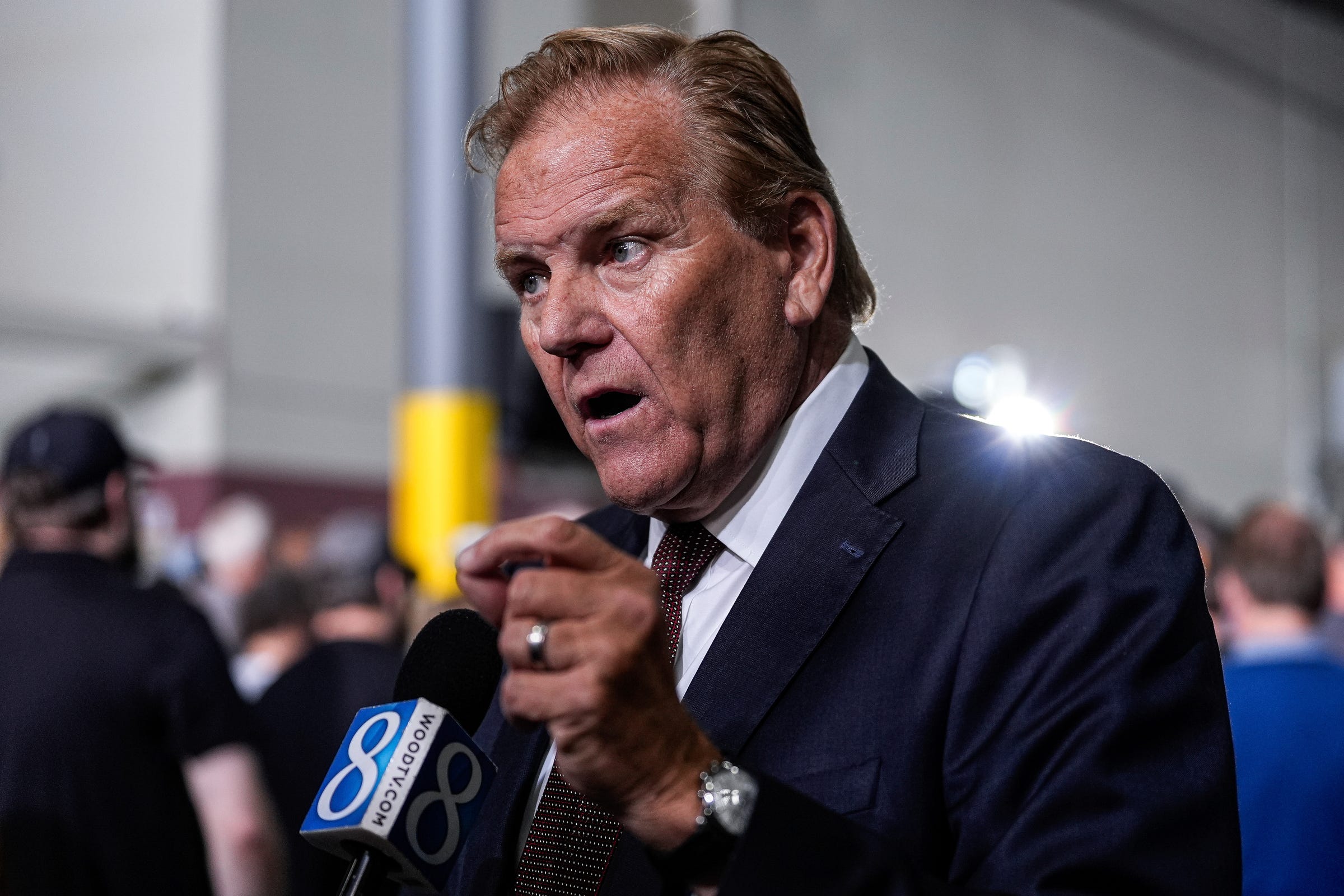
Rogers told CBS Detroit this month that most people don't want a public health insurance option; contrary to those recent surveys from Epic MRA and the Glengariff Group. He wants to eliminate key Affordable Care Act provisions like preventative care without co-pays, and create high-risk pools that would require sicker people to pay more for health care.
He backs Trump's Canadian tariffs, along with just 28.6% of Michiganders, Glengariff found, and appeared at the Sept. 10 Republican convention in Texas that lauded the president – underwater here with a disapproval rating as high as 67% in a recent Epic MRA survey ‒ and which some other Michigan GOP candidates sat out.
Rogers has said he doesn't believe in marriage equality, in 2008 calling it "a right that has never existed" and comparing same-sex marriage to polygamy. Throughout his career in office, he consistently lobbied or voted for bills that would ban or sharply restrict reproductive rights, which two-thirds of Michiganders voted in 2022 to place in the state constitution.
In a 2024 endorsement interview with the Detroit Free Press Editorial Board, Rogers would not commit to upholding the results of Michigan elections, refused to say whether he believed Joe Biden had won the 2020 election and, bizarrely, suggested that illiterate inmates in Michigan prisons should be incarcerated until they have learned to read.
Rogers told one interviewer this summer that he had the advantage because this is a "change election," a startling assertion from a career politician endorsed by an unpopular sitting president.
But that’s Rogers’ campaign, seemingly premised on the hope that enough Michigan voters will be discomfited by El-Sayed's Egyptian surname and Muslim faith to choose the white guy who stands with Trump.
There's an extremist in this race, all right, and it's the election denier who's willing to deprive Michiganders of essential rights.
The elephants in the room
Like any other candidate, El-Sayed has flaws: His career in public health is impressive, but abbreviated, and he has never held elected office. He can be quick to offer simplistic answers to complex problems. He can bristle when there’s opportunity to be conciliatory.
To deliver for the Michiganders who’ve placed their faith in him, a Senator El-Sayed must build the coalitions required to advance his agenda, even if that means embracing incremental progress or working with lawmakers who’ve taken corporate cash or be marginalized by more capable colleagues.
Some Democrats blame El-Sayed and other progressives for Donald Trump's 2024 victory, arguing their criticism of then-Vice President Kamala Harris and the Biden administration’s position on Gaza weakened the party. But El-Sayed was an early endorser of Harris, who visited Michigan last week to return the favor. He campaigned for her, urging Arab American voters to support the Democratic ticket.
Much has likewise been made of El-Sayed's connection to controversial political commentator Hasan Piker, a Twitch streamer and influencer who has made antisemitic statements. El-Sayed has denounced Piker's most outrageous comments, and Piker himself has walked some of his own words back.
El-Sayed says he views Piker as an important conduit to young Americans who are disengaged from civic and political life, and his supporters note that Republican candidates routinely appear alongside personalities who've voiced explicitly antisemitic, racist or misogynistic sentiments.
"People are really struggling, and they're not struggling because of Hasan Piker,” El-Sayed told the editorial board. “Like, Hasan is not raising our gas prices. He's not raising the cost of groceries. The amount of discourse spent on this one man has been really eye-popping.”
The most vocal opposition to El-Sayed often smacks of hysteria and racism. The message, from those circles, is that a Muslim American with Egyptian ancestry must have some nefarious agenda – like when Rogers and other detractors falsely claim that El-Sayed refused to condemn a March 12 attack on West Bloomfield’s Temple Israel, when a man who had lost family in an Israeli airstrike on Lebanon drove a car loaded with gasoline into the building holding 140 schoolchildren.

But in a video posted March13, El-Sayed denounced the attack in unequivocal terms. Still, for some voters, as he traced the cycle of violence, one phrase leapt out.
"I listened to communities of folks who told me, 'Listen, when you said that thing about ‘hurt people hurt people,' it felt like you were putting asterisk on our pain,'" El-Sayed told the Free Press Editorial Board. "I thought about it, and I was like, 'I think you're right. I understand why you felt that way, and I was wrong.' So I apologized, and I'd like to not make that mistake again.”
He listened, and learned. It’s a quality a U.S. Senator ought to have.
Submit a letter to the editor at freep.com/letters, and we may publish it in print or online.
This article originally appeared on Detroit Free Press: Abdul El-Sayed or Mike Rogers? Freep's pick in U.S. Senate race | Endorsement