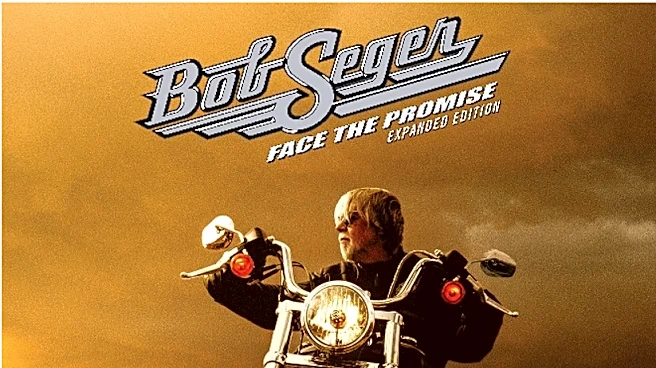




In September 2006, Bob Seger emerged from a decade-long hiatus to win widespread acclaim for an album harking back to his roots.
Now, as “Face the Promise” turns 20, Capitol Records is spotlighting Seger's comeback record with multiple vinyl and CD releases, a digital streaming debut and several never-heard bonus tracks. The “Face the Promise” reissue includes an expanded four-disc vinyl edition, along with an Amazon-only colored vinyl version and a CD that includes a Walmart specialty release. The music is also hitting streaming platforms for the first time.
The Detroit Free Press has dipped back into the archives for a pair of stories from the week of the album’s original release. Below is Seger’s track-by-track breakdown, and we've also reposted
a wider-ranging interview with Seger.
∼∼∼∼
Originally published Sept. 12, 2006.
Bob Seger’s ‘Face the Promise,’ track by track
By Brian McCollum
Writing and rewriting, tweaking and tinkering down to the wire, Bob Seger spent a decade on his latest album.
Today marks the release of "Face the Promise," a 12-song effort recorded in Nashville and near Clarkston with longtime engineer David Cole of Los Angeles.

"It's real easy to get snowblind working on a group of songs for that long," says Cole. "My hat's off to Bob for staying the course, and pushing himself as an artist."
Seger and Cole sat down with the Free Press to break down the tracks.
1. "Wreck This Heart"
Seger: "It's about the balance of family and work. I was banging along on an electric guitar and started singing ‘Wreck this Heart' to the chords and said, ‘Oh, wow, is that cool.' And that's how it happens: I'll sing 200 times and not get anything. Then on 201 I'll sing something cool and, boom, I've got a song."
Cole: "I'm excited there's so much rock on this album. Fans will gravitate toward those songs."
2. "Wait for Me"
Cole: "I know they made a video that showcases a younger Bob kind of guy on a motorcycle with the beautiful girl. It's the director's interpretation of that song, and invokes the heartland, and hopefully captures some broader audience for him. But when Bob explained the song to me, it's really a message to his kids."
Seger: "I don't think anybody got it. In my mind, you've got to have the discipline to allow your kids to make their own mistakes. … Sometimes I've got to get away, but I'll always come back."
3. "Face the Promise"
Seger: "It's about kids from small towns looking at the big American dream: ‘I'm gonna go out and face the promise of the promised land. I want to get to the big city and get off this farm.'… A pretty swampy, rock-blues song. I really like it."
Cole: "One of the songs that's been around for the duration of this process. Another barnburner."
4. "No Matter Who You Are"
Seger: "There was a song by Joni Mitchell called ‘Dog Eat Dog' that inspired ‘No Matter Who You Are.' She's singing about an artist who comes out and has this special, unique thing, as all artists do. And then after maybe one or two hits, the record company says, ‘Now keep writing 'em like that.' That's it in a nutshell: You have to guard your special, pure thing and cherish it."
5. "Are You"
Seger: "‘Are You' is about rampant commercialism, and how we're inundated with it."
Cole: "This has some of the best drum work. I love what Steve Brewster brought to it. It was a tough song for him to wrap his head around. Bob had this idea for a particular beat. He had demo'd it at home with a drum machine. You can do anything you want with a drum machine, but when it comes time for a real person to do it, it can be really difficult. But he nailed it.
"Obviously you see a lot of Nashville musicians on this record. Bob likes working in Nashville. You call these cats, and they're just thrilled to come in and play on a Bob Seger record."

6. "Simplicity"
Seger: "Keep things simple. Again, it's advice to my kids: The fundamentals will get you through. Be a good listener if you wanna be a good friend. Little things like that."
Cole: "Normally people record a few instruments at a time, but Bob said, ‘No, I want to do this as a full band like the old Phil Spector records.' A full horn section, keyboards, guitars, percussion, drums, and Bob singing live — we had the whole thing going at once."
7. "No More"
Seger: "‘No More' is about the Iraq war. I don't know if we stay there any longer that it's going to get any better. The troops have done a fantastic job. … But what's going to change in the next five years if we come home right now?"
8. "Real Mean Bottle" (with Kid Rock)
Cole: "He's got the mutual admiration society with Kid Rock — they're buddies, they share a manager, their kids play together. When he said to Kid, ‘Hey, do you want to do this Vince Gill song?' Kid dropped everything and said, ‘When?!'
"He came in and said, ‘Man, we've got to rock this thing.' He started singing it at double speed with all this attitude. Bob's eyes lit up. It really came together on the spot."

9. "Won't Stop"
Seger: "‘Won't Stop' is about addiction. And I think it goes nice with ‘Real Mean Bottle,' actually. We were kind of making fun of drinking, and all that, but then I wanted a serious song about addiction — like, ‘I don't condone this.' "
Cole: "He said, ‘You know, I think this should be really sparse, just guitar and voice.'… I said, ‘We should bring in this guy Eric Darken to do percussion — he might have an idea for a tambourine or shaker part, something simple.' He's down in Nashville, we're in Detroit. I sent him a file over the Internet and had him play on it and send it back to us."
10. "Between"
Seger: "I think my favorite song on the record is ‘Between.' I just love the groove. I love the way I sang it, I love the way they played it, I love the way the girls sang it. And it says exactly what I wanted to say."
11. "The Answer's in the Question" (with Patty Loveless)
Seger: "I thought, what a cool idea for a song: The answer is in the question. ‘Will you be home late again?' OK, if you ask somebody that, there's something wrong."
Cole: "When he wrote that song, he said, ‘You know, I can hear this as a duet. It would be cool to have the male and female perspective on the lyric.' He said his first choice would be to sing with Patty Loveless, because he's such a fan of hers. He wasn't sure she'd want to do it."
Seger: "I called her up and said, ‘Now, trust me — it's not a hit.' "
Cole: "She just gushed and responded, ‘I'm you're biggest fan — what are you talking about?!' "
12. "The Long Goodbye"
Cole: "When I heard it, I really was attracted to the melody and the simplicity of the arrangement, and I didn't really understand what the lyric was all about. I had a sense of it, but didn't really get it. And Bob explained it to me."
Seger: "It's about Alzheimer's disease. I dealt with that with my aunt, after my mother died. And now, my wife is dealing with it with her father. So it became fresh again.
"I was just folk-picking one day on a guitar, doing all these strange chords. That song has more chords in it than any other song on the record. There's like four chords for three words at times. So it's a very complicated chord structure, and I just really loved it. So I thought, ‘What am I going to sing to this?' And I came up with ‘The Long Goodbye.' "
Contact Detroit Free Press music writer Brian McCollum: 313-223-4450 or bmccollum@freepress.com.
This article originally appeared on Detroit Free Press: From the archives: Bob Seger breaks down 'Face the Promise' tracks