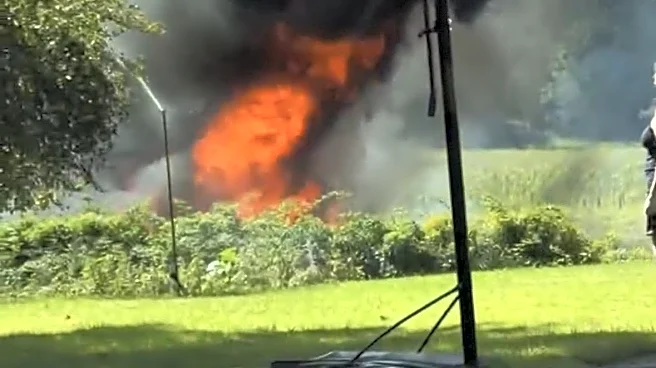








More than 30 people were evaluated and decontaminated – six of them still hospitalized in stable condition − after a military jet crash in Northern Michigan exposed them to a hazardous chemical called hydrazine.
The F-16 Fighting Falcon went down Thursday, Sept. 17, in the area of County Road 633, about 15 minutes south of Traverse City, amid a training trip for the Texas Air National Guard.
The pilot ejected and was reported to be in stable condition, but a new health worry arose due to hazardous chemicals at the scene. At about 4 p.m. Thursday, about two hours after Grand Traverse County dispatchers posted on social media about the downed jet, county officials upgraded a shelter-in-place to an evacuation within a mile radius from the crash site.
The evacuation was lifted about six hours later, though some specific residents were disallowed from going home, according to social media posts from county officials.
However, Munson Medical Center became the site for decontamination, as officials decided to have those within 150 feet of the crash come in for evaluation, said Megan Brown, chief communications officer for Munson Healthcare, on Friday, Sept. 18.
Of the 34 people who did, some were symptomatic and some were not, she said. Six of the 34 were admitted to the hospital and were listed in stable condition.
Symptoms include coughing, wheezing or trouble breathing, according to the health system.
Hydrazine is a chemical used in rocket fuels, chemical manufacturing, and as boiler water treatments, according to a FAQ page on the chemical on the website of the U.S. Department of Health and Human Service’s Agency for Toxic Substances and Disease Registry.
The substance can cause irritation of the mucus membrane in the lungs and can cause someone to stop breathing, Brown said.
Another concern is impact on the nervous system, though that is generally if it is ingested, she said. So, the primary concern was the lung concern.
The majority of those evaluated and decontaminated were first responders, Brown said.
The health system’s guidance for others in the area, within 1 mile of the crash, was to seek treatment if symptoms arise. Others in that radius who don’t have symptoms are instructed to monitor for symptoms at home over the next several days.
The federal substance registry website notes that “the effects of exposure to any hazardous substance depend on the dose, the duration, how you are exposed, personal traits and habits, and whether other chemicals are present.”
It indicates that multiple agencies describe hydrazine as a known, possible or probable cancer-causing substance and that one other agency changed its listing recently to list the chemical as an animal carcinogen not likely to cause cancer in humans under normal exposure.
Several articles on U.S. military websites alsoidentify the chemical as cancerous.
The health system will be working with the county’s health department in the coming days when it comes to evaluating any long-term concerns, Brown said.
This article originally appeared on Detroit Free Press: 6 still in hospital, dozens decontaminated after Up North F-16 crash