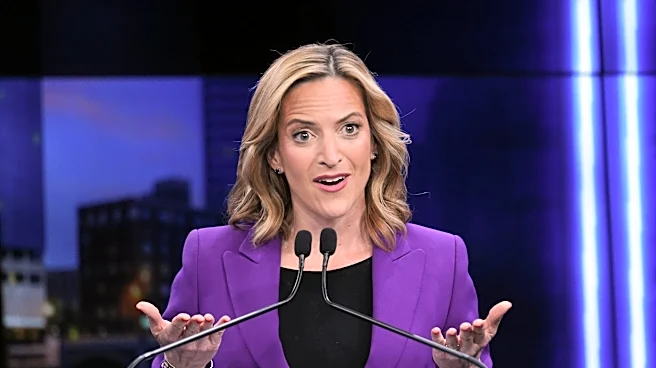




In a populist moment, Jocelyn Benson proudly wears the label of a technocrat.
If voters choose the sitting secretary of state to lead Michigan as its next governor, Benson argues she can tackle other broken government systems the way she tackled the ones she inherited when she took office in 2019.
She boasts about saving drivers time with grocery store kiosks for renewing license plate tabs and implementing universal absentee voting during the COVID-19 pandemic. Even the tech glitches that plagued the rollout of a new campaign finance reporting platform is evidence, she has argued, that she is unafraid to transform unwieldy government systems.
She not only highlights her professional background in making the pitch but also says being a mother to
her 10-year-old son, Aidan, motivates her to tackle Michigan's biggest challenges with urgency.
At a "Women for Benson" coalition launch event over the summer in Ferndale, Benson said, "Look, women get it done, do we not?" to applause. She had recently returned from Philadelphia, she said, noting its nickname as the City of Brotherly Love.
"We're going to build a state of sisterly effectiveness," she promised.
Benson, 48, came into statewide office in 2018 on a Democratic ticket dominated by women as she ran alongside Gov. Gretchen Whitmer and Attorney General Dana Nessel. In her race to lead Michigan, she faces Republican U.S. Rep. John James of Shelby Township.
Benson is a graduate of Wellesley College, the alma mater of prominent female political leaders such as former Democratic presidential nominee Hillary Clinton and former U.S. Secretary of State Madeleine Albright.
The day after her August primary win, she wore a shirt that read "We are the women we've been waiting for." On Instagram and on the stage of the Michigan Democratic Party convention, Benson picked "Maneater" by Nelly Furtado as her hype track.
If she and her running mate, Michigan Senate Majority Leader Winnie Brinks, D-Grand Rapids, win, it would mark the first time in Michigan history that a woman governor and lieutenant governor have served alongside one another.
"We built this ticket where you've got two women potentially serving in the highest two offices in the state, so that's exciting," Benson said.
Benson's campaign got off to a rocky start when she held a launch event in 2025 at the Michigan Department of State’s office in violation of campaign finance law.
But as Benson – an avid marathoner – approaches the finish line of her race, political observers see her cruising toward a victory as voter sentiment sours toward President Donald Trump, who supports her opponent James.
"If Jocelyn Benson were to lose then everyone is reading the tea leaves tremendously badly," said Sterling Heights Councilmember Michael Radtke, a Democratic strategist at Wolverine Strategies.
Benson's path to office
Benson first ran for elected office as a college student in 1997, becoming the youngest member to serve on the local governing body in Wellesley.
Her goal, she said in a recent phone interview, was to ensure student representation on the body. "There were decisions being made without our say," she said. She recalled going to the clerk's office to obtain a list of voters in her precinct, tapping a group of classmates to call them from her dorm room and introducing herself to voters at the polling place on Election Day.
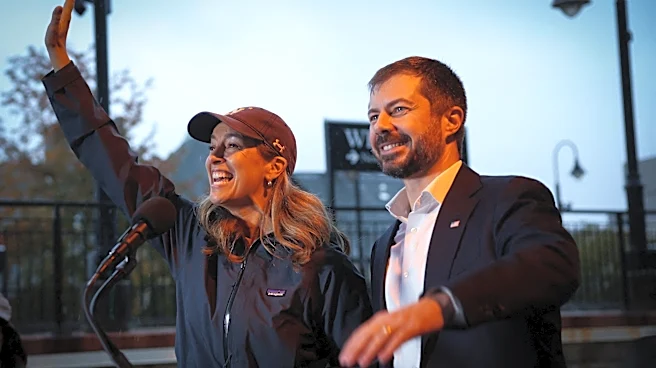
Today, she traverses the United States for fundraisers and her campaign hosts big national Democratic names such as Maryland Gov. Wes Moore, Kentucky Gov. Andy Beshear and former U.S. Transportation Secretary Pete Buttigieg to stump for her in Michigan.
As she asks voters to promote her to governor, Benson talks about her first job out of college. She said she worked as a waitress while also working an unpaid internship with the Southern Poverty Law Center in Alabama before studying at the University of Oxford in the United Kingdom through the prestigious Marshall Scholarship program. She doesn’t recall the name of the restaurant where she said she worked but the feeling of economic uncertainty stuck with her.
"I still remember waiting tables and counting tips at the end of my shift," she says in one ad. "I believe government should work as hard as you do."
Benson received her law degree in 2004 from Harvard University, where she met her husband Ryan Friedrichs in an election law class and first connected during a debate on open primaries, she told the Free Press in a 2022 interview.
She first sought elected office in Michigan in 2010 and lost to Republican Ruth Johnson. She mulled a congressional run in 2014 but ultimately decided not to pursue it. She went on to serve as dean of Wayne State University's Law School and the CEO of the Ross Initiative in Sports for Equality, a nonprofit started by Stephen Ross — the founder of the real estate firm Related Companies — focused on improving race relations in sports. Friedrichs is a vice president of development at Related Companies and his previous work on a controversial data center project in Saline Township has come up often as Benson promises a moratorium on data centers.
As Michigan's chief elections officer, Benson resisted Trump and his allies' campaign to interfere in the 2020 election, which he lost. She says she has already stood up to the president when his agenda threatens Michigan and would do so as governor.
Meanwhile, she has called her GOP rival James an "election denier" and cast him as a Trump loyalist.
Benson's campaign pitch
Benson has put forward a broad policy agenda that includes establishing a $5,000 tax credit for caregivers, expanding a cash assistance program for new mothers statewide, giving families access to free pre-K for all three-year-olds, lowering household energy costs and allowing local governments to set a minimum wage higher than the statewide one.
At the heart of her campaign is a promise to bring "costs down" and "wages up."
She hasn't outlined specific plans for paying for her proposals, indicating that she can work with current state funds without raising taxes, though she has also promised to create a "blue ribbon commission" to examine how the state generates revenue.
Benson calls health care the "defining issue" in her campaign. She has promised to overhaul the Michigan Department of Health and Human Services to ensure Michiganders receive the benefits they qualify for as she rails against the Medicaid cuts approved by Republicans in Washington, D.C., including her opponent, James.
It's one of many votes Benson has highlighted in her relentless quest to tie James to Trump as she hammers their Republican agenda, including the president's trade war with Canada and military conflict in Iran that has raised gas prices, which James has supported but now wants to see come to an end.
Democratic strategist Charly Norton said voters who previously backed Trump will support Benson this fall. "We're seeing across the state, as well as across the country, Trump is underwater and rightfully so," she said.
If Benson wins, it will mark the first time in decades that Michigan voters don't replace the outgoing governor with someone from the opposite party.
Contact Clara Hendrickson at chendrickson@freepress.com or 313-296-5743.
This article originally appeared on Detroit Free Press: Benson promises to make Michigan 'a state of sisterly effectiveness'