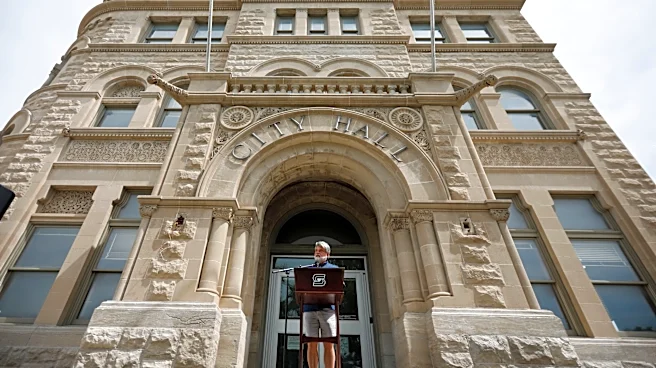





More than a year after Willard residents gathered the more than 400 signatures needed for the state to audit the city, the results have been made public. State Auditor Scott Fitzpatrick announced Thursday, Aug. 13 that while the audit found no evidence of fraud, the city is in dire need of improvements to its water system.
The petition was started after a former mayor and alderman had been charged in federal court with wire fraud and identity theft. Corey Hendrickson was sentenced to serve three years in federal prison for embezzling nearly $300,000 from the company he worked for in August 2024. He was released from prison July 8 on supervised release.
"I know the people of Willard were concerned that the fraud perpetrated by Corey Hendrickson
at his place of employment may have spilled over to the city, but our audit of the city has found no evidence that he misused taxpayer dollars," Fitzpatrick said in a news release. "There are, however, many areas where the city can improve the way it operates and that includes city officials taking action to mitigate the extreme amount of water the city's system is losing each year. In order to keep utility rates down for its citizens, the city needs to figure out why it is losing tens of millions of gallons of water each year and take steps to keep that from happening in the future."

The audit found that in 2024, the city lost nearly 72.7 million gallons — 24% — of the nearly 300.6 million gallons of the water it pumped, according to the release. In 2025, that rose to 82 million gallons, or 26%, of nearly 315.2 million gallons pumped. The standard for acceptable losses from public water systems set by the Missouri Department of Natural Resources is 10%.
According to the city's responses in the audit report, Willard has already began efforts to repair water lines, upgrade meters and detect leaks.
"In response to this audit, the city intends to include a dedicated annual appropriation of approximately $200,000 for water loss reduction initiatives and will continue funding these efforts until water loss rates are reduced to 10% or less," the city's response read.
The city has faced years of deferred maintenance on its water and sewer systems. In order to address this issue, the city has in recent years weighed and implemented rate increases.
Other findings in the audit include the city lacking a written procedure for collecting outstanding balances for inactive utility accounts and not submitting old accounts to a collection agency as a city policy sets out. As of March 2026, the city had more than 320 customer utility accounts that had been disconnected with balances totaling nearly $42,000 that were more than 90 days past due, according to the release.
Willard Mayor Troy Smith told the News-Leader he was glad to see the audit confirm there was no criminal activity within the city and said the city already had "solutions in motion to rectify" all the other issues identified. He noted that the water and sewer systems are costly to fix, but the city is moving along to address infrastructure needs.
Smith said he was hopeful the audit addressed citizens' concerns and the city can continue moving forward.
Other issues include outstanding checks, Sunshine Law violations
Beyond utilities, the audit also found issues with the city's personnel management. It revealed that the city did not report allowances paid to the city administrator as taxable income on the employee's W-2 form for 2024, the year Willard hired a new city administrator. That included $5,000 for housing expenses, $2,000 for moving expenses and $200 in automobile expenses. The audit also found the city's personnel manual does not adequately address holiday pay, with nine employees using more personal holiday leave than allowed by policy or practice, ranging from 1.5 to 11 hours in excess per employee. Smith said the city has almost completed its updated employee handbook to address these points.
Other findings in the audit report point to inconsistent compliance with the Sunshine Law and failure by the city to have a comprehensive records management and retention policy that includes electronic communications. According to the audit report, city staff could not provide closed meeting minutes for 9 out of 19 closed meetings held in 2024 and 6 of these 19 meetings lacked a documented specific reason or section of law allowing the meeting to be closed. This is not the first time the city of Willard has struggled with compliance with the Sunshine Law. In 2024, city leaders were instructed to undergo Sunshine Law training after two complaints were filed with the Missouri Attorney General's Office.
Another issue the audit found was the failure to follow up on old outstanding checks and paying sales taxes on purchases that should have been tax exempt. According to the report, as of June 2025, there were 134 checks totaling more than $7,200 that were outstanding for more than a year, with the oldest dating back to 2016.
Overall, the audit gave the city a rating of "fair," the second lowest rating.
Two Willard residents led the charge collecting signatures for the audit — Angie Wilson and Megan Applegate. The process took nearly a year, with the duo arranging meet ups and setting up outside of polling places during elections. While the Willard Board of Aldermen had heard requests for an audit to ensure the city's finances were in order, the board ultimately did not vote to call upon the state auditor themselves. It did however budget $100,000 for the cost of the audit in anticipation of a successful petition. According to a city of Willard news release, the city has not yet received the invoice for the exact amount the audit will cost.
Wilson and Applegate via an emailed statement to the News-Leader expressed relief that the audit did not find any misuse of public funds but noted the findings the audit did reveal still should be taken seriously. Particularly, the two noted recent concerns from residents regarding Sunshine Law practices and hoped for the city to work toward being more open and responsive.
"The state petition audit is an opportunity to make local government stronger and more accountable," the statement read. "We hope this serves as an example to other communities that may feel unheard. This process demonstrates that when residents come together, ask questions, and respectfully seek accountability, their collective voice can lead to meaningful action."
The duo stated they are hopeful that city leadership will follow through on the auditor's recommendations and use the report as an opportunity for growth. They noted the goal of requesting the audit was "not to find wrongdoing, but to ensure our city is operating in the best interest of Willard residents."
Prior to the petition audit, the last state audit of Willard was completed in 2010, according to previous News-Leader reporting. However, the city is audited by a private auditing company every year.
Marta Mieze covers local government at the News-Leader. Have feedback, tips or story ideas? Contact her at mmieze@news-leader.com.
This article originally appeared on Springfield News-Leader: Willard state audit reveals water loss double the state standard