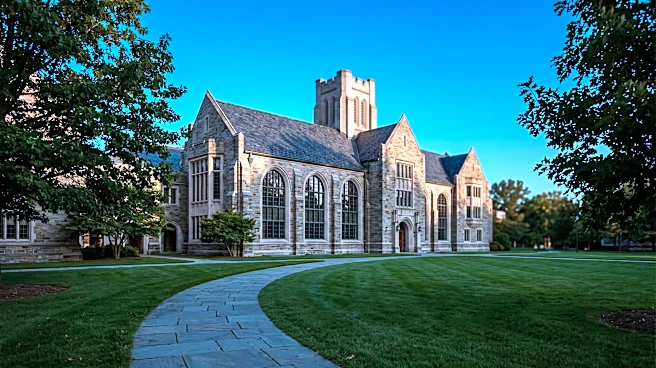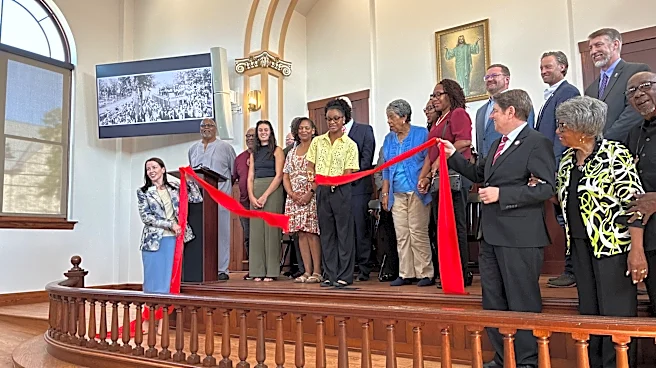

After years of renovations, a century-old church will live a new life as a part of Drury University's campus. The school formally dedicated Benton Avenue African Methodist Episcopal Church and hosted a ribbon-cutting
on Sept. 25.
The project, which was made possible by private donations as well as funds from the State of Missouri and Greene County, included a 50-year roof, improvements to windows and brickwork and a complete restoration of the church's sanctuary.
In addition to preserving a key part of African American history in Springfield, the church will serve as an educational center by hosting lectures, classes, community programs and events, said Lauren Coleman, a junior at Drury University who introduced each speaker during the dedication and cut the ribbon.

Former Drury University administrator Roslyn Thomas shared her joy at knowing the church would continue to serve the community.
"As an alumna of Drury and later an administrator who served under three presidents, I am pleased to know that this beautiful building will be a place where our students can learn about history and be exposed to a variety of cultural experiences. As an educator who worked in Springfield Public Schools for 34 years after graduating from Drury, I am excited to know that exhibits and events in this building will serve as a resource for school children and the greater community," Thomas said. "As a longtime resident of Springfield, I have known many friends who were part of Benton Avenue AME Church congregation, and I am deeply moved to know that the legacy that they built will continue here on the campus of Drury University."
Benton Avenue AME Church was organized in 1872 and the current church building at 830 N. Benton Ave. was completed in 1926. People worshiped, mourned, celebrated and found comfort and connection there until it closed on July 1, 2014.
From 1959 to 1961, the church was pastored by the Rev. Oliver Brown. Brown was the lead plaintiff in the landmark 1954 Brown v. Board of Education Supreme Court decision, which led to desegregation by ending "separate but equal" legal doctrine in schools.
"We pause to remember and honor all those people who came into this building for the causes of faith and the causes of freedom, believing that the promise of the nation could be fulfilled if good people could come together and have meaningful conversations changing the world," said Drury President Jeff Frederick during the dedication. "And we pause ... to honor all the people who came into a space like this, hoping, praying, and desiring a space where all schools were open to them, as well as neighborhoods, employment, the very basis of liberty, in every other way inherent to the belief that we're all in this together."
Since its establishment after the Civil War, Benton Avenue AME Church was a place of liberty and connection for Springfield's African American community.
"Benton Avenue, along with Gibson Presbyterian Church, Pitts Chapel and Washington Avenue, all of these churches actually began once slavery was abolished, which is very similar to what took place across the nation," said Lyle Foster, a professor of sociology, anthropology and gerontology at Missouri State University, after the dedication ceremony. "They represent the call of freedom, the ability to worship together and not have to do it in the silence, not have to do it in hiding, not have to be in the upper balcony in other churches. And so it just kind of takes us back to a time that we can learn from and hopefully never replicate."
This article originally appeared on Springfield News-Leader: Historic Springfield African American church will live on with Drury