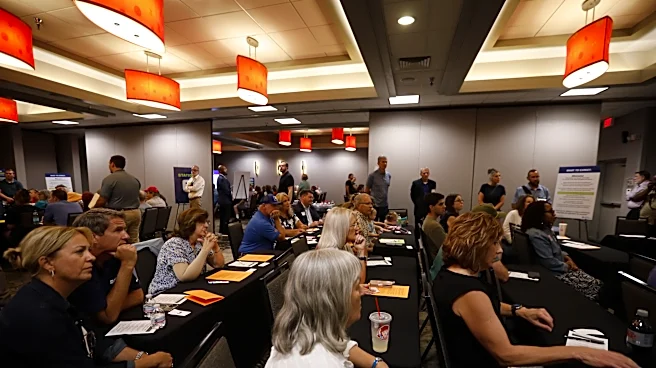



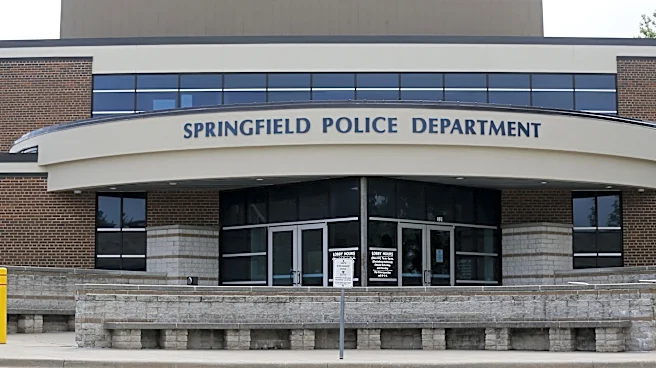

Amid a 120-day moratorium on data centers, Springfield city staff are working to put together a framework of regulations to evaluate any data centers proposed within city limits. On Thursday, Aug. 27, the city held the first public engagement session on the topic, which saw several members of the public outright opposed to data centers as a whole.
The term "data center" generally pertains to structures that contain computer equipment and typically operate autonomously around the clock but can vary in scale. While these developments that store servers and other equipment needed to power the internet are not new, the recent artificial intelligence boom has created significantly higher demand for these types of facilities.
Springfield City Council
passed a 120-day administrative delay on data center applications in late June to give time for the city to evaluate a long-term policy framework to use when reviewing data center proposals. In order to create regulations, the city, alongside City Utilities, is hosting public engagement sessions to gather input.

Thursday night's event at the DoubleTree by Hilton filled the event to capacity at 200 people. Cora Scott, the city's chief spokesperson, said several community members who were not able to get a spot Thursday were put down to be first in the door for the next public engagement session, Tuesday, Sept. 1, from 4:30-6:30 p.m. at the Library Center's Hatch Auditorium, 4653 S. Campbell Ave. She said the city has struggled to find an available event space large enough to accommodate the events and an additional third session is likely going to be scheduled in the future due to the high interest.
The session included the crowd being split into six groups with subject matter experts rotating through each station to share information, answer questions and listen to feedback. In the group the News-Leader joined, several members of the public expressed a perception that the city has already set its sights on allowing data centers and the community was being asked for ways to make peace with it.
While some noted they were there to learn more about the topic and what the city was doing, others already were opposed to any proposals for data centers. City staff emphasized that a "no" was an option for the end result of the city's process, though some attendees expressed frustration that did not feel like the case.
The topics covered Thursday night were land use, safety, water, electricity, sound and community benefit.
How utilities would handle data centers
Two stations focused conversations on utilities, split between electricity and water and sewer. Computer technology within data centers typically requires more electricity to operate and uses water to keep equipment cool.
CU Senior Vice President Amy Derdall said CU's top priority is protecting current customers. The utility has put together a large load taskforce to review any applications for new large load customers and ensure costs of any upgrades to infrastructure necessary to accommodate a development like a data center would be covered by that business.
"Any cost, any upgrades for capacity, for generation, for purchase power, transmission, substations, electric infrastructure or any other cost will be passed on to that developer," Derdall said. "So, to further protect customers, we'll require contracts with financial commitments. We will need deposits or some kind of security bonds or some types of lines of credit that we can draw on to ensure that we receive full payment from them."
CU is part of the regional Southwest Power Pool grid. Vice President of Electric Operations Warren Brooks said any proposal for a large enough data center or a project that requires changes in the transmission system, such as a new substation, would be required to undergo an SPP study and review prior to approval, which could place additional requirements on the developer.
Across the country, some communities where data centers have moved in have seen electricity bills skyrocket due to the increased demand on the grid. Derdall said the utility is working with rate consultants and external counsel to research rate models that could be designed for data center-type users specifically to ensure that specific customer covers any price increase due to increased demand. She said CU has looked at different models across the state and the country to see what efforts have been working well.
When it comes to water, Krista Shurtz, CU's vice president of Natural Gas & Water Operations, said the utility has to ensure long-term water supply for the area, so any addition of a data center-type customer will first have to undergo a capacity review to determine what the impact would be on the distribution or treatment system. She said the end cost of providing water to a data center or similar large water user would be passed on to the developer directly.
Data centers are typically categorized by two possible cooling methods — a closed-loop system or an open, or evaporative, system. In a closed-loop system, water consumption is typically lower because water is recycled within the system cooling equipment. An evaporative system requires more direct water consumption as it is exposed to air and cools equipment through evaporation.
Shurtz said the water consumption of a typical closed-loop data center would exceed the largest consumer the utility currently provides water to.
Water consumed also creates wastewater for the city to treat. Ron Petering, the city's assistant director of Environmental Services, said a data center would be regulated like any other industrial player in the community, via a permit that sets parameters on content concentrations found in their wastewater. For the evaporative model, he said a data center would produce less wastewater, but it would be more highly concentrated, which could make it harder to treat.
Petering also presented that the city's effluent could be used to cool data centers, therefore cutting down on the water needed from CU and providing a revenue source for the wastewater operations. Industrial users already pay surcharges based on what they send for wastewater treatment. Currently, sewer bills are based on the volume of water usage, though questions arose Thursday night whether data center rates could consider volume of actual wastewater.
Other regulations on data centers
Steve Childers, the city's director of Planning & Development, categorized data centers by scale. Small data centers consume up to two megawatts of electricity, medium facilities 2-5 MW and large ones more than 5 MW. With sound being a concern for property owners near proposed data centers, especially with 24/7 operations, he said regulations such as setbacks and design guidelines of structures such as sound walls can help mitigate that impact. Childers noted regulations could include setting certain thresholds for sound and light emitted by a development.
Similarly, Justin Crighton, the city's assistant director of Planning & Development, laid out four ways the city can set rules for development: By designating which areas are appropriate for a certain development, how far away developments should be from their neighbors, what and how big the buffer between the two should be, and what happens to a structure, like a data center, at the end of its life. Those voicing their thoughts in the group the News-Leader was a part of expressed feeling like there were too many variables to be able to give detailed feedback that would also depend on scale of the operation proposed.

Springfield Fire Chief David Pennington said a new section of the fire code specific to data centers is being drafted. He noted that while these structures are not inherently dangerous, they consist of a complex concentration of risk factors. The fire chief said he has had discussions with up to 10 benchmark cities to consider how others have approached it and craft regulations specific to Springfield. Alongside the legislative side, he said the department must also be trained and have necessary resources to respond to fire events at these facilities.
To ensure Springfield is prepared, Pennington said the fire code would be in place prior to any proposal being considered, if the city decides to allow data centers.
"As the fire chief, my job is to see around corners about what hazards could be presented to your community, and I have to be prepared to solve the problem," he said. "If I waited until the council made a decision, now I'm behind, sorely behind."
Amanda Ohlensehlen, director of economic vitality, asked what Springfieldians would like to see prioritized in a potential community benefit agreement, a legally binding contract that other communities have used to require a project developer to contribute to the community in some way. She shared examples of direct monetary contributions to the city or a dedicated fund, job and wage requirements or infrastructure improvements.
Ideas heard by the News-Leader included requiring construction and installation workers to be paid a livable wage, receive insurance and be hired from within the community, and a requirement for the developer to cover the cost of retraining the workforce whose jobs could be replaced by AI.
Yet, skepticism of any benefit coming from a data center development persisted.
"When it's couched in terms of something's going to generate this many jobs or something's going to bring this much tax revenue into the coffers, that money never seems to make it back to me. It never feels like it makes it back to the people," said Christine Vande Griend. "So, it's difficult for me to give an answer as to what that would look like — it's all very ephemeral ... and not worth the risk in my view at all."

Vande Griend lives in Springfield but has a family farm and land in Webster County, where a data center was built earlier this year. Speaking with the News-Leader following Thursday's event, she said she does not want to see the same scenario, which she called "dreadful," play out in Springfield.
"I'm glad that they're doing this in order to get some feedback at all," she said. "What will come of that feedback, and what kind of action and transparency we will get as a result of that feedback, that remains to be seen."
While concerns about plans for a data center at 2900 S. National Ave. have circulated on social media, Scott told local media previously that a rezoning application has been filed for the property to allow for the development for a veterinary clinic/hospital. She confirmed the city did have formal pre-development conversations with Trent Overhue, owner of Plaza Towers who was involved in the data center development in Marshfield, regarding the property prior to the administrative delay's passage.
Because of the pause, no plans for data centers can proceed, and Scott stressed that the rezoning application makes no references to a data center. City Manager David Cameron previously said the 120-day moratorium set to expire in late October could be extended if the city needs additional time. A member of the group the News-Leader was a part of suggested the city hold a special election on a permanent moratorium.
The consulting group Habitat Communication & Culture is helping the city host public engagement sessions. Scott said the contract is not to exceed $35,000 and is funded through the city manager's contingency fund.
Feedback can also be shared with the city via email at city@springfieldmo.gov and via phone through the city's hotline at 417-864-1700. Information is also available on the city's website at www.springfieldmo.gov/datacenters. A citywide survey can also be filled out online.
Marta Mieze covers local government at the News-Leader. Have feedback, tips or story ideas? Contact her at mmieze@news-leader.com.
This article originally appeared on Springfield News-Leader: Experts explain how data centers work and how Springfield is preparing