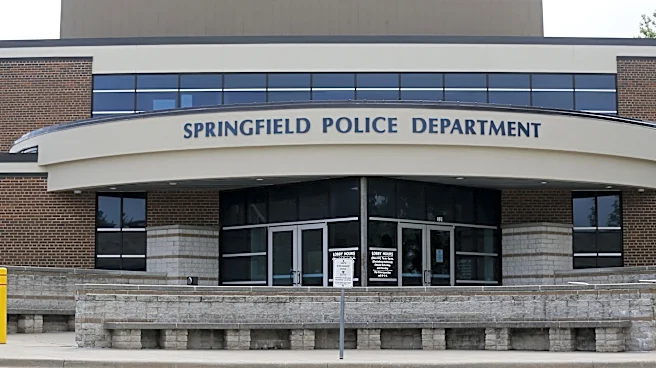





A comprehensive review of the Springfield Police Department's traffic stop data and internal policies shows the department has largely shifted traffic enforcement toward issuing more warnings, but it is yet to be seen whether this approach is effective in reducing high-risk driving behaviors.
After Springfield City Council adopted a public safety council priority, the council directed the city manager to conduct a review of SPD's policies for alignment with the priority as it relates to enforcement of motor vehicle violations and traffic safety. The council priority calls for the city to "reimagine public safety to improve community trust, reduce offenses impacting quality of life, and enhance operational efficiency through enforcement, resource
optimization, and strategic partnerships." On Monday, Aug. 24, the results of that review were presented.

Overall, the report showed the city has seen a decline in injury crashes at the highest-risk intersections over the past decade and most officers believe the department's Standard Operating Guidelines, the internal policies that dictate day-to-day policing, are not an obstacle to effective enforcement of traffic violations. The operating guidelines were found to align with council's priority and national best practices. But the report also posed several policy questions to the elected leaders for possible steps forward, including the potential use of red-light cameras.
Data shows shift to warnings over citations
The data presented Monday showed that over the past five years, total traffic stops increased 48%, from roughly 13,800 in 2021 to nearly 20,500 in 2025. At the same time, citations declined by about 20% while warnings increased by 76%. Because this more discretionary approach is more recent, it is not yet clear how or if it will translate into measurable safety improvements.
The report also included data on the top 10 intersections that see the highest frequency of injury crashes. Combining the number of injury crashes at these intersections from 2016 to 2025 showed that the Campbell Avenue corridor dominated, with both Campbell and Walnut Lawn and Campbell and Republic Road crossing 100 injury crashes total across those years. However, the report notes that recent road improvements at Republic have resulted in a reduction in injury accidents and there are upcoming plans for improvements at Walnut Lawn. SPD also uses these top 10 locations to inform enforcement efforts.
Other top intersections include Kansas Expressway and Sunshine Street, Kearney Street and Glenstone Avenue, and Kearney and National Avenue. Overall, the data showed injury crashes declining in the past decade alongside traffic violations, suggesting enforcement and compliance lead to safer behavior on the streets.
A survey of SPD staff showed most don't see the department's policies as a hindrance to more proactive enforcement, instead pointing to a lack of staffing and increased workload as more significant obstacles. The report noted that SPD's dedicated traffic unit has struggled with understaffing, leaving targeted traffic enforcement without or with a reduced squad at night, which the report notes is the time when impaired and hazardous driving is most prevalent. As staffing at the department improves as a whole, SPD is rebuilding the evening squad to step up proactive enforcement. The traffic unit also includes two daytime squads.
"These positive trends indicate that many of SPD’s strategies — targeted enforcement, collaboration with Traffic Engineering, specialized DWI/HMV operations, and the application of data analytics — are contributing to improved roadway safety," the report stated. "At the same time, staffing shortages, limited evening enforcement capacity, fluctuations in enforcement emphasis, and evolving driving behaviors continue to affect SPD’s ability to maximize proactive enforcement during critical hours."
The survey, which saw an 18.2% response rate, pointed to some officer concerns regarding policies centered on pursuits, homeless protocol and general administrative tasks, such as documentation and report-writing. The survey indicated some policies could be streamlined and adjusted to reduce redundant reporting requirements.
Alongside rebuilding the traffic unit's staffing, the SPD's next steps outlined Monday include focusing deployment at high-risk corridors, such as Campbell and Glenstone, and reporting progress publicly to establish community trust and to be more transparent about crash reductions and enforcement metrics.
Council to consider policy guidance
The review asked council to consider the following policy questions moving forward:
- How should the city balance visible, proactive enforcement with community trust? — Proactive traffic enforcement is a proven tool for reducing crashes and hazardous driving but increased stops could lead to a perception of over-policing.
- What is the right mix of warnings vs. citations to drive compliance? — While the current shift to warnings builds community trust, how effective it is at actually deterring violations is not yet clear.
- How should the city prioritize resources among hazardous driving, neighborhood complaints and parking? — SPD has recently had specialized enforcement campaigns focused on out-of-date vehicle registration in 2025 and noisy vehicles more recently, but hazardous-behavior crashes still remain a top community concern.
- Should automated tools, such as red-light cameras, be considered and under what guardrails? — The city used red-light cameras at certain intersections from 2007 to 2010, when the Missouri Supreme Court ruled the way the city was handling violations conflicted with state law, according to previous News-Leader reporting. Although there was a way to operate the cameras legally under a different system, the city instead removed the cameras entirely in 2014. The report presented Monday questions whether the city should consider reinstating the program. SPD currently uses technology such as body-worn cameras, in-car video cameras, and automatic license plate readers, the latter of which have attracted criticism locally and nationwide.
On Monday night, council voted to refer the report and these policy questions to the Plans and Policies Committee to review and discuss. Prior to any changes to policies or police tools, the matter will have to come back to the full council for a public hearing and final vote.
Marta Mieze covers local government at the News-Leader. Have feedback, tips or story ideas? Contact her at mmieze@news-leader.com.
This article originally appeared on Springfield News-Leader: What a review of Springfield traffic enforcement shows about approach