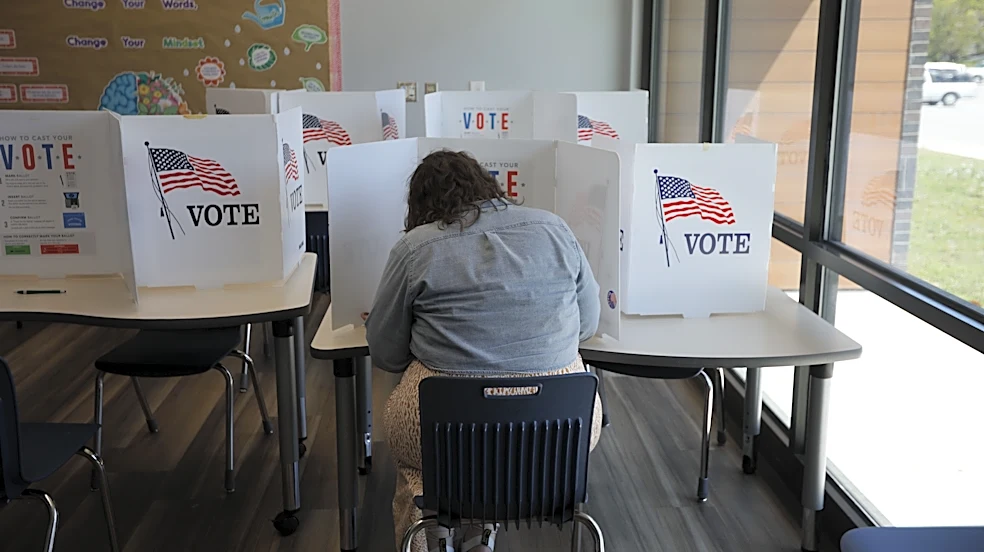









For the second time in as many years, Missouri voters are being asked to give their opinion on the legality of abortion.
On Nov. 3, they will vote on it again, this time deciding whether to enact an amendment that would repeal most abortion rights and prohibit gender transitions for minors.
In 2024, 51.6% of voters approved an amendment that enshrined the right to abortion in the state constitution. That measure, also known as Amendment 3, made abortion legal in Missouri, which previously had some of the nation's most restrictive laws after Roe v. Wade was overturned in 2022. Recent polling by St. Louis University and YouGov show that it may once again be a tight race: In August, 43% said they approved of the new ban and 44% opposed it.
Opponents
of the measure like Tori Schafer call the new Amendment 3 "a political power grab meant to undo the will of the people," especially after hearing from people at their doors and at town halls. Schafer is an attorney with the American Civil Liberties Union and a spokesperson for Stop the Ban Missouri. She is also a running to represent Missouri House of Representatives District 99.
"Folks are really, really upset that the Missouri legislature is playing a dirty trick with this amendment, connecting it to different issues. They're also upset that it feels like the politicians of Jefferson City are not listening to voters ... And people feel like their elected officials are just so out of touch with the real concerns of Missourians," Schafer said. "People are like, why are we voting on this again when diesel prices are up? Why are we voting on this again when the economy is crap? That's what Missourians want to talk about. They've already made their voice known on the right to reproduction freedom."
Organization Her Health Her Future advocates for a "yes" vote. They state that the new amendment would "protect children from dangerous transgender procedures" and that it would re-instate "health and safety standards for women's health clinics" that were undermined by "anti-women laws." The News-Leader was not able to reach HHHF for additional comment.
Schafer pushed back on those claims. A 2023 law — known as the SAFE Act — permanently bans "gender transition surgeries on any minors" and until August 2027, bans providers from prescribing cross-gender hormones or puberty blockers to minors. Recent bills such as Senate Bill 10 in 2025 and House Bill 2033 in 2026 have shown legislators' intent to permanently ban cross-gender hormones and puberty blockers for minors.
"That care is not going to be available in Missouri regardless how Missourians vote on Amendment 3," Schafer said.
Additionally, she worries that the amendment will actually make it more harder for people to receive medical care and that it raises questions about how the exceptions for rape and incest would work.
"The chilling effect that this new provision will have on medical care will mean that no one's getting access to abortion care. It is an abortion ban because, right, even if you go into the doctor's office, and a doctor believes their patient and says, okay, I think you qualify for abortion care," Schafer said. "Well, what happens when the Attorney General's office doesn't agree with that assessment? What happens when a survivor is questioned about why she didn't go to the police to report it? We know that the majority of survivors do not take that action, right, and so there is no realistic way where a person under that scenario is going to have access to meaningful care in the state of Missouri."
A "yes" on Amendment 3 would repeal Article I, Section 36 of the Missouri Constitution. It would limit abortion to cases of medical emergency, rape and incest under 12 weeks gestation and fetal anomalies, essentially reinstating post-Roe restrictions; and prohibit gender-affirming procedures for minors including surgery, cross-sex hormones or puberty-blocking drugs. Gender-affirming procedures for minors are already banned by a 2023 law, which is set to expire in 2027.
A "no" vote will leave access to abortion available through fetal viability, which the Missouri statute define as "that stage of fetal development when the life of the unborn child may be continued indefinitely outside the womb by natural or artificial life-supportive systems."
Here are the other ballot measures voters will see at their polling place this year.
Amendment 6
Amendment 6 is another frequently talked about ballot measure, this time pertaining directly to how Missouri citizens add proposals to the ballot.
The amendment, if approved, would enshrine the right to the initiative and referendum petition process, prevent the legislature from weakening those powers, and would make it so that the legislature must have approval from at least 80% of both the House and Senate if it wants to change or repeal laws enacted through the initiative process.
"Amendment 6 protects and strengthens our freedom to pass laws through the citizen initiative petition process. Written by everyday Missourians, AMENDMENT 6 protects your vote from being overturned, guarantees clear ballot language, and protects your right to use the initiative process," according to Respect MO Voters, a grassroots coalition.
The opposition argues that passing the law will allow billionaires to "spend millions putting their preferred rules on the ballots," according to No On 6, and would give them an "even bigger advantage."
A "yes" on Amendment 6 will prevent the people's elected representatives from directly amending or changing any law enacted through the initiative petition process, require any modifications to laws enacted through the initiative process receive at least 80% approval from each chamber of the legislature before going to a public vote, restrict the legislature from passing laws to limit the ability to pursue initiatives and referenda, maintain the current signature requirements for proposing a law or a constitutional amendment; and keep the current requirement that a statewide majority of votes cast by individual legal voters is enough to enact any law or constitutional amendment.
A "no" vote will not change any current constitutional provisions.
Amendment 7
Taxes are back on the ballot with Amendment 7, which proposes the creation of a public endowment fund, the earnings of which are meant to replace tax revenue and eliminate state taxes once the fund has generated enough earnings.
The fund, called the "Show-Me Prosperity Fund" would consist of "money appropriated to it by the General Assembly, and may also receive gifts, donations, grants, and bequests from any source," according to the text of Senate Joint Resolution 95.
Public policy research organization Missouri Budget Watch believes that if approved, Amendment 7 is "unlikely to lead to the elimination of state taxes for decades, if ever" due to the amount the fund would need to reach, and that it could change how Missouri funds services such as public education and health care.
Bill sponsor Sen. Adam Schnelting believes it could be a path forward for the state government.
“My hope is that in, say, 100 years from now, or 125 years from now, Missouri doesn’t tax its citizens whatsoever — at all,” Schnelting said, according to an article by nonprofit newsroom The Beacon. “All taxes, whether of income, corporate income, sales and use, the state portion of the personal property tax or the real estate tax, all of them will be gone. That’s the goal.”
A "yes" vote on Amendment 7 would establish the "Show-Me Prosperity Fund," a public endowment fund to eliminate state-imposed taxes "without impairing the real value of the fund's principal," according to the Secretary of State's site; prohibit the legislature from appropriating or diverting money from the fund until the earnings are enough to eliminate state-imposed taxes; cap the total amount of money that may be appropriated from the fund in a fiscal year; and prohibit the legislature from enacting the eliminated state-imposed taxes unless the fund is unable to meet its obligations due to insolvency, revenue shortfall or program failure.
A "no" vote would not amend the constitution to establish a public endowment fund with the goal of eliminating state-imposed taxes.
Amendment 8
While most county sheriffs are already elected, Amendment 8 would enshrine that right in the Missouri Constitution. It would also make a writ of quo warranto — a legal document that challenges a person's right to hold public office, according to the Cornell Legal Information Institute — the only way to remove a sheriff.
A "yes" vote on Amendment 8 would require counties to elect a sheriff every four years; add sheriff's duties, which are currently outlined in statute, into the constitution; and make it so the only way to remove an elected sheriff from office is through a writ of quo warranto initiated by the Attorney General.
A "no" vote will not amend the constitution.
Proposition A
After three weeks of legal battles, culminating in a decision from the U.S. Supreme Court ordering the use of the 2022 congressional map, voters will have the final say on whether or not Missouri will adopt the congressional map approved by the legislature in 2025.
The 2025 map was drawn in an effort to gerrymander a Kansas City seat held by a Democrat in order to favor Republicans.
A "yes" vote on Proposition A would approve the legislature's redrawn map and repeal the current congressional plan.
A "no" vote would leave the 2022 congressional district boundaries in place.
This article contains reporting by Jackson Cooper.
This article originally appeared on Springfield News-Leader: MO voters to decide on abortion, initiative petitions during midterms