





Collaboration continues to be among Springfield's greatest strengths. Despite the "blue ribbon, red flag" report growing and evolving since its inception in 2004, the ability to work together has persisted across the various editions of the report.
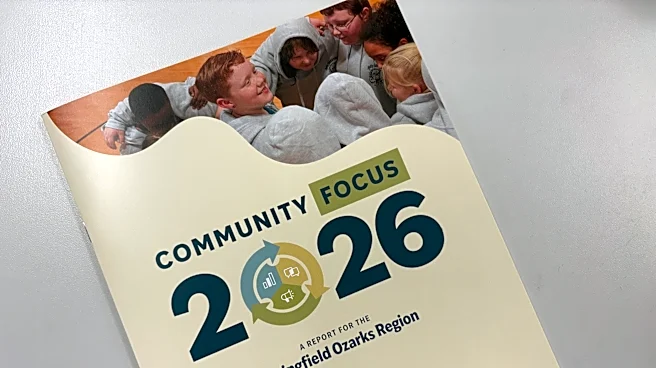
"People here have banded together to actually make things happen, that is the power of collaboration," said Traci Nash, the facilitator of the Community Focus Report that was released Friday, Oct. 2.
The newest report highlights the Queen City's accomplishments and areas for improvement from education and civic engagement to arts and culture and public safety. The community-authored report is created through a partnership of the Community Partnership of the Ozarks, the Darr Family Foundation, Hatch
Foundation, Missouri Foundation for Health and the Tinkler family. In 2024, the Community Focus effort shifted from just a biannual written report to a continuous program housed in the Ozarks Public Health Institute at Missouri State University.

The 2026 report adds two new chapters for exploration — Faith and Food. The report also includes a deeper dive into child welfare in Greene County. Nash said children and families consistently are the most immediately impacted by the "red flags" that show up throughout the report across topics.
Here are the key takeaways from this year's report.
Economic development and civic engagement clash
Springfield's strengths include local industries expanding and growing and higher education institutions that help train workers and align programs with employment demand. Several programs, like Missouri State University's efactory, also give entrepreneurs the tools to innovate and access capital.
Yet barriers still persist for the regional economy to continue to grow and for all to prosper as a result. The report found childcare and housing shortfalls prevent people from entering the workforce and lower-wage workers are affected particularly by lack of transportation and skill alignment for more stable, higher-paying jobs. The housing chapter of the report notes that while collaboration and programs that focus on home ownership are making investments in improving housing in Springfield, the city still lacks affordable and accessible housing stock, with lower-income renters paying a higher percentage of their income for housing and utilities.
While the region's higher education institutions produce a lot of young talent, it is hard to retain those graduates without strong personal and economic ties. Mobility for local Springfield workers also remains limited. The report found that it is not simply that wages in Springfield are low, it is the fact that the region has a higher concentration of service-sector jobs compared to higher-paying industry sectors. This points to a need to expand the availability of career pathways in high-earning sectors.
The ingredients are ripe in Springfield for more development of housing and commerce, especially as the report highlights the city's investment in infrastructure ahead of growth as a "blue ribbon." Yet the report found pre-construction investment and unpredictable and inconsistent processes slow that process down, with a risk of being more expensive or driving investment away altogether. Part of this clash between growth and process is also highlighted in the citizen participation chapter of the report, which points to declining public confidence in the process as evidenced by the increased use of lawsuits and initiative petitions to challenge zoning changes.
"Some of this friction reflects genuine disagreements over the scale and pace of growth, while others come from a desire to preserve the history and character of longstanding neighborhoods," the report states. "Both perspectives are valid and deserve to be heard on their own terms, rather than dismissed as simple resistance to change."
The report recommends government leaders make every effort to be transparent at every stage of the process and provide meaningful opportunities for public input in order to restore trust. The chapter also highlights low voter turnout at local elections and the same small group of volunteers serving on multiple boards and community initiatives, which means civic participation does not encompass the full diversity of the city. In other ways though, meaningful civic engagement is still taking place, particularly within neighborhoods. Additionally, the city has worked on and completed several improvement projects that have successfully included public input, such as Renew Jordan Creek, Grant Avenue Parkway and the renovations at the Springfield Art Museum.
While some infrastructure investments have supported the development of industries and businesses, other infrastructure that supports workers is in need of additional funding. A long-term stable funding source for the Springfield-Greene County Park Board has been a "red flag" in the report since 2009, and park inventory and greenspace has been a concern since 2005. The parks' facilities are aging and have lagged behind in maintenance, meaning new revenues are required to address all needs. The number of acres of designated public parklands have not kept up with population growth, either.
When it comes to transportation, Missouri is one of the lowest per capita transit funders, according to the report, with state transit funding dropping from $1.88 per person in 2023 to 66 cents per person in 2026. Likewise, federal uncertainty in funding creates further challenges in transportation investments. While Ozark Greenways trails have created greater connectivity and the Springfield-Branson National Airport continues to break passenger records, The Bus system operated by City Utilities does not meet the community's needs for day-to-day transit.
Education, childcare struggle with workforce
Childcare continues to be a persistent challenge for families in Springfield and beyond.
Families relying on financial assistance to access childcare are seeing greater barriers as the Missouri Office of Childhood implemented a waitlist for childcare subsidy applications in March. According to the report, more than 1,000 children in the Springfield area were on the waitlist as of July, with no families statewide moving from the waitlist since its implementation. The lack of state assistance means families may not be able to retain stable employment or pursue training, while providers face financial instability and increased challenges with recruitment.
The report finds that childcare workforce instability is one of the most significant threats to the availability and quality of services in the region. Low wages, limited benefits combined with children entering care with increasingly complex behavioral, developmental and social-emotional needs make the work increasingly demanding without adequate payout.
"Childcare professionals can often earn comparable or higher wages in other industries without the responsibilities and stress associated with caring for young children," the report states. "The community cannot build a sustainable early care system without investing in those who provide care."
However, Springfield also has solutions in place. The Child Care Works public-private cost-sharing program contributes to a more sustainable future in childcare and the Darr Family Foundation HUB at the O'Reilly Center for Hope creates a coordinated "front door" for families to find resources and navigate complex systems, as well as, lending its space to a 36-seat childcare program.
Similar issues continue into K-12 education. Springfield has done well in creating more accessible pathways into teaching to address teacher shortages, especially as the uncertainty of state funding and relatively low pay make retention of experienced staff more difficult. The region has also expanded youth programs to support all student needs that may stretch beyond the school system. Still, an increasingly greater number of students face barriers to success in the classroom, such as poverty, hunger or mental health.
Need for mental health services continues to grow
The Springfield area has seen a much greater focus placed on mental health in recent years. The ratio of mental health providers in Greene County is better than across the region. Several efforts have made services more accessible, such as the Centerstone Youth Resiliency Campus, Springfield Police Department'sco-responder program, 988's integration within Springfield-Greene Conty 911 and Greene County Sheriff's Office new full-time behavioral health liaison at the jail.
Still, the death rate from suicide is a significant concern for the community. While the mortality rate has stabilized from its peak in 2022, it is still a more than one-third increase in the last two decades, according to the report. Suicidal ideation is also higher in Greene County than the rest of the region and the state.
Substance use also still remains a problem. This is especially troubling as modern synthetic opioids become more potent, reducing the effectiveness of standard Narcan doses. Overall, the community has seen drug overdose mortality in Greene County continue to decline as Narcan has become accessible at distribution boxes at all 13 Springfield Fire Department stations. There also now is expanded access to substance use services, with Jordan Valley's Springfield Benton Clinic offering walk-in care from 7 a.m. to 7 p.m. and CoxHealth expanding telehealth services and welcoming walk-ins at its Center for Recovery at Cox North.
Gun-related and violent crimes remain a challenge in public safety, although shots fired documented by SPD have steadily declined. The first responder sector continues to struggle with staffing shortages, though interagency collaboration helps bring a more holistic approach to keeping the community safe.
Additional information can be found on www.cfophi.org. Community Focus Data Analyst John Schupbach said the website will include a dashboard that will track the Missouri Childcare Development Fund; SNAP, or Supplemental Nutrition Assistance Program, participation; the local housing market and Springfield's labor market. He said the dashboard will be updated quarterly.
Through a new collaboration with Ozarks Public Radio, discussion of all areas of the report will continue beyond the written report. A new series, "Community in Focus," will air monthly episodes on KSMU starting January 2027 to explore each of the 13 topic areas. The conversation will include Nash, a person with lived experience of the topic and a community expert working to address problems.
"There are many in our community who really can't see the big picture of the blue ribbons and red flags beyond those that immediately affect their daily life, and most importantly, there are many who have yet to imagine their own active role in helping take red flags to blue ribbons," said OPB General Manager Rachel Knight on Friday. "And we want to change that."
Marta Mieze covers local government at the News-Leader. Have feedback, tips or story ideas? Contact her at mmieze@news-leader.com.
This article originally appeared on Springfield News-Leader: New report assesses Springfield's 'blue ribbons, red flags'