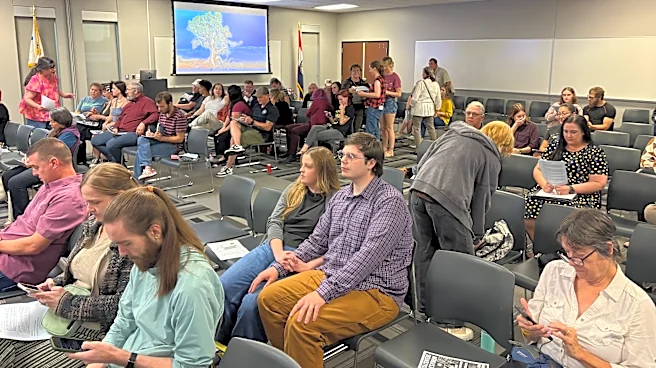







Boos and shouts erupted during a Springfield City Council meeting Monday, Sept. 21 that saw police detain two attendees after elected leaders stalled an effort to gather more information about the use of automatic license plate reader cameras like Flock. The meeting was nearly at capacity Monday night, but the crowd gathered never got to share their thoughts in the expected public hearing.
Councilman Brandon Jenson submitted a resolution calling for the city manager to conduct a comprehensive review of all contracts and operating guidelines pertaining to the use of automatic license plate reader (ALPR) cameras. Specifically, the council action would require the report to disclose how information can be searched, who has access to the data, how data is protected,
specific terms of contracts and how ALPR cameras have been utilized to enhance public safety.

Currently, there are 41 Flock cameras in Springfield being used by SPD. The department has a transparency portal available on its website regarding ALPR cameras and their use. According to records obtained by the News-Leader under the state's Sunshine Law, the city executed a contract in 2025 for Flock ALPR cameras that spans five years and costs $45,000 a year, though a previous contract dates back to 2022 that was renewable annually.
Council for several months has heard concerns from local residents calling for an end to ALPR use. The topic of ALPR cameras, often operated by Flock Safety, has been an ever-growing point of contention across the nation with many citizens sounding alarms over privacy concerns. Jenson noted the resolution asking for the report was a way to answer the questions raised by the public, not actually change policy.
Mayor Jeff Schrag motioned to refer the resolution asking for a report to the Plans and Policies Committee. Schrag's motion was met with a challenge by Jenson on procedural grounds. After a five-minute recess for City Attorney Jordan Paul to review the procedural rules, the motion was re-made with Jenson trying to table the motion, though Paul noted a motion cannot be tabled, only the bill itself can. Jenson was hoping to table the referral until after the public hearing to allow the crowd to speak.
"Apparently I've been out-maneuvered procedurally," Jenson said.
"All I'm trying to do is give people answers to some real questions that they brought to us for months, and it's a shame that it comes down to this sort of, I guess, theater that I'm a part of to try and help get those answers," he later added. "Like, this isn't how government is supposed to run."
Councilman Craig Hosmer, who has previously criticized the committee process for preventing legislative progress, said he was sympathetic to the issue but noted a committee review would actually allow more voices to be heard and allow greater input on the topic. Committee meetings do not inherently include public hearings, though do allow written comment cards. Committee meetings are also held in the afternoons. Councilman Bruce Adib-Yazdi said the matter did not need committee input at this stage.
"What Councilman Jenson is asking for is some information, and information is not something that we need to go to a committee and have them debate whether we need the information or not," Adib-Yazdi said.
Councilwoman Monica Horton pointed out that in February, a nearly identical resolution also called for a comprehensive review of the Springfield Police Department's operational guidelines. That resolution was approved and did not go through committee. The report of that review was presented last month.
"We have a history of requesting comprehensive reviews via resolution, and it sounds as though this one is being treated a little differently," she said.
The referral ultimately passed 5-3, with Jenson, Horton and Adib-Yazdi opposed. Councilwoman Heather Hardinger was absent. In response, the crowd got up to leave while booing, shouting and shaming the council for its action. Noah Powell, who shouted profanities at Schrag, was handcuffed just outside council chambers. He was released soon after. Another attendee was briefly detained later in the meeting after attempting to make her comments during the public hearing for a different agenda item.

Powell said he received a citation under city code for disturbing a council meeting and planned to obtain legal counsel. While he was not the only one at that time shouting, he was the only one to be detained. Powell expressed frustration with Schrag's leadership, noting this was not the first time the mayor has tried to derail topics with a committee referral.
"In my opinion, he wants to control things from the shadows," Powell said, describing it as "unacceptable."
Local anti-Flock group frustrated with referral
Isaac Protiva is one of the lead members of Flock Out SGF, the group drawing attention to the system of ALPR cameras locally and calling for the contract with Flock to end. He said the resolution presented Monday was seen as a "compromise" by the group.
"Nothing has been addressed by council about Flock directly," Protiva said. "There's never been a bill voted on by council directly about Flock, so this was kind of a compromise to get to the next step. This should have gone through, and what we saw was kind of ridiculous."
Traci Phelps, another leader with Flock Out SGF, expressed her gratitude for Jenson, who she said was the only council member willing to engage and work with the group. She said this setback will be remembered in April, when four council seats will be up for election.
Despite the response, organizer with Flock Out SGF James Ritzendollar said he was proud of the crowd's reaction and shamed the council for stalling the resolution.
"I would say our city council looks completely incompetent after tonight, and this is going to be the thing that people see," he said.
Both Protiva and Ritzendollar said the lack of response from council is discouraging to see. Protiva, 27, said that as a young person, change happening so slowly is disheartening.
"How do we fix voter engagement? I don't know, maybe do one thing that the people want — that might be a nice start," he said.
The resolution directed for the written report to be completed by no later than Jan. 31, 2027, and presented to council on or before March 1, 2027. With the committee referral, this timeline will no longer be feasible and will likely stretch answers deeper into next year.
Ahead of the Monday night discussion, Springfield Police Department posted a video on its social media channels addressing concerns and answering questions regarding Flock cameras.
Communities around the country have joined the DeFlock movement, calling for the technology to be removed due to privacy concerns. Increasingly, leaders around the Ozarks have moved to distance themselves from Flock and end existing contracts. Elected leaders voted to not renew the contract with the company in Willard and Bolivar and Pulaski County Sheriff Stacy Ball shared a letter Aug. 19 telling citizens he had heard their concerns and decided not to renew the county's Flock contract.
At the state level, Gov. Mike Kehoe recently signed an executive order directing the Missouri Department of Public Safety to establish state-wide safeguards for state agencies or local law enforcement agencies receiving state funds using ALPR technology. The executive order requires most license plate and vehicle data to be deleted within 30 days, prohibit vendors from commercializing Missouri-generated data and prohibit the integration of artificial intelligence facial recognition technology with the ALPR system. This action sets minimum standards until the General Assembly establishes a permanent statutory framework.
Monday night council also voted to accept the Edward Byrne Memorial Justice Assistance Grant from the United States Department of Justice, which is split between SPD and Greene County. Part of SPD's portion was set to fund Clearview AI, a facial recognition law enforcement software. Jenson expressed opposition to the adoption of the technology without further review. Cris Swaters, SPD's public information officer, said via text that the software is used to generate investigative leads as a starting place for additional evidence, but SPD policy prohibits this type of information from being used as the sole basis for probable cause.
Marta Mieze covers local government at the News-Leader. Have feedback, tips or story ideas? Contact her at mmieze@news-leader.com.
This article originally appeared on Springfield News-Leader: Council meeting ends with handcuffs as Flock camera report stalled