







For the first time in decades, the boards and commissions that oversee and advise various functions of Springfield city government have undergone review. While overall the board system was found to be functional and within the framework established in the Springfield City Charter, some corrections are required and other improvements recommended.
An audit of the city's boards and commissions was performed over several months starting in May after Mayor Jeff Schrag referred the matter to the Plans and Policies Committee in March. That referral came after the Citizens' Advisory Board, established to evaluate uses of the SPRING Forward SGF sales tax, was found to be in violation of several charter provisions.
The results of the audit, completed by
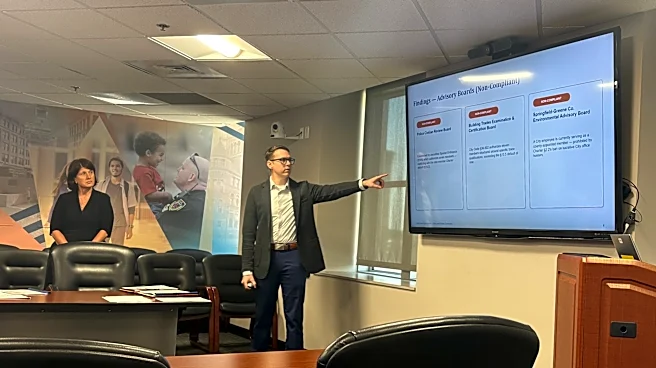
City Clerk Anita Cotter and Assistant City Attorney Nick Woodman, were presented to the committee Tuesday, Aug. 18. Of the total 23 boards reviewed, 16 were found to be fully compliant with no additional recommendations. Three were found to be explicitly non-compliant. The Tax Increment Financing Commission was determined to fall outside of the audit's scope due to its varying membership based on specific projects.

Cotter and Woodman reviewed boards that strictly fell under the city's purview for their alignment with governing provisions of the city charter, such as composition, membership qualifications, and terms of service. Nonprofit boards and separate political subdivision boards, such as the Springfield-Greene County Library Board or the Visit Springfield Board of Directors, were not subject to the audit, even though the city plays a role in member appointments. The review also did not look at how effective the boards were or what their day-to-day operations were.
Non-compliant boards
Three boards were found to be in violation of the city's typical rules for boards and commissions.
- Police Civilian Review Board: An ordinance authorizing this board allows a seven-member board, which is in conflict with the charter's requirement of nine members. The governing authority of this board is also not codified in an ordinance, which is best practice.
- Springfield-Greene County Environmental Advisory Board: As an inter-local board, this board is allowed to have 12 members, six appointed by Springfield City Council and six appointed by Greene County Commission. However, currently a city employee is serving on the board as a county-appointed member. The charter prohibits board members from holding a lucrative position in city government. Fixing this simply requires that member to resign.
- Building Trades Examination and Certification Board: This board is currently allowed to have 11 members, instead of the charter-required nine members. Cotter also noted it currently has stringent requirements for specific trade qualifications, which have posed challenges in filling vacancies. Beyond correcting the number of members, she recommended further reviewing this structure.
Councilman Abe McGull, who chairs the Plans and Policies Committee, directed city staff to bring recommendations for how to correct these to the committee as the immediate priority. Once the committee votes on a recommendation, it will head to the full council for consideration.
City Utilities board correction
While the Board of Public Utilities is established under its own section of the charter and therefore has a unique makeup that does not fall under the general provisions, the audit did find room for improvement. Currently, the charter notes the presence of five out of the total 11 members constitutes a quorum.
Woodman noted this poses operational issues where, technically, a quorum could be established at two separate meetings at the same time since the quorum does not require a majority of members to be present. He explained that when the question to add two members to the board was posed to voters in 1989, expanding the board from 9 to 11 members, the ballot language did not address a need to increase the quorum as well.
To correct this, Woodman and Cotter are recommending a charter amendment be posed to voters to increase the quorum requirement from five members to six. Because the city charter acts as the city's constitution, any changes to it require voter approval.
Some boards found to likely be defunct
The audit also found that three boards, while compliant, are no longer operating the way they were intended. One of these is the Mayor's Commission on Human Rights and Community Relations, whichcouncil is already working to revamp since the commission's ability to meaningfully investigate discrimination complaints has been diminished.
However, two other boards were found to be operationally deficient: the Traffic Advisory Board and the Springfield Cable Television Advisory Commission.
The cable commission has no active members and has not met in recent history but was established when the city had a franchising agreement with cable companies and therefore could field complaints. Because of regulatory changes since then, Cotter and Woodman found the commission is essentially defunct and, if no continued purpose is identified, should be dissolved.
The traffic board, too, has not met for years, though technically has some members appointed to it. Cotter said that previously the board's role was to hear concerns regarding traffic flow and road infrastructure needs but with the traffic management center and advancing technology, that work has become unnecessary. She noted that the board's format or scope could be adjusted to meet modern needs or be formally dissolved if it is found to not be needed.
Other recommendations include codification, reference document
In total, five boards were identified to be governed by a resolution or a special ordinance, instead of being recorded in city code as is best practice. Those include: the Citizens' Advisory Board, Tree City USA Citizen Advisory Committee, Enhanced Enterprise Zone Board and Citizens Advisory Committee for Community Development.
"From a staff perspective, that makes it a little bit more difficult to determine what provisions apply to the board because you can't just go look in the city code and see what provisions apply ...," Woodman said. "Also, to the public, it's difficult to figure out what the requirements are that apply to Tree City USA, because it's in a resolution that was adopted in the 1990s or something like that."
Cotter also highlighted a recommendation to review the enhanced qualification requirements for the Landmarks Board. While the board is compliant, she said it has often been hard to fill these more specialized seats.
She also shared plans for a board reference document that would act as a central resource for all things related to boards and commissions. It would include membership requirements, references to specific sections of code and charter and audit findings.
"I would recommend that we don't wait another 29 years to do an audit of our boards and commissions," Cotter said. "So, we're hoping that a document like this, you'll see everything that's tied to that particular board in that reference document ... That's kind of the goal is to prevent some of these things from happening again."
Marta Mieze covers local government at the News-Leader. Have feedback, tips or story ideas? Contact her at mmieze@news-leader.com.
This article originally appeared on Springfield News-Leader: Audit of Springfield city boards finds 3 in violation of City Charter