





When talking with constituents, an Ozarks state representative noticed the same topic kept coming up: Transportation needs for those with disabilities.
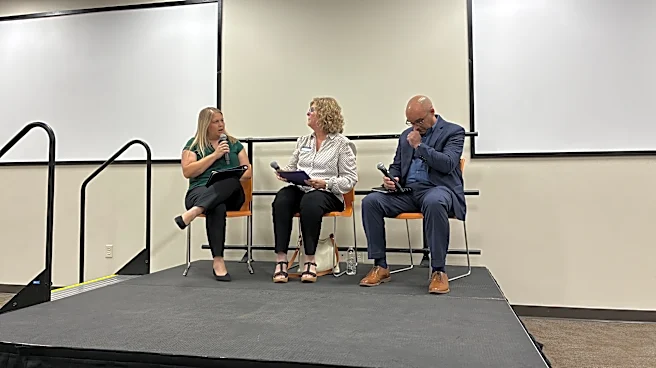
On Aug. 31, Dist. 133 Rep. Melanie Stinnett moderated "Springfield in Focus: Access in Motion,"
a panel discussion about public transportation's accessibility. Stinnett has been an advocate for those with disabilities even before her time in the legislature.The event featured speakers who have disabilities, those who live and work with people with disabilities and those who run Springfield's public transportation system.
Here are four key takeaways from the discussion.
Public transportation is a necessity for those with disabilities
For many with disabilities, public transportation is how they are able to be present and connect with their communities.
Scott Steelman-Rhoden
is a self-advocate and an inclusion educator with Abilities First. During the panel, he shared how important public transportation is for folks with disabilities like himself. Steelman-Rhoden uses public transportation to get to appointments as well as to work.

Sarah Tilley, Abilities First chief operating officer, knows firsthand that how important public transportation is for those with disabilities.
"We serve over 2,000 people in Greene County alone. I've seen this issue daily," Tilley said.
Access to public transport is the largest issue for those with disabilities
Of those that Abilities First serves, Tilley said, most are either using public transportation or privately contracted transportation.
Without a mode of personal transportation available, people face issues such as scheduling, access to and waiting at bus stops, navigating difficult terrain, and general safety. These can have a larger impact on folks' lives than just being late for an appointment.
"I think you are (losing) opportunities for employment particularly when you're relying on public transportation. Depending on where you live, there might be a restricted area that you're able to transport to in order to find employment, which can limit your opportunities," Tilley said. "The schedule, while it's commendable and has expanded with our help, I think is still restrictive in terms of the times that you can work. It's a great loss to the employers in our communities, as well, lost opportunities for individuals who want to work, who are very eager, motivated to work."
It can be difficult to consistently rely on public transportation, even when using the para-transit system, Access Express. Steelman-Rhoden shared that there have been times when he has to get to work at 8 a.m., but has been notified the night before that the bus won't be able to get him to work until 8:10 a.m., or he is stuck at work until 6:45 p.m. after finishing at 5 p.m.
"Sometimes it's hard getting transportation scheduled, and when you do schedule it, it's too late or too early," Steelman-Rhoden said, "and you end up having to take an Uber or taxi."
However, he has to be careful with that, as well. In addition to those alternatives being expensive, too many last-minute cancellations when using Access Express can result in not being able to use the system at all.

City Utilities' public transit system has a para-transit system to fill in The Bus's gaps
Currently, City Utilities provides eight fixed routes that are available to everyone, regardless of abilities. All of its fixed-route buses, said director of transit Matt Crawford, are Americans With Disabilities Act accessible buses: Each has low floors, all "kneel" and all have a ramp that extends.
All of CU's buses also have a Quantum automatic mobility aid restraint system, which allows users to secure themselves quickly and without assistance.
Despite those measures, some may still not be able to use the fixed route system, Crawford said, so CU offers Access Express Paratransit as a complementary option.
"If someone is unable to ride the fixed route system due to some kind of disability or inability to ride the system, they can go through a qualified application process that has to be signed off on by a qualified medical professional, that allows them to" use Access Express Paratransit, Crawford said.
The paratransit system is an origin-to-destination program, meaning that participants don't have to wait at bus stops or navigate difficult terrain to access the bus.

... But even that can have its own challenges.
While programs like CU's Access Express Paratransit allow people with disabilities to use public transportation, it's limited geographically just like the fixed route buses.
"We're kind of limited by our service boundaries, the city limits of Springfield with or 3/4 of a mile buffer on any of our fixed route systems," Crawford said. "People want us connecting to Republic, Ozark and Nixa. They've been wanting that for a long time, but most people don't want to pay for that."
Both fixed route and paratransit are also limited in their hours of service — operating from 6 a.m. to 10 p.m. Monday through Saturday and from 8 a.m. to 5 p.m. Sundays.
"People want us to be available 24/7, but most of our benchmark agencies operate, they're done with their services by 5 or 7 p.m. and they don't operate on Sundays, they don't operate on major holidays," Crawford said.
Steelman-Rhoden said that as someone with a disability who relies on public transportation, these limits effectively impose "a curfew" on him and others.
"Transportation is important to everyone. It shouldn't matter what time, how long or when it is. A person should have access to transportation when they need it, not just luxury ..." Steelman-Rhoden said. "If a person needs to go to urgent care at 1 o'clock in the morning, and can't afford an Uber, what then?"
This article originally appeared on Springfield News-Leader: Ozarks lawmaker leads discussion on public transport accessibility