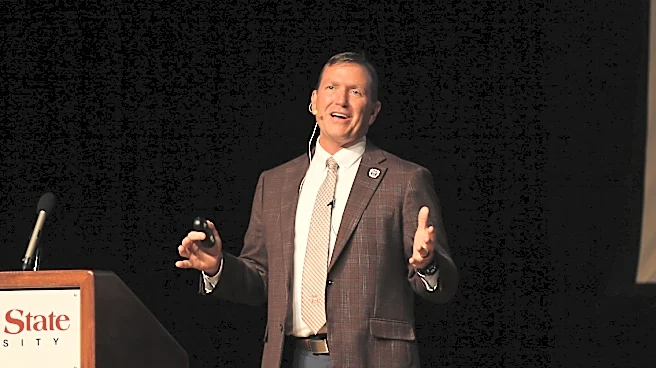







Missouri State University is a year in to its five-year strategic plan, dubbed "Igniting Opportunity." On Friday, Oct. 2, MSU President Richard "Biff" Williams shared the strides made and laid out plans for future work to achieve the plan's five goals by 2030.
Williams shared updates on the implementation of the strategic plan at his State of the University address at Plaster Student Union. He highlighted the ways which the university has already made progress on the goals the plan outlines to advance MSU and integrate the school's public affairs mission across the curriculum.
Students, faculty and staff were engaged through different work groups and committees to help share feedback and implement the plan. In the first year of implementation,
$500,000 was allocated.
Here's what the progress updates included.

MSU has added new degree programs, connecting curriculum with career
The first goal in the strategic plan is focused on academic opportunities and innovation. Williams highlighted that MSU has identified peer and aspirational institutions to benchmark itself against and worked to identify ways to improve online programs.
MSU added a tourism management bachelor's degree program, the first four-year tourism degree in the state, and, thanks to legislation passed by Missouri's General Assembly, can now offer research doctorate and professional degrees. Williams said the first PhD program is set for Defense and Strategic Studies, awaiting Higher Learning Commission approval. Additionally, he pointed to a plethora of recognitions the university has received for its academic programs and the 10-year reaffirmation the Higher Learning Commission granted the university with no interim monitoring requirement.
To better prepare students to be career-ready, MSU also developed recommendations for General Education enhancements, identified career readiness competency skills and located a model for a competency-based syllabi. Williams also highlighted several apprenticeship programs and additional work being completed to focus on student-centered experiential learning. In the past year, MSU has opened the Collaborative Care Clinic, Small Animal Education Center, Ag Innovation Center and the Construction Education Success Center.
Moving forward, Williams said work continues to add more doctorate programs, find ways to showcase research and integrate transferable skills into programs and courses. According to an MSU news release, several other proposals for PhD programs are under review, with the goal of moving one or two through the curriculum approval process this year.
University is working to connect students with community, employers
The second goal in the plan focuses on community partnerships and economic development. Williams said the university reached out to local area employers to learn about talent needs. This past year, MSU piloted Handshake for student employment to provide one online platform to post and search for off-campus jobs and internships.

Williams said an Interdisciplinary Innovation Institute has also been developed to connect academic programs, research, entrepreneurship, workforce development and community partnerships. The institute is set to enter its second phase and launch in early 2027.
"It's an unbelievable way for our faculty and staff to come together from all part of our campus to help build businesses and create innovation here in Springfield, Missouri," Williams said.
MSU is also working on creating an expertise database by establishing directories and developing a prototype for a search tool that could help university experts with internal and external stakeholders and collaborate.
As work to achieve this goal continues, Williams said the university plans to secure funding to sustain and grow existing experiential learning programs, such as the Community Engagement Intern Program and the Entrepreneurship Intern Program, and map an integrated innovation and commercialization pathway that connects idea development, applied research and prototyping, intellectual property, business formation, incubation and company growth.
Missouri State's new chatbot helps with admissions questions
The strategic plan notes the aim to become the "institution of choice" for students and employees by improving satisfaction. One of the main goals is to enroll 30,000 students by 2030.
This fall, systemwide headcount of just over 26,900 was down 1.1% compared to last year's record-setting enrollment.
Williams highlighted that an artificial intelligence chatbot is now available for after-hours inquiries on admissions, and most students received notification of admittance earlier due to developments in the financial aid award process. These efforts, combined with increased recruitment presence and strategies, aim to drive up enrollment in coming years.
To improve student and employee satisfaction, Williams shared that mental health support has been expanded at Magers Health and Wellness Center, the Bear Shield Safety App provides a toolkit of safety measures, and the completion of more than 60 capital projects for renovations and new construction have added quality to campus facilities. MSU has recently completed improvements to Plaster Stadium and is set to soon open the Clifton M. Smart III Advancement Center and the new Judith Enyeart Reynolds Performing Arts Complex.
Some efforts, like building an inventory of professional development efforts and greater focus on recognizing employees, seek to retain quality employees; other programs, like the Bears Share, hope to improve student success and accessibility. Williams also noted the creation and implementation of an ombuds program for employees and students to address questions and concerns.
Williams also outlined future work, including a commitment to provide two town halls each academic year and rolling out a Strategic Enrollment Management plan. He shared that this past year the university hired its first vice president for enrollment management, Dawn S. Medley, who has hired a team to focus on recruitment and enrollment.
MSU steps up efforts to boost its brand and student engagement
The fourth goal of the plan is focused on meaningfully engaging students and alumni while the fifth seeks to improve MSU's branding and recognition.
During his address, Williams highlighted the nearly $50 million fundraised, school athletics achieving competitive excellence with fan engagement growing, along with implementation of student satisfaction and success measurements. Under the branding goal, the school has stepped up efforts to enhance game experiences. One of the main goals was for the Missouri Bears football team to attend a bowl game by 2030, something that already happened at the end of 2025 at the Xbox Bowl.
Future work under both of these goals includes development of a comprehensive hub for student resources, implementation of a refined donor acquisition strategy, completion of an athletic master plan and raising fan experience satisfaction scores.
For branding, the university has completed the first phase of work — research and competitive analysis. Williams said the brand refresh is set to launch in February or March.
"It's such an exciting time to be at Missouri State University," he said, highlighting the momentum the university currently has in making the strategic plan a reality.
The full report can be found on MSU's website.
Marta Mieze covers local government at the News-Leader. Have feedback, tips or story ideas? Contact her at mmieze@news-leader.com.
This article originally appeared on Springfield News-Leader: Missouri State's president highlights progress toward 2030 goals